
Cognitive Assessment and Training Market Size – Industry Structure Evaluation, Demand Drivers Analysis, Regional Growth Analysis and Identification, Competitive Positioning Review & Global Market Size Forecast to 2032
Overview
Cognitive Assessment and Training Market was valued at USD 34.56 Bn in 2024, and total global Cognitive Assessment and Training Market revenue is expected to grow at a CAGR of 27.02% and reach nearly USD 234.18 Bn from 2025-2032. Rising demand for neuro-screening, AI brain training, and mental wellness fuels market growth.
Cognitive assessment involves systematically evaluating an individual's cognitive abilities, including memory, attention, problem-solving, and more. These assessments employ standardized tests, neuropsychological evaluations, or computerized tasks to gauge cognitive strengths and weaknesses. The Cognitive Assessment and Training Market has witnessed significant growth driven by increased awareness about brain health, technological advancements in assessment tools, and a growing aging population. The Cognitive Assessment and Training Market includes various sectors, including healthcare, education, research, and corporate institutions, all seeking to improve cognitive functions. Key players in this Cognitive Assessment and Training Market, such as Cogstate Ltd., Cambridge Cognition, Pearson, and Lumosity, have contributed to its expansion by developing innovative cognitive assessment tools and training programs. These companies focus on creating user-friendly, scientifically validated software and applications that cater to diverse demographics. The rising emphasis on personalized medicine and the integration of artificial intelligence (AI) and machine learning (ML) in cognitive assessment and training tools have bolstered Cognitive Assessment and Training Market prospects. Recent advancements include the integration of virtual reality (VR) and augmented reality (AR) in cognitive training platforms, enhancing engagement and effectiveness. The Cognitive Assessment and Training Market is poised for continued expansion, driven by increasing investments in research and development, rising demand for early detection of cognitive disorders, and a growing focus on preventive healthcare strategies centered around cognitive wellness.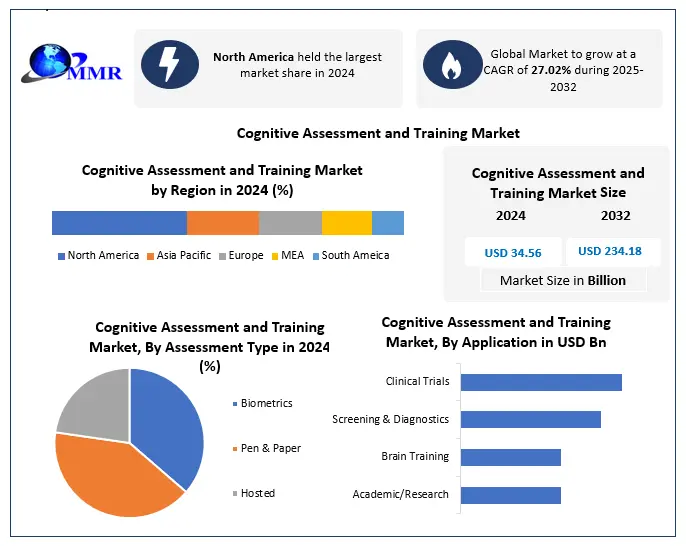 To know about the Research Methodology :- Request Free Sample Report
Cognitive Assessment and Training Market Dynamics:
FDA-Approved Digital Therapeutics: EndeavorRx and AI Advancements Drive Cognitive Assessment and Training Market
An aging population worldwide intensifies the need for cognitive health solutions, exemplified by the rising prevalence of conditions like Alzheimer's disease. Technological advancements, notably in AI and VR, revolutionize assessment and training methods, as seen in FDA-approved digital therapeutics like EndeavorRx for ADHD. The shift to remote healthcare due to the pandemic accelerates the adoption of remote cognitive assessments, evident in platforms like Cogniciti offering at-home evaluations. Increased mental health awareness fosters interest in cognitive wellness, expanding platforms like Headspace into cognitive training. Integration of cognitive training into education through programs like Pearson's Cogmed and its use in corporate settings, such as Lumosity in workplaces, further drives market growth. Personalized approaches in medicine, illustrated by Cambridge Brain Sciences' personalized assessments, align with healthcare trends. Continuous research investments, government initiatives like the BRAIN Initiative, and increased demands for cognitive enhancement in competitive fields contribute to the Cognitive Assessment and Training Market. These interconnected drivers collectively fuel the cognitive assessment and training market, showcasing its evolution and adaptability across diverse sectors and demographics.
Costs and Regulatory Hurdles in Cognitive Health Tools Cognitive Assessment and Training Market
Data privacy concerns persist as the handling of sensitive cognitive data raises ethical and legal issues, as seen in past legal actions against companies like Lumosity for alleged deceptive advertising and data handling practices. Another challenge involves the lack of standardized validation methods for cognitive assessment tools, impeding their comparability and widespread acceptance across healthcare and research domains. Unequal accessibility to technology and cognitive tools creates disparities, limiting their reach in underserved regions. Ethical dilemmas regarding AI-driven assessments and algorithmic biases raise concerns about fairness and accuracy. Resistance to change from traditional assessment methods and skepticism toward technology-based solutions hinder broader adoption. High costs, complexity in user engagement, regulatory hurdles, limited clinical evidence, and persistent societal stigmas surrounding cognitive health collectively impede Cognitive Assessment and Training Market growth. These challenges highlight the need for concerted efforts in addressing data privacy, standardization, accessibility, and ethical considerations to foster wider acceptance and utilization of cognitive assessment and training tools.
Remote Healthcare Adoption for Cognitive Assessment Propel the Cognitive Assessment and Training Market
The expanding geriatric population, marked by a rise in age-related cognitive disorders like dementia, provides a significant avenue. Companies like Neurotrack capitalize on this by offering AI-driven tools for early detection and risk assessment of Alzheimer's, aligning with the Cognitive Assessment and Training Market potential to address the cognitive health needs of older adults. Advancements in technology present another fertile ground for growth, with innovations like smartphone-based cognitive assessments by companies such as Savonix, leveraging the ubiquitous use of mobile devices. Additionally, the increasing focus on mental health offers prospects for cognitive wellness solutions, seen through platforms like HappyNeuron which provides accessible online cognitive training programs. Remote healthcare adoption, personalized medicine trends, integration into educational curricula, inclusion in corporate wellness programs, R&D investments, government initiatives, and the integration of AI and big data analytics all offer substantial growth opportunities in the Cognitive Assessment and Training Market. These interconnected opportunities pave the way for innovations, expanded accessibility, and tailored solutions catering to diverse needs and demographics, propelling the Cognitive Assessment and Training market's evolution.
Cognitive Assessment and Training Market Segment Analysis:
Based on assessment, the market has been divided into Biometrics Assessment, Pen and paper-based Assessment, and Hosted Assessment. Among these, the Pen and paper-based Assessment sub-segment is projected to generate the maximum revenue. The Pen and paper-based Assessment sub-segment witnessed the highest market share in the global Cognitive Assessment and Training Market in 2024. The pen and paper-based assessment segment remains a cornerstone within the Cognitive Assessment and Training Market, despite the evolution and integration of technology-driven approaches. Its enduring importance stems from its adaptability, reliability, and extensive applicability across various sectors. These traditional methods offer a versatile and accessible means of evaluating cognitive functions without relying on specialized technology, making them widely applicable in diverse environments, including clinical settings, educational institutions, and professional assessments.
Based on application, the cognitive assessment and training market is segmented into clinical trials, screening & diagnostics, brain training, and academic/research. Clinical trials use cognitive assessment tools to measure the impact of new drugs or treatments on brain function, ensuring accurate evaluation of cognitive side effects or improvements. Screening & diagnostics applications help in the early detection of neurological conditions like Alzheimer’s, dementia, and other cognitive impairments, making them highly critical in healthcare. Brain training applications focus on enhancing memory, attention, and problem-solving skills through personalized exercises and digital programs. Academic and research applications dominate in studying cognitive development, mental health, and neurological disorders. These tools are widely used by universities, research institutes, and laboratories to develop innovative approaches for mental performance enhancement. Continuous advancements in AI-driven cognitive testing and the rising importance of mental health awareness are accelerating adoption across all these applications.
Table: Applications of Cognitive Assessment and Treatment in Various Cognitive Diseases
| Cognitive Disease | Applications |
| Alzheimer's Disease | Early detection through cognitive assessments<br>- Monitoring cognitive decline<br>- Research into treatment and prevention strategies |
| Parkinson's Disease | Cognitive assessments to measure executive function<br>- Rehabilitation and training programs<br>- Research for cognitive symptoms management |
| Dementia | Comprehensive cognitive assessments<br>- Tailored care plans and interventions<br>- Supportive tools and therapies for caregivers |
| Multiple Sclerosis (MS) | Cognitive assessments to track cognitive changes<br>- Cognitive rehabilitation programs<br>- Research for cognitive symptoms management |
| Traumatic Brain Injury | Cognitive assessments for diagnosis and treatment planning<br>- Cognitive rehabilitation and therapy programs<br>- Monitoring cognitive recovery |
Cognitive Assessment and Training Market Regional Analysis:
The North American region accounted for the largest revenue share in the market by generating a revenue in 2023. The growth of the market in the region is attributed to the increasing prevalence of cognitive disorders, which necessitates innovative diagnosis and treatments. In North America, several key factors converge to shape a robust and expanding Cognitive Assessment and Training Market. The region experiences a rapid increase in its aging population, spurring concerns regarding age-related cognitive decline and dementia, thereby elevating the demand for cognitive health assessment tools. This demand aligns with the region's status as a technological innovation hub, fostering the development of advanced cognitive assessment and training platforms. These platforms offer convenience, accuracy, and personalized training programs, benefiting from North America's high healthcare expenditure. The substantial portion of GDP dedicated to healthcare makes the region receptive to adopting new technologies and therapies for cognitive health, especially with its robust research infrastructure. Strong research institutions and clinical trial facilities drive advancements in methodologies for cognitive assessment and training. Moreover, increased awareness of the benefits of cognitive health, spurred by media campaigns and advocacy groups, fuels market growth. Government initiatives in the US and Canada, focusing on dementia and cognitive health, further catalyze this growth through funding research and promoting early detection and intervention. Additionally, expanding coverage for cognitive assessments and training programs by Medicare and private insurance companies incentivizes their adoption.
Regulatory frameworks, including FDA regulations, ensure the safety and efficacy of these tools. Moreover, the North American market sees a rising emphasis on mental wellness, with workplaces and educational institutions increasingly adopting cognitive training programs to boost performance and focus. The incorporation of gamification elements and personalized learning algorithms into these platforms enhances engagement and effectiveness. Furthermore, corporate investment in employee wellness programs, encompassing cognitive training initiatives, serves to enhance productivity and reduce stress, indicating the multifaceted growth drivers within the North American Cognitive Assessment and Training Market.
Competitive Landscape of Cognitive Assessment and Training Market
In May 2023, Linus Health, a digital health solutions provider, revealed findings from its study on a digital cognitive assessment solution. This study compared the effectiveness of their digital tool with the Mini-Mental State Examination (MMSE), a widely utilized paper-based cognitive test, in identifying cases of cognitive impairment. The results highlighted the digital solution's efficacy in the early detection of cognitive issues, offering a promising means of identifying such impairments at an earlier stage.
Cognitive Assessment and Training Market Scope: Inquire before buying
| Cognitive Assessment and Training Market | |||
|---|---|---|---|
| Report Coverage | Details | ||
| Base Year: | 2024 | Forecast Period: | 2025-2032 |
| Historical Data: | 2019 to 2024 | Market Size in 2024: | USD 34.56 Bn. |
| Forecast Period 2025 to 2032 CAGR: | 27.02% | Market Size in 2032: | USD 234.18 Bn. |
| Segments Covered: | by Assessment Type | Biometrics Pen & Paper Hosted |
|
| by Component | Solutions Services |
||
| by Application | Clinical Trials Screening & Diagnostics Brain Training Academic/Research |
||
| by Industry Vertical | Healthcare & Life Sciences Education Corporate Others |
||
Cognitive Assessment and Training Market by Region:
North America (United States, Canada, and Mexico)
Europe (UK, France, Germany, Italy, Spain, Sweden, Austria, and the Rest of Europe)
Asia Pacific (China, South Korea, Japan, India, Australia, Indonesia, Malaysia, Vietnam, Taiwan, Bangladesh, Pakistan, and the Rest of APAC)
Middle East and Africa (South Africa, GCC, Egypt, Nigeria, and the Rest of ME&A)
South America (Brazil, Argentina Rest of South America)
Cognitive Assessment and Training Market Leading Key Players:
North America
1. CNS Vital Signs, LLC. (U.S.)
2. WIRB-Copernicus Group (U.S.)
3. Signant Health (U.S.)
4. Posit Science (U.S.)
5. Clario (U.S.)
6. Cognetivity Neurosciences (Canada)
7. Lumos Labs, Inc. (Lumosity) (USA)
8. Quest Diagnostics (USA)
9. Bracket Global (USA)
10. Cognifit (USA)
11. Posit Science Corporation (USA)
Europe:
12. Cambridge Cognition Ltd (U.K.)
13. Pearson PLC (UK)
Asia Pacific:
14. Cogstate Ltd. (Australia)
15. Brain Resource Company (Australia)
FAQ:
1] What segments are covered in the Global Cognitive Assessment and Training Market report?
Ans. The segments covered in the Cognitive Assessment and Training Market report are based on Assessment, Component, Application and industry Vertical.
2] Which region is expected to hold the highest share in the Global Cognitive Assessment and Training Market?
Ans. The North American region is expected to hold the highest share in the Cognitive Assessment and Training Market.
3] What is the market size of the Global Cognitive Assessment and Training Market by 2032?
Ans. The market size of the Cognitive Assessment and Training Market by 2032 is expected to reach USD 234.18 Billion
4] Who are the top key players in the Cognitive Assessment and Training Market?
Ans. CogniFit Inc. (U.S.), Cogstate Ltd. (Australia), and CNS Vital Signs, LLC. (U.S.) are the top key players in the Cognitive Assessment and Training Market.
5] What was the market size of the Global Cognitive Assessment and Training Market in 2024?
Ans. The market size of the Market in 2024 was valued at USD 34.56 Billion.