
Biometrics Technology Market – Global Market Size, Strategic Growth Drivers, Risk Assessment Framework, Regulatory Landscape Review, Competitive Intensity Mapping & Long-Term Industry Outlook to 2034
Overview
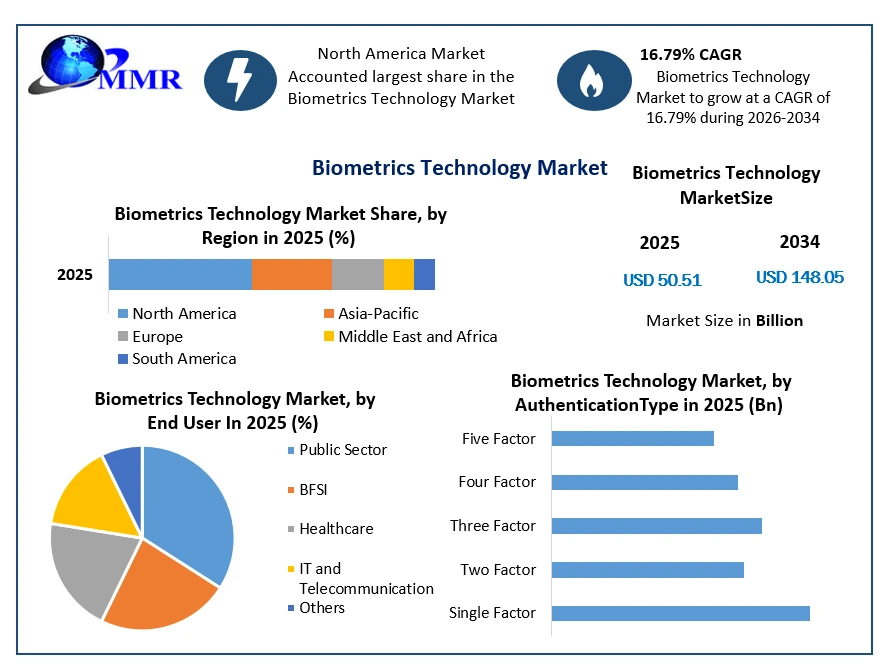
Global Biometrics Technology Market size was valued at USD 50.51 Bn. in 2025, and the total Global Biometrics Technology Market revenue is expected to grow by 16.79% from 2026 to 2034, reaching nearly USD 148.05 Bn.
Biometrics Technology Market Overview
Biometrics technology involves the use of biological characteristics or behavioral traits to authenticate and identify individuals. It relies on unique physical or behavioral attributes that are difficult to duplicate or forge. These attributes include fingerprints, iris patterns, facial features, voice patterns, hand geometry, and even DNA. Biometrics technology is used in various applications, including access control systems, time and attendance tracking, border control and immigration, law enforcement, financial transactions, and healthcare. It offers enhanced security, convenience, and efficiency compared to traditional methods of authentication, such as passwords or identity cards. There are also concerns about privacy, data security, and potential misuse of biometric data, which need to be addressed in the implementation of these systems.
Biometrics Technology Market Growth Share Analysis
 To know about the Research Methodology :- Request Free Sample Report
Continued advancements in biometric technologies, such as the development of touchless or contactless biometric solutions, multimodal biometrics combining multiple biometric modalities for enhanced accuracy, and improvements in performance and usability, are driving the Biometrics Technology market growth. The biometrics industry is subject to various regulations and standards concerning data privacy and security, such as the General Data Protection Regulation (GDPR) in Europe and the Health Insurance Portability and Accountability Act (HIPAA) in the United States. Compliance with these regulations is essential for biometric solution providers. The adoption of biometrics technology varies across regions, with North America and Europe being significant markets due to the presence of key players, stringent security regulations, and high adoption rates in sectors such as government and finance. The Asia-Pacific region is witnessing rapid growth due to increasing government initiatives, technological advancements, and rising adoption in sectors like banking, healthcare, and transportation.
Biometrics Technology Market Dynamics
Security Concerns and Identity Fraud to boost Biometrics Technology Market growth
In an era marked by escalating cybersecurity threats and identity fraud, organizations are prioritizing robust security measures to safeguard sensitive information and assets. Biometric technologies offer a highly secure method of authentication, mitigating the risks associated with stolen passwords or identity theft. The escalating security concerns are driving the adoption of biometrics across various sectors, including government, finance, healthcare, and enterprise, which is expected to boost the Biometrics Technology Market growth. Continuous innovations and advancements in biometric technologies are significantly enhancing their accuracy, reliability, and usability. These advancements include the development of touchless or contactless biometric solutions, multimodal biometrics combining multiple biometric modalities for enhanced accuracy, and the integration of artificial intelligence (AI) and machine learning algorithms for improved performance. Such technological innovations are expanding the applicability of biometrics across diverse use cases and driving the Biometrics Technology Market growth.
Biometric authentication offers unparalleled convenience and user experience compared to traditional authentication methods such as passwords or PINs. With biometrics, users authenticate themselves effortlessly using their unique biological characteristics or behavioral traits, eliminating the need to remember and manage complex passwords. This enhanced convenience and user experience are driving the adoption of biometrics in various consumer-facing applications, including mobile devices, banking, e-commerce, and travel, which significantly boosts the Biometrics Technology Market growth. Biometric technologies are finding applications across a wide range of industries, including government, banking and finance, healthcare, retail, transportation, and telecommunications. In the government sector, biometrics are used for border control, national ID programs, and law enforcement purposes. In banking and finance, biometric authentication is employed for secure access to accounts and financial transactions. Similarly, biometrics are being integrated into healthcare systems for patient identification and electronic health record (EHR) access. The increasing adoption of biometrics across diverse industries is fueling the Biometrics Technology Market growth.
Table 1: A taxonomy for biometric AI systems in the workplace
| Purpose | Technologies used | Use case | Real life example/brand |
| Security | Facial, fingerprint, gait,keystroke recognition | Access control, continuous authentication | BehavioSec, Innovatrics, FaceKey |
| Recruitment | Affective computing based on computer vision, voice and speech recognition and natural language processing (NLP) | AI-powered job interviews and personality assessments to evaluate candidates | Pymetrics, HireVue, Retorio |
| Monitoring | Affective computing basedon voice recognition andNLP; wearable movementtrackers; eye movementtrackers; smart mouse | Worktime control,productivity and activity tracking, performance measurement | Cogito, WorkSmart, Geodis,Humanyze |
| Safety and well being |
Smart wearables; Computer vision |
Accident prevention; physical and psychosocial health risk management |
StrongArm Technologies, Fitbit,(many technologies in development) |
Privacy Concerns and Security Vulnerabilities to limit Biometrics Technology Market growth
The concern over privacy implications associated with the collection, storage, and use of biometric data is significantly restraining the Biometrics Technology Market growth. Biometric identifiers, such as fingerprints, iris scans, and facial features, are inherently personal and unique, raising concerns about potential misuse, unauthorized access, and identity theft. As biometric systems become more pervasive across various sectors, there is a growing need for stringent privacy safeguards, transparent data practices, and robust encryption methods to protect biometric data from unauthorized access and exploitation. Despite their inherent security features, biometric systems are not immune to vulnerabilities and attacks. Biometric data, once compromised, is not easily replaced such as passwords or tokens, making it crucial to safeguard against potential security breaches. Threats such as spoofing attacks (e.g., using fake fingerprints or facial images), replay attacks, and data breaches pose significant risks to biometric authentication systems, which is expected to boost the Biometrics Technology Market growth. To mitigate these risks, biometric system developers need to continually invest in research and development to enhance security measures, such as liveness detection techniques, encryption algorithms, and anti-spoofing technologies.
The widespread adoption of biometric technologies raises ethical concerns and societal implications regarding individual privacy, autonomy, and civil liberties. Issues such as mass surveillance, discriminatory practices, and the potential for misuse of biometric data by governments and corporations have sparked debates around the ethical implications of biometric technologies, which is expected to boost the Biometrics Technology Market growth. Building public trust, fostering transparency, and engaging in open dialogue with stakeholders is essential for addressing these concerns and ensuring responsible deployment and use of biometric systems.
Biometrics Technology Market Segment Analysis
Based on Type, the market is segmented into Physiological Biometrics and Behavioral Biometrics. The Physiological Biometrics segment dominated the market in 2025 and is expected to hold the largest Biometrics Technology Market share over the forecast period. Physiological biometrics is a branch of biometric technology that utilizes the physical characteristics of individuals for identification and authentication purposes. These physical characteristics are inherent to an individual's body and are difficult to alter or replicate, making them ideal for biometric authentication. Physiological biometrics offer several advantages over other biometric modalities. They are highly accurate, reliable, and difficult to spoof or replicate, making them suitable for a wide range of applications requiring robust authentication and identification. Physiological biometrics also pose challenges related to privacy, data security, and user acceptance, which need to be addressed in the deployment of biometric systems.
Based on Technology, Fingerprint Recognition technology dominated the market in 2025 and is expected to hold the largest Biometrics Technology Market share over the forecast period. Fingerprint recognition is one of the most widely adopted biometric technologies, leveraging unique ridge patterns on human fingers for identification and authentication. It has been extensively used in law enforcement, border control, and consumer electronics due to its high accuracy, cost-effectiveness, and ease of deployment. The dominance of fingerprint recognition are attributed to its long standing acceptance, mature technology infrastructure, and widespread integration into devices such as smartphones, laptops and access control systems. Moreover, advancements in sensor technology, such as capacitive and ultrasonic fingerprint sensors, have improved accuracy and reduced spoofing risks.
Biometrics Technology Market Regional Insight
Rising Adoption of Biometrics across Industries to boost North America Biometrics Technology Market growth
North America dominated the market in 2025 and is expected to hold the largest Biometrics Technology market share over the forecast period. Biometric technologies find applications across a wide range of industries in North America, including government, banking and finance, healthcare, retail, transportation, and hospitality. The adoption of biometrics is driven by factors such as regulatory compliance requirements, the need for enhanced security, and the desire for convenient and frictionless user experiences. Industries such as banking and finance leverage biometric authentication to combat fraud and improve customer authentication processes, driving market growth. The proliferation of smartphones and mobile devices has led to the integration of biometric authentication capabilities, such as fingerprint recognition, facial recognition, and iris scanning, into mobile applications and devices. Mobile biometrics offer a convenient and secure method of authentication for users accessing mobile banking, e-commerce, and social media platforms, which significantly boosts the North America Biometrics Technology Market growth. The increasing adoption of mobile biometrics fuels market growth and increases the reach of biometric technologies in North America.
The escalating cybersecurity threats, identity fraud, and data breaches drive the demand for robust authentication solutions in North America. Biometric technologies offer a highly secure method of identity verification, reducing the risk of unauthorized access and fraudulent activities. The growing awareness of security threats among businesses, government agencies, and consumers fuels the adoption of biometrics across various applications, including access control, financial transactions, and online authentication.
Biometrics Technology Market Recent Development
| Date | Company | Development | Impact |
|---|---|---|---|
| 15 January 2025 | NEC Corporation | NEC Corporation launched its next-generation Bio-IDIOM multimodal biometric platform featuring enhanced 3D facial recognition and contact-free palm vein authentication algorithms. | The system significantly increases authentication accuracy to 99.99% while reducing processing latency for high-security border control and financial deployments. |
| 12 May 2025 | IDEMIA | IDEMIA introduced its advanced OneLook Gen2 contactless biometric terminal combining iris and facial capture in a single motion-tolerant device. | This development doubles passenger throughput at international airport hubs while adhering to strict zero-trust cybersecurity standards. |
| 18 September 2025 | HID Global | HID Global partnered with a major European banking consortium to commercialize its AI-powered behavioral biometrics suite for mobile fraud prevention. | The collaboration reduced unauthorized digital banking transactions by over 40% through continuous user verification and risk scoring. |
| 10 November 2025 | Fingerprint Cards AB | Fingerprint Cards AB announced the mass production of its ultra-thin optical under-display fingerprint sensor tailored for premium smartphones and IoT locks. | The component reduces module manufacturing costs by 15% and enables seamless glass-surface integration for consumer electronics. |
| 20 February 2026 | Thales Group | Thales Group unveiled its Quantum-Resistant Biometric ID SDK designed to safeguard stored biometric templates against post-quantum decrypt risks. | It establishes a new benchmark for national identity card infrastructure and critical defense access systems worldwide. |
Biometrics Technology Market Scope: Inquire before buying
| Global Biometrics Technology Market | |||
|---|---|---|---|
| Report Coverage | Details | ||
| Base Year: | 2025 | Forecast Period: | 2026-2034 |
| Historical Data: | 2020 to 2025 | Market Size in 2025: | USD50.51Bn. |
| Forecast Period 2026 to 2034 CAGR: | 16.79% | Market Size in 2034: | USD 148.05 Bn. |
| Segments Covered: | by Type | Physiological Biometrics Face Recognition Iris Recognition Fingerprint Recognition Hand Geometry Others Behavioral Biometrics Signature Recognition Voice Recognition Others |
|
| by Component | Hardware Software Service |
||
| by Offering | Contact Contactless Hybrid |
||
| by Authentication Type | Single Factor Two Factor Three Factor Four Factor Five Factor |
||
| by End User | Public Sector BFSI Healthcare IT and Telecommunication Others |
||
Biometrics Technology Market, by Region
North America (United States, Canada and Mexico)
Europe (UK, France, Germany, Italy, Spain, Sweden, Austria and Rest of Europe)
Asia Pacific (China, South Korea, Japan, India, Australia, Indonesia, Malaysia, Vietnam, Taiwan, Bangladesh, Pakistan and Rest of APAC)
Middle East and Africa (South Africa, GCC, Egypt, Nigeria and Rest of ME&A)
South America (razil, Argentina Rest of South America)
Leading Biometrics Technology key players include:
North America:
1. IDEMIA - Reston, Virginia, USA
2. Aware, Inc. - Bedford, Massachusetts, USA
3. HID Global - Austin, Texas, USA
4. Nuance Communications - Burlington, Massachusetts, USA
5. BIO-key International - Wall, New Jersey, USA
6. NEC Corporation of America - Irving, Texas, USA
7. L-1 Identity Solutions (now part of Idemia) - Stamford, Connecticut, USA
8. Veridium - Quincy, Massachusetts, USA
9. IDEX Biometrics - Wilmington, Delaware, USA
10. Daon - Reston, Virginia, USA
Europe:
11. Thales Group - Paris, France
12. SAGEM (part of Idemia) - Paris, France
13. Fingerprint Cards AB - Gothenburg, Sweden
14. Precise Biometrics - Lund, Sweden
15. BioConnect - Toronto, Ontario, Canada
16. Vision-Box - Lisbon, Portugal
Asia-Pacific:
17. NEC Corporation - Minato, Tokyo, Japan
18. Suprema Inc. - Seoul, South Korea
19. ZKTeco - Dongguan, Guangdong, China
Frequently asked Questions:
1. What are the main drivers of growth in the biometrics technology market?
Ans: Continued advancements in biometric technologies, increasing security concerns, rising adoption across industries, and regulatory compliance are key drivers of growth in the biometrics technology market.
2. What are some examples of technological advancements in biometrics technology?
Ans: Technological advancements include the development of touchless or contactless biometric solutions, multimodal biometrics combining multiple biometric modalities, and integration of artificial intelligence (AI) and machine learning algorithms for improved performance.
3. Which region dominated the biometrics technology market in 2025, and why?
Ans: North America dominated the biometrics technology market due to the presence of key players, stringent security regulations, high adoption rates in sectors like government and finance, and the proliferation of mobile biometrics.
4. What are the main challenges limiting the growth of the biometrics technology market?
Ans: Privacy concerns, security vulnerabilities, ethical considerations, and societal acceptance issues pose challenges to the growth of the biometrics technology market, necessitating the development of stringent privacy safeguards and security measures.
5. How does biometrics technology address security concerns and identity fraud?
Ans: Biometrics technology offers highly secure authentication methods that are difficult to replicate, mitigating the risks associated with stolen passwords or identity theft, and providing enhanced security measures for various sectors, including government, finance, healthcare, and enterprise.