
Automotive Noise Filter Market Size by Type, Types, Technology, Grade, Region – Revenue Pool Analysis, Margin Structure Assessment, Capital Flow Trends, Competitive Benchmarking & Forecast to 2032
Overview
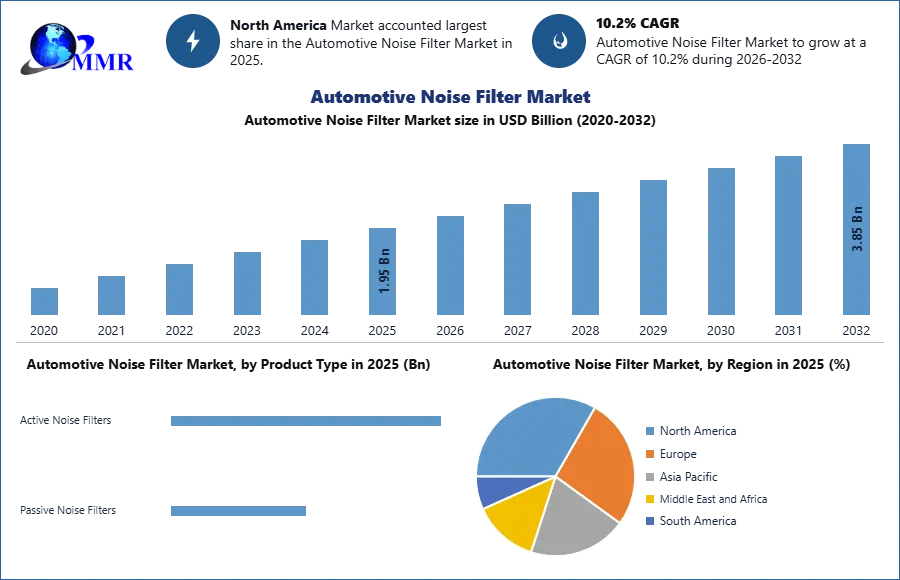
Global Automotive Noise Filter Market size was valued at US$ 1.95 Bn in 2025 and the total revenue is expected to grow at 10.2% through 2026 to 2032, reaching nearly US$ 10.2% Bn in the forecast period.
The global Automotive Noise Filter Market report is a comprehensiv0e analysis of the industry, market, and key players. The report has covered the market by demand and supply-side by segments. The global Automotive Noise Filter Market report also provides trends by market segments, technology, and investment with a competitive landscape.
 Global Automotive Noise Filter Market Overview:
The noise filter is a high-end technology system used to eliminate the frequency and unwanted noise produced by noise-generating components in a vehicle that is responsible to obstruct the driving comfort of the driver when driving a vehicle.
Global Automotive Noise Filter Market Dynamics:
The application of automotive noise filters can improve the quality of the sound during calls in a vehicle. An automotive Noise Filter also enhances the quality of the voice command when driving a vehicle. To reduce that noise, engineers use active acoustic control or ANC to deliver noise-cancellation signals that are played on loudspeakers in the car's cabin.
The demand for luxury and comfy vehicles is a fueling factor driving the automotive noise filter market. Luxury vehicles are furnished with various electronic components and devices that are responsible to boost the comfort level of the vehicle to the passengers by reducing obstructions like high inaudible sound and vibrations while traveling. A vehicle is integrated with various systems and components like noise filters, infotainment systems, safety systems, music systems that deliver comfort inside the vehicle. Moreover, Automotive Noise Filter also decreases High Pitched Noise caused by the car's electrical system like engine, woofer, speaker, amplifiers, and other systems.
Additionally, the growing income of an individual is one of the major factors in concern with demand for luxury vehicles in countries like the U.S, India, China, and Germany, and this demand is fueling the market of automotive noise filter market. As these countries are developing with the modernization and adoption of new technologies is further boosting the growth of the automotive noise filter market in the forecast period of 2026-2032.
Global Automotive Noise Filter Market Segment Analysis:
By Type, the segment is divided into In-vehicle Infotainment System, Alerting System, TPMS. In-vehicle Infotainment System is dominating the type segment of automotive noise filter market. The In-vehicle Infotainment (IVI) is an amalgamation of vehicle systems that are used to deliver entertainment and information to the driver and the passengers by means of audio and video interfaces, control elements like touch screen displays, button panels, voice commands, and more. The in-vehicle infotainment market is estimated to grow with a CAGR of 11.90% in the forecast period and is estimated to reach USD 30.89 in the forecast period. Moreover, the research study has shown that the In-vehicle infotainment market is fuelling vehicle production, technological advancement, telematics regulations, with rising demand for luxury vehicles. And this factor is boosting the market globally.
To know about the Research Methodology :- Request Free Sample Report
By Application, the segment is bifurcated into Digital Filters, Analog Filters. Digital filters are dominating the application segment of the automotive noise filter market. As digital filters are widely used due to technological advancement in the automotive industry. There are two types of digital filters finite impulse response (FIR) and infinite impulse response (IIR). As the speed of Digital Signal Processing (DSP) technology growing with modernization. Digital filters are used in high-frequency signals in the radio frequency domain. Moreover, Digital filters are more precise in filtering the sound, but it requires digital signals. Digital filtering includes the transfer of analogue data to a processor and this is responsible to runs code to digitally filter the data. Further, the digital filters are portable and this is a driving factor responsible to boost the market growth of the automotive noise filters market in the forecast period.
The objective of the report is to present a comprehensive analysis of the global Automotive Noise Filter Market to the stakeholders in the industry. The past and current status of the industry with the forecasted market size and trends are presented in the report with the analysis of complicated data in simple language. The report covers all the aspects of the industry with a dedicated study of key players that include market leaders, followers, and new entrants.
PORTER, PESTEL analysis with the potential impact of micro-economic factors of the market have been presented in the report. External as well as internal factors that are supposed to affect the business positively or negatively have been analyzed, which will give a clear futuristic view of the industry to the decision-makers.
The report also helps in understanding the global Automotive Noise Filter Market dynamics, structure by analyzing the market segments and project the global Automotive Noise Filter Market size. Clear representation of competitive analysis of key players by Grade, price, financial position, Grade portfolio, growth strategies, and regional presence in the global Automotive Noise Filter Market make the report investor’s guide.
Global Automotive Noise Filter Market Scope: Inquire before buying
| Automotive Noise Filter Market | |||
|---|---|---|---|
| Report Coverage | Details | ||
| Base Year: | 2025 | Forecast Period: | 2026-2032 |
| Historical Data: | 2020 to 2025 | Market Size in 2025: | 1.95 USD Billion |
| Forecast Period 2026-2032 CAGR: | 10.2% | Market Size in 2032: | 3.85 USD Billion |
| Segments Covered: | by Product Type | Active Noise Filters Passive Noise Filters |
|
| by Vehicle Type | Passenger Vehicles Commercial Vehicles Electric Vehicles |
||
| by Application | Infotainment Systems Engine Control Units (ECU) Battery Management Systems (BMS) Others |
||
| by Distribution Channel | OEMs Aftermarket |
||
Global Automotive Noise Filter Market, by Region
• North America
• Europe
• Asia Pacific
• The Middle East and Africa
• South America
Global Automotive Noise Filter Market Key Player
1. Continental AG
2. TDK Corporation
3. Murata Manufacturing Co., Ltd.
4. Panasonic Corporation
5. Vishay Intertechnology, Inc.
6. Analog Devices, Inc.
7. KEMET Corporation
8. STMicroelectronics N.V.
9. Littelfuse, Inc.
10. Texas Instruments Incorporated
11. Bosch GmbH
12. Bose Corporation
13. Johnson Controls International plc
14. Sumitomo Riko Company Limited
15. Faurecia
16. Trelleborg AB
17. Magna International Inc.
18. Eaton Corporation
19. Delphi Technologies
20. Hutchinson SA
FAQ
1. What is the projected market size and growth of the Automotive Noise Filter market?
The market is expected to grow from USD 1.95B in 2025 to USD 3.85B by 2032 at a CAGR of 10.2%.
2. What are the main types of automotive noise filters?
It include Active Noise Filters for real-time noise cancellation and Passive Noise Filters for basic suppression in electronic systems.
3. Which vehicle types are driving demand?
Demand is rising in passenger, commercial, and electric vehicles, with EVs increasing use in BMS and infotainment systems.
4. What are the key applications of automotive noise filters?
Filters are used in infotainment systems, ECUs, and BMS, as well as in lighting, sensors, and other electronic devices.
5. Who are the leading players in the market?
Top companies include Continental AG, TDK Corporation, Murata Manufacturing, Panasonic Corporation, and Vishay Intertechnology.