
Automotive Camera Cleaning System Market – Industry Structure Evaluation, Demand Drivers Analysis, Regional Growth Analysis and Identification, Competitive Positioning / Landscape Review & Global Market Size Forecast to 2032
Overview
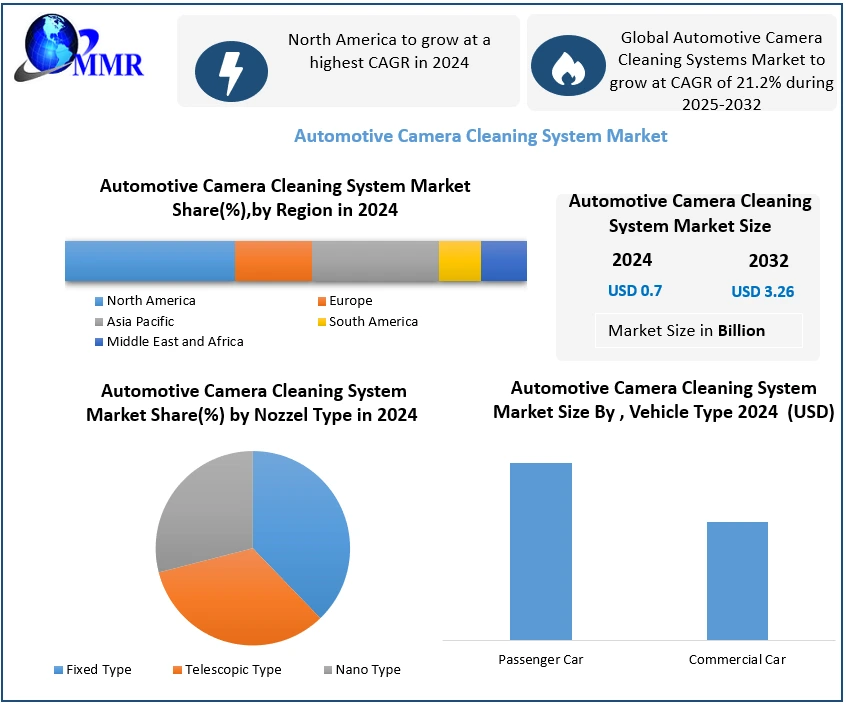
Automotive Camera Cleaning System Market Size was valued at USD 0.7 Bn. in 2024 and the total Global Automotive Camera Cleaning System Market revenue is expected to grow at a CAGR of 21.2% from 2025 to 2032 reaching nearly 3.26 Bn. by 2032
Automotive Camera Cleaning System Market Overview:
Global Automotive Camera Cleaning System Market characterizes an evolving segment of Automotive vehicle safety and driver assistance technologies, designed to ensure optimal camera visibility under varying environmental conditions. These systems utilize a combination of nozzles, pumps and intelligent sensors to detect dirt water or debris on camera lenses and automatically activate cleaning mechanisms, thereby maintaining clear visual input for Automotive Driver Assistance Systems and autonomous driving functions. North America dominated Automotive Camera Cleaning System Market in 2024 with the highest CAGR boost by stringent vehicle safety regulations rising adoption of autonomous vehicles and growing demand for premium and electric vehicles across Germany, France, and the UK. Presence of leading OEMs like BMW, Volkswagen and Mercedes-Benz, combined with proactive investments in autonomous and ADAS integration, has accelerated regional innovation and deployment.
 To know about the Research Methodology :- Request Free Sample Report
Leading Automotive Camera Cleaning System Market players include Continental AG (Germany), Valeo SA (France), Ficosa International SA (Spain), dlhBOWLES (USA), Kautex Textron GmbH (Germany), and Toyota Boshoku Corporation (Japan). Focusing on system miniaturization, integration with thermal management solutions and developing adaptive cleaning technologies that operate in real-time. These players are also contribution in sustainable materials, compact designs and AI-based detection algorithms to enhance system efficiency and vehicle compatibility across various automotive platforms.
Automotive Camera Cleaning System Market Report delivers in depth analysis of system types, activation technologies, nozzle placements and end-use vehicle segments. It further examines regional trends, emerging OEM strategies and competitive positioning through 2032 offering stakeholders a strategic roadmap to capitalize on the growing demand for enhanced vision systems in next-gen mobility ecosystems.
Automotive Camera Cleaning System Market Dynamics
Increasing Adoption of Camera Cleaning Systems to Drive Automotive Camera Cleaning System Market growth
Growing consumer demand for premium and luxury vehicles in various regions increased camera deployment in modern premium cars, and the use of camera cleaning systems for mounted cameras are some of the main factors driving markets growth. As a result of the reduced visibility caused by dirt or snow on the camera, vehicle manufacturers are more likely to use camera cleaning systems for mounted cameras. Since 2022, government regulations in nations like the United States have required automobiles to be fitted with rear-view cameras to reduce accidents and fatalities caused by reversing vehicles. Thus, governments' consistent efforts are likely to increase the global need for vehicle camera cleaning systems during the forecast period.
Statistics shows, North America accounted for over one-third of the worldwide market, followed by the Asia Pacific with a 29 percent share and Europe with nearly 18 percent. This growing use of automotive cameras in vehicles is contributing to the market's growth.
Growing Integration of ADAS Technologies to Drive Demand for Automotive Camera Cleaning System Market
Safety functions like blind-spot recognition, lane keep assist, and other ADAS-based technologies are solely dependent on the car camera. Because numerous Automotive driver assistance system-based technologies rely on the camera, a malfunction of the camera caused by mud, fog, or dirt may have an impact on the vehicle's operation. As a result, the number of camera cleaning systems installed is expected to rise throughout the forecast period.
market's key players are likely to focus on cost and efficiency as they develop cars with cutting-edge technology to ensure optimum user safety. Continental AG, Created a cleaning solution for fish-eye automotive cameras. The Surround View cleaning mechanism detects dirt automatically to keep the camera clean at all times. It also has anti-freeze chemicals to prevent ice from accumulating on the lens, which reduces visibility. Continental AG has also stated that heated cleaning devices are going to be available to provide warm water to keep the camera clean.
High Cost and System Complexity to Restrain the Automotive Camera Cleaning System Market
Adoption of Automotive camera cleaning systems is restrained by factors such as high integration costs and system complexity. These systems often require additional components like sensors, pumps, heated fluid lines and electronic control units, which increase the overall cost of the vehicle particularly in mid-range and budget segments.
Also designing compact, reliable and efficient cleaning mechanisms seamlessly integrated into the vehicle’s body without compromising aesthetics or aerodynamics remains a technical challenge. OEMs and Tier 1 suppliers must also ensure these systems are durable under extreme weather conditions and compatible with various camera placements, adding to the development and manufacturing complexity. These challenges may hinder rapid adoption, especially in price-sensitive markets.
Automotive Camera Cleaning System Market Segment Analysis
Based on Vehicle Type, the Automotive Camera Cleaning System Market is segmented into Passenger Car and Commercial Car. Passenger Car dominated the Market in 2024 and is expected to hold largest share during the forecast period. The growth of the segment is attributed to the large production of passenger cars and the increased penetration of camera systems in passenger vehicles. Thus, the growing interest of consumers towards safety, premium, luxury, and comfortable vehicles is expected to drive the growth Market during the forecast period.
The luxury/premium sub-segment held a significant portion of the passenger vehicle segment, providing a substantial opportunity to the market because most premium vehicles are integrated with safety systems and cameras. luxury vehicles include cutting-edge technology, which is expected to account for a larger market share during the forecast period. Globally, BMW dominates the premium automobile market in the United States, selling over 280,000 units. The three German luxury vehicle companies - Stuttgart-based Mercedes-Benz, Munich-based BMW and Ingolstadt based Audi - are not only among the top three luxury brands in the United States but also in the world.
Based on Sales Channel the market is segmented into Original Equipment Manufacture and Aftermarket. Original Equipment Manufacture segment dominated the market in 2024 and is expected to hold largest share during the forecast period. This dominance is primarily driven by the increasing integration of camera cleaning systems as standard features in new vehicle models especially in premium and electric vehicles equipped with ADAS technologies.
Growing reliance on cameras for safety features like lane keep assist, adaptive cruise control, and autonomous parking, automakers are proactively incorporating factory installed cleaning solutions to ensure consistent camera performance. Government mandates such as compulsory rear view cameras in markets like the U.S. have further encouraged OEMs to embed cleaning systems to comply with safety regulations and enhance user satisfaction.
Regional Insights:
North America dominated the market in 2024 and is expected to hold largest share during the forecast period. vehicle demand for improved driver assistance is increasing, which is expected to grow the global market in the region. Strict safety rules and a high level of concern for road safety among society is the other factor driving the growth of the market in the region. a federal law requiring all new automobiles to include backup cameras went into effect in 2024. In the same year, dlhBowles, a prominent manufacturer of camera cleaning equipment, reported its sales to have risen steeply.
Automotive Camera Cleaning System Market Competitive Landscape:
Global Automotive Camera Cleaning System Market is shaped by a specialized group of automotive component manufacturers and technology innovators whose expertise in vision systems, fluid dynamics and sensor integration is driving rapid product development and deployment. We have more than 25 Industry players profile analysis in that Continental AG (Germany), Valeo SA (France), Ficosa International SA (Spain), dlhBOWLES (USA), Kautex Textron GmbH (Germany), and Toyota Boshoku Corporation (Japan).
Continental AG stands out as a global leader through its development of intelligent camera cleaning solutions such as the Surround View cleaning system, which automatically detects dirt and includes anti-freeze and heated cleaning functions. Company’s strong focus on innovation and integration with ADAS and autonomous driving systems cements its dominance in premium automotive segments.
Valeo SA is known for its broad portfolio of vehicle cleaning and visibility systems, offering high-performance camera washer modules that are compact, durable, and optimized for integration with both front and rear-facing cameras. Its collaborations with major automakers have strengthened its global market reach.
Recent Trends and their Impact on Market:
| Sr No | Recent Trends | Impact on Market |
| 1 | Rising adoption of ADAS and autonomous driving technologies | Increased demand for reliable camera visibility, boosting the integration of cleaning systems. |
| 2 | Stringent government safety regulations (e.g., mandatory rear-view cameras) | Drives OEM adoption of cleaning systems to ensure compliance and improved road safety. |
| 3 | Growing sales of premium and electric vehicles | Expands the target market for Automotive camera cleaning systems, particularly in high-tech vehicle models. |
| 4 | Development of intelligent and sensor-based cleaning solutions | Enhances system efficiency and user convenience, attracting OEM interest and premium vehicle placement. |
| 5 | Use of anti-freeze and heated fluid technologies | Improves performance in extreme weather, increasing adoption in colder regions like Europe and North America. |
Recent Development in Automotive Camera Cleaning System Market:
• July 2024, Continental AG – Launched an advanced camera cleaning solution integrating AI-based detection for automated cleaning activation, enhancing ADAS performance.
• May 2024, Valeo – Announced partnership with a leading EV manufacturer to supply integrated camera and sensor cleaning modules for upcoming autonomous models.
• March 2024, dlhBOWLES – Expanded its manufacturing facility in Ohio, USA, to increase production capacity for camera and sensor cleaning systems targeting North American OEMs.
Automotive Camera Cleaning System Market Scope: Inquire before buying
| Global Automotive Camera Cleaning System Market | |||
|---|---|---|---|
| Report Coverage | Details | ||
| Base Year: | 2024 | Forecast Period: | 2025-2032 |
| Historical Data: | 2019 to 2024 | Market Size in 2024: | USD 0.7 Bn. |
| Forecast Period 2025 to 2032 CAGR: | 21.2% | Market Size in 2032: | USD 3.26 Bn. |
| Segments Covered: | by Nozzel Type | Fixed Type Telescopic Type Nano Type |
|
| by Vehicle Type | Passenger Car Commercial Car |
||
| by Sales Channel | OEM Aftermarket |
||
| by Application | Parking Front Safety Monitoring Night Vision Mirror Central Monitoring System (CMS) |
||
Automotive Camera Cleaning System Market, by Region
North America (United States, Canada and Mexico)
Europe (UK, France, Germany, Italy, Spain, Sweden, Austria, Turkey, Russia and Rest of Europe)
Asia Pacific (China, India, Japan, South Korea, Australia, ASEAN and Rest of APAC)
Middle East and Africa (South Africa, GCC, Egypt, Nigeria and Rest of ME&A)
South America (Brazil, Argentina, Columbia and Rest of South America)
Automotive Camera Cleaning System Market, Key Players
Key Players in Automotive Camera Cleaning System Market:
North America
1. dlhBOWLES (USA)
2. MS Foster & Associates, Inc. (USA)
3. Seeva Technologies (USA)
4. SEEVA Technologies (USA)
5. Magna Electronics Inc. (Canada)
6. Ford Motor Co. (USA)
7. General Motors Co. (USA)
8. Waymo (USA)
9. GVS Filtration Inc. (USA)
10. Spraying Systems Co. (USA)
Europe
11. Continental AG (Germany)
12. Valeo SA (France)
13. Ficosa Internacional SA (Spain)
14. Kautex Textron GmbH & Co. KG (Germany)
15. Robert Bosch GmbH (Germany)
16. Magneti Marelli S.p.A. (Italy)
17. Delphi Technologies (UK)
18. ACTIA Group (France)
19. Trico Group (UK)
Asia Pacific
20. Denso Corporation (Japan)
21. Panasonic Corporation (Japan)
22. Shenzhen Mingshang Industrial Co., Ltd. (China)
23. Hyundai Mobis (South Korea)
24. Mitsuba Corporation (Japan)
25. Minda Industries Ltd. (India)
Frequently Ask Questions:
1. What is the primary function of an automotive camera cleaning system in ADAS-equipped vehicles?
Ans: To automatically remove dirt, snow, or water from camera lenses, ensuring clear vision for ADAS features like lane keep assist and parking assist.
2. How do heated cleaning systems improve camera performance in extreme climates?
Ans: Heated systems use warm water or anti-freeze fluids to prevent ice build-up and maintain camera visibility in freezing conditions.
3. Why is the integration of intelligent sensors crucial in modern camera cleaning systems?
Ans: Sensors detect lens contamination in real-time, triggering cleaning actions only when necessary, enhancing system efficiency.
4. What challenge does system miniaturization address in automotive camera cleaning technology?
Ans: Miniaturization allows easy integration without affecting vehicle design, aerodynamics, or camera performance.
5. Why is OEM adoption higher than aftermarket in the camera cleaning system market?
Ans: OEMs can embed systems during production, ensuring compatibility with existing ADAS architecture, unlike complex aftermarket retrofits.