
Anti-allergic Therapeutics Market – Global Market Size, Strategic Growth Drivers, Risk Assessment Framework, Regulatory Landscape Review, Competitive Intensity Mapping & Long-Term Industry Outlook to 2032
Overview
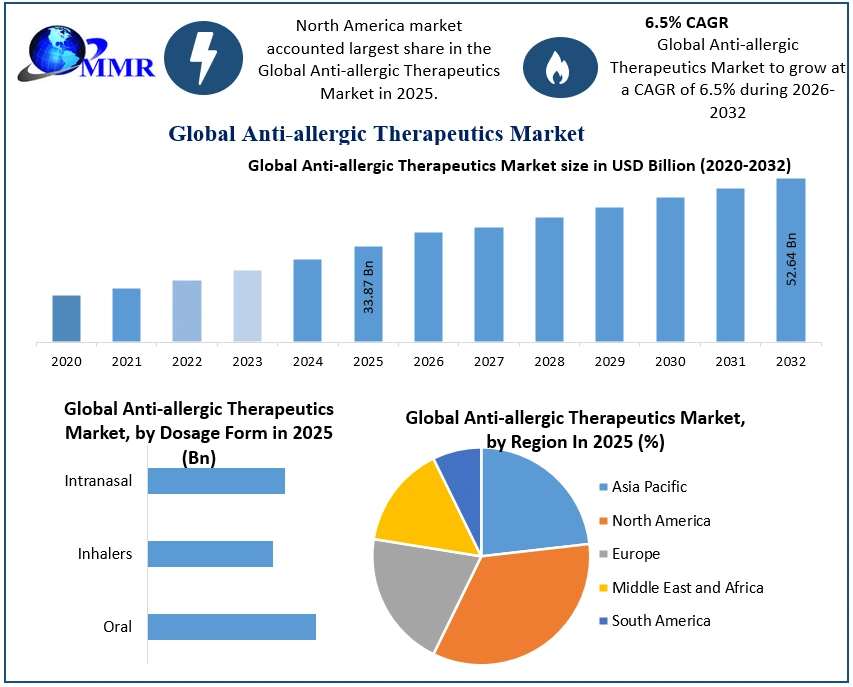
The Anti-allergic Therapeutics Market size was valued at USD 33.87 Billion in 2025 and the total Anti-allergic Therapeutics revenue is expected to grow at a CAGR of 6.5% from 2025 to 2032, reaching nearly USD 52.64 Billion by 2032.
Global Anti-allergic Therapeutics Market Overview:
Allergies are the immune system’s hypersensitivity reactions to chemicals that penetrate or come into contact with the human body. Treatment for allergies varies depending on the seriousness of the disease and the type of allergies the individual has.
 To know about the Research Methodology :- Request Free Sample Report
Global Anti-allergic Therapeutics Market Dynamics:
Increasing prevalence of allergic diseases is expected to drive the global market growth.
The rising prevalence of different forms of allergies, increasing investments from the key manufacturers for the production of novel allergic therapies, and the rising awareness of self-medication are all driving the market forward. Increased patient population with different types of allergies, changing lifestyles, unhealthy eating habits, growing demand for advanced allergy treatment therapy, increased research and development activities, and government initiatives are some of the factors driving the global anti-allergic Therapeutics market forward.
Over the last decade, there have been a rise in over-the-counter (OTC) medications as a result of self-medication. These OTC medications are less expensive and more available to a larger number of patients, resulting in increased drug procurement. More than half of the population in North America had positive responses to one or more allergens. In the United States, allergic rhinitis affects between 10% and 30% of all adults and up to 40% of infants. The American College of Allergy, Asthma & Immunology states that allergies are the sixth leading cause of chronic disease in the United States. In April 2020 Menlo Therapeutics Inc. reported promising results from two ongoing Phase-III clinical trials assessing the safety and efficacy of oral serlopitant for the treatment of Pruritus, a form of skin allergy.
However, restraining factors such as high costs of immunotherapy for allergy treatment, stringent drug regulatory approval and immunotherapy side effects impose challenges on the market growth.
The report has profiled twenty key players in the market from different regions. However, report has considered all market leaders, followers and new entrants with investors while analyzing the market and estimation the size of the same. Increasing R&D activities in each region are different and focus is given on the regional impact on the cost, availability of advanced technology are analyzed and report has come up with recommendations for future hot spot in APAC region.
Segment Analysis:
The Global Anti-allergic Therapeutics Market is segmented on the basis of Allergy Type, Therapy and Dosage Form.
Based on Allergy Type, the Rhinitis allergy segment dominated the global market. The segment is projected to grow by a CAGR of 5.5% during the forecast period. Allergic rhinitis is caused due to inhaling tiny allergen spores. Dust mites, pollen, and spores, as well as animal skin, urine, and saliva, are the most common airborne allergens that cause rhinitis. An increase in government-funded healthcare services to raise awareness about allergic diseases and the rising incidence of allergic rhinitis propel the segment growth. The European Academy of Allergy and Clinical Immunology (EAACI) states that Rhinitis affected about 400 million people worldwide in 2017.
Based on Therapy, the anti-allergy drugs segment dominated the global market in 2025 and is expected to continue its dominance during the forecast period. The segment experiences lucrative growth due to the ease with which oral dosage forms can be self-administered, as well as their compactness and ease of manufacture. Antihistamines and corticosteroids such as prednisolone, which can be injected or taken orally, have aided in the steady growth of the anti-allergy therapeutics market.
Global Anti-allergic Therapeutics Market Regional Insights:
North America accounted for dominant market share in 2025 and is expected to continue the dominance throughout forecast period.
North America is expected to lead the global market at a CAGR of xx% during the forecast period. Factors encouraging the market growth in the region include the high prevalence of respiratory allergic disorders, increasing awareness of allergy diagnostics, and the adoption of in vitro blood tests. Europe holds the second largest market share owing to its established pharmaceutical industry and growing demand for therapeutics. Asthma is the leading cause of large allergic patient pool in North America. It accounted for 3.8 million asthma patients in 2025. The market is expected to develop significantly in the future due to the high death rates associated with asthma and increased investment in asthma in this region.
APAC is expected to witness lucrative growth during forecast period.
During the forecast period, Asia Pacific is expected to grow at the fastest pace. This is due to the growth of adequate healthcare facilities, the prevalence of food allergies among the younger population, and the entry of key players into the healthcare sector with adequate allergy treatment investments.
The report also helps in understanding Global Anti-allergic Therapeutics Market dynamics, structure by analyzing the market segments and project the Global Anti-allergic Therapeutics Market size. Clear representation of competitive analysis of key players by product, price, financial position, product portfolio, growth strategies, and regional presence in the Global Anti-allergic Therapeutics Market make the report investor’s guide.
Key Developments:
Johnson & Johnson's investigational antihistamine lens received positive Phase 3 findings in March 2019.
ITULAZAX, Alk-Abello A/latest S's tree SLIT-tablet, was released in Germany in September 2019. Northern Europe has a high prevalence of tree pollen allergies, making Germany a key market for the medication.
Global Anti-allergic Therapeutics Market Scope: Inquire before buying
| Anti-allergic Therapeutics Market | |||
|---|---|---|---|
| Report Coverage | Details | ||
| Base Year: | 2025 | Forecast Period: | 2026-2032 |
| Historical Data: | 2020 to 2025 | Market Size in 2025: | USD 33.87 Bn. |
| Forecast Period 2026 to 2032 CAGR: | 6.5% | Market Size in 2032: | USD 52.64 Bn. |
| Segments Covered: | by Allergy Type | Eye Allergy Rhinitis Asthma Skin Allergy Food Allergies Other Allergies |
|
| by Therapy | Anti-Allergy Drugs Antihistamines Corticosteroids Decongestants Other Drugs Immunotherapy Sub-cutaneous Immunotherapy (SCIT) Sub-Lingual Immunotherapy (SLIT) |
||
| by Dosage Form | Oral Inhalers Intranasal |
||
Global Anti-allergic Therapeutics Market, by Region:
North America (United States, Canada and Mexico)
Europe (UK, France, Germany, Italy, Spain, Sweden, Austria and Rest of Europe)
Asia Pacific (China, South Korea, Japan, India, Australia, Indonesia, Malaysia, Vietnam, Taiwan, Bangladesh, Pakistan and Rest of APAC)
Middle East and Africa (South Africa, GCC, Egypt, Nigeria and Rest)
South America (Brazil, Argetina and Rest of South America)
Global Anti-allergic Therapeutics Market, Key Players
1. Allergy Therapeutics
2. Allergan, Plc.
3. Genentech, Inc.
4. Collegium Pharmaceutical, Inc.
5. McNeil Consumer Healthcare
6. Strides Arcolab
7. Allergopharma GmbH & Co. KG.
8. GlaxoSmithKline
9. ALK-Abelló A/S
10. Sallergenes Greer
11. Sanofi SA
12. Johnson & Johnson
13. Merck Co. In
14. F. Hoffmann-La Roche AG
15. Novartis AG
16. Cipla Inc
17. Aurobindo Pharma
18. Zydus Cadila
19. Lupin
20. Mylan N.V
Frequently Asked Questions:
1. Which region has the largest share in Global Anti-allergic Therapeutics Market?
Ans: Asia Pacific region held the highest share in 2025.
2. What is the growth rate of Global Anti-allergic Therapeutics Market?
Ans: The Global Anti-allergic Therapeutics Market is growing at a CAGR of 6.5 % during forecasting period 2026-2032.
3. What is scope of the Global Anti-allergic Therapeutics Market report?
Ans: Global Anti-allergic Therapeutics Market report helps with the PESTEL, PORTER, COVID-19 Impact analysis, Recommendations for Investors & Leaders, and market estimation of the forecast period.
4. What was the Global Anti-allergic Therapeutics Market size in 2025?
Ans: The Global Anti-allergic Therapeutics market was valued at USD 33.87 Bn. In 2025.
5. What is the study period of this Market?
Ans: The Global Anti-allergic Therapeutics Market is studied from 2025 to 2032.