
Antacids Market Size by Dosage Form, Drug Class, Distribution Channel, and Region – Segment-Level Market Assessment, Growth Opportunity Analysis, Competitive Mapping & Forecast to 2034
Overview
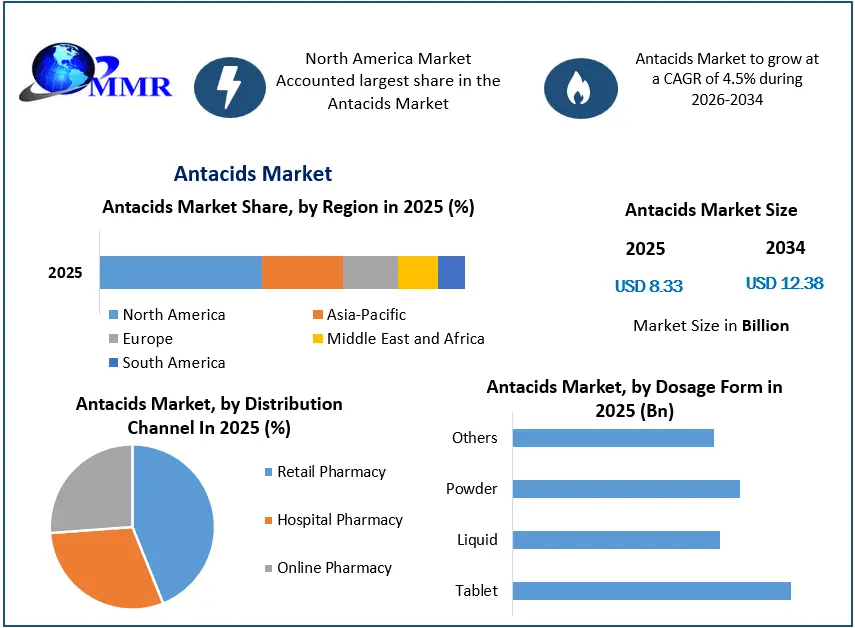
Antacid Market size was valued at USD 8.33 Bn. in 2025 and the total Antacid Market revenue is expected to grow at 4.5 % from 2026 to 2034, reaching nearly USD 12.38 Bn.
Antacids Market Overview:
The most common treatments for stomach upset, sour stomach, acid indigestion, and dyspepsia discomfort are antacids. They are used to ease the symptoms quickly because they begin to operate in a matter of seconds. Without a prescription, antacids are offered in easy chewable tablet form or as a liquid. Antacids are a well-liked product owing to their low cost.
As soon as an antacid enters the body, the stomach's acids begin to diminish. There are fewer possibilities of heartburn if the acid is weaker. Calcium carbonate, aluminum hydroxide, magnesium hydroxide, and sodium bicarbonate are a few of the chemicals that make up antacids. Simethicone, a component of certain antacids, aids in your body's elimination of gas. Histamine antagonists and proton pump inhibitors are two classes of medications that aid in reducing stomach acid.
Examples of antacids include calcium carbonate, magnesium hydroxide, aluminum hydroxide gel, gaviscon, gelusil, maalox, mylanta, rolaids, and pepto-bismol. Antacids can also cause adverse effects such stomach pains, constipation, diarrhoea, and changes in the colour of faeces.
Antacids Market Report Scope:
A quantitative analysis of the market's drivers, restraints, trends, and projections is provided by the research on antacids. Porter's five forces analysis shows how buyers and suppliers can develop their supplier-buyer networks and make decisions that are motivated by profit. With the use of extensive analysis, market size, and segmentation, the current Antacid Market potential can be determined. Investors will gain a thorough understanding of the industry's future from the study, which also includes the factors expected to affect the company either favorably or unfavorably.
The research offers a complete understanding of the market for those investors wishing to invest. This study contains scenarios for the Antacid Market from the past and present, along with projected market numbers. The report's thorough analysis of kay competitors, including market leaders, followers, and new entrants, covers every aspect of the market.
The research contains strategic profiles of the top market participants, a full examination of their key competencies, and their company-specific plans for the introduction of new products, growth, partnerships, joint ventures, and acquisitions. With its clear portrayal of competitive analysis of significant companies by product, pricing, financial condition, product portfolio, growth strategies, and regional presence in the domestic as well as the local market, the research acts as an investor's guide.
Antacids Market Size, Growth & Share Analysis
To know about the Research Methodology :- Request Free Sample Report
Antacids Market Dynamics:
Self-medication is becoming increasingly popular and is expected to reflect the growth rate of the antacids market
Antacids are used to counteract acidity, which results in a sharp growth in demand. But according to research done by the American Gastroenterological Association and released by the International Functional Foundation in February 2017, around one-third of Americans have GERD.
With the help of digital marketing initiatives and commercials, over-the-counter pharmaceuticals are becoming more and more popular, creating profitable growth potential for the antacids market. There are opportunities for the market to expand because of the rising prevalence of gastrointestinal issues being treated globally. The market's demand is driven by the growing elderly population since aged people are more likely to experience acidity issues.
Numerous acidity-related issues are also brought on by adopting sedentary lifestyles. The market for antacids is developing along with the growing need for early diagnosis among people. Increased emphasis on producing high-quality pharmaceuticals and a high manufacturing rate have a big impact on market demand.
The antacids market is expanding as a result of rising disposable income in metropolitan areas. Additionally, the rising popularity of self-medication is substantially accelerating this market's development pace. Growing consumer knowledge of the early signs of digestive disorders is also driving up antacid use.
A digestive disorder called gastroesophageal reflux disease affects the muscular ring that separates the oesophagus from the stomach. The frequency of this illness ranged from 18.1-27.8% in North America, 2.5-7.8% in East Asia, and 8.8-25.9% in Europe, according to information from the 2014 paper "update on the epidemiology of GERD: a systematic review."
In addition, according to the National GI Survey done in 2015, 31% of patients had at least one episode of GERD per week, and 18% of the 71,000 people evaluated reported having symptoms twice a week. Additionally, it was found that women are more likely to have the illness. Nearly 35% of GERD patients took medication, with proton-pump inhibitors being the drug of choice for 55.1 % of them.
Antacids Market Growing Cases of Obesity A significant risk factor for GERD has been obesity. Extra belly fat puts pressure on the stomach, and a hiatal hernia causes acid to back up into the stomach. Additionally, obese individuals experience higher acid reflux due to the LES's (lower esophageal sphincter) increased relaxation. Acidity or GERD affects the majority of obese or those with high BMIs (25–30 kg/m2). Over 1.10 billion persons were judged to be overweight in 2020, with 680 million of them being obese, according to the WHO. In the US from 2019 to 2022, the prevalence of obesity was 45.4%.
Antacids Market Restraints: The growth rate of the antacids market is expected to be constrained by elements like side effects including constipation, laxative effect, and allergic responses. Additionally, those who have specific medical conditions are more vulnerable to side effects that harm their health because antacids' high sodium content can cause issues for those who have heart disease. Additionally, it is expected that the market is impacted by the growing prevalence of heartburn during the forecast period. According to a report in the online medical and health news service Medical Xpress, in 2017 experts from the University of Michigan determined that more than 20.5 % of Americans suffered from acid reflux and heartburn.
Antacids Market Opportunities: The growing number of elderly people with Gastroesophageal Reflux Disease (GERD), unhealthy lifestyle choices that increase acidity, and adverse drug reactions such as non-steroidal anti-inflammatory drug side effects are the driving forces behind the growth of the antacids market. Around 703 million individuals worldwide were 65 years of age or older in 2019, according to a United Nations World Ageing 2019 report. In 2050, this figure is expected to increase to 1.5 billion.
Globally, the proportion of people 65 and older climbed from 6% in 1990 to 9.5 % in 2019, and acid reflux affects 68% of the elderly population. Similarly, the Administration on Aging (AoA), a division of the Administration for Community Living, of the United States Department of Health and Human Services, published a study in May 2022.
In the United States, there were 54.1 million persons aged 65 or older in 2019, and that number is projected to increase to 94.7 million by 2060, according to a report titled "2020 PROFILE OF OLDER AMERICANS." As a result, the market is expected to develop owing to the growing prevalence of GERD among the senior population.
One of the most encouraging growth factors for the antacids market is the growth in the population of older people, who are more prone to stomach ulcers and gastroesophageal reflux diseases. The relationship between GERD disease and the aging population has been clarified by several study papers. For instance, a study paper named "GERD and the Elderly Patient: Clinical Considerations" that was published in January 2021 found that GERD is more common as patients age, with a prevalence of at least 20.2 % in the outpatient setting.
As a result, it is expected that the aging population suffers an increase in GERD, which raise demand for antacids and further market growth. The prevalence of GERD was 20.7% in this region of Saudi Arabia, according to a research report titled "Prevalence of Gastroesophageal Reflux Disease and Associated Risk Factors in the Eastern Region, Saudi Arabia" that was published in November 2022.
The condition was connected to several sociodemographic and lifestyle factors. Growing prevalence, therefore, increases antacid demand and encourages market growth. As a result of the aforementioned variables, it is expected that the analyzed market would significantly grow during the forecast period.
Antacids Market Competitive Landscape:
The antacids market is somewhat competitive, and the total market will experience severe rivalry during the forecast period as a result of the entry of small- to medium-sized businesses and multinational firms. Among others, Johnson & Johnson, Haleon, Sanofi S.A., Bayer AG, and Sun Pharmaceuticals Ltd. are the prominent companies in the market under study. The major firms have chosen tactics including strategic alliances, partnerships, and acquisitions that will help them increase their market share and fortify their competitive positions.
Antacids Market Segment Analysis:
Based on Dosage Form, The Tablet segment is expected to grow at the highest CAGR during the forecast period. The market's availability of a range of chewable tablets in various tastes that aid in enhancing patient adherence to the prescription is expected to support the segment's growth. Additionally, tablets are convenient to keep and give patients the right dosage. These elements are responsible for the segment's growth during the forecast period.
Since tablets are the cheapest oral dosage form and the easiest to handle, use, and carry, they are the most commonly utilized solid dose form. Additionally, as the senior population is more susceptible to gastrointestinal diseases, the growing geriatric population is expected to fuel market growth. In 2050, 1 in 7 persons worldwide may be beyond the age of 65 (17%), up from 1 in 11 in 2019 (10%), according to figures from the World Population Prospects, 2019 version.
To release innovative and trustworthy products on the market, the key industry players are also concentrating on research and development operations. For instance, Dr. Reddy's Laboratories brought generic chlordiazepoxide hydrochloride and clidinium bromide capsules for the treatment of stomach ulcers, irritable bowel syndrome, and colon inflammation to the American market in August 2022. Additionally, Dr. Reddy's laboratories introduced generic omeprazole delayed-release tablets in the US in January 2019 to treat heartburn.
Additionally, product approval also helps the market expand. For instance, the United States Food and Drug Administration (FDA) in December 2021 approved glycopyrrolate orally disintegrating tablets (Dartisla ODT; Edenbridge Pharmaceuticals) to treat and decrease the symptoms of peptic ulcers. These approvals are expected to speed up market growth by introducing better products to the market. The aforementioned factors are expected to cause the market under study to grow significantly during the forecast period.
Based on Drug Class, The Proton Pump Inhibitors segment is expected to grow at the highest CAGR during the forecast period. Proton pump inhibitors (PPIs) are commonly used for treating acid-related disorders, such as gastroesophageal reflux disease, and secondary prevention of aspirin/NSAID-induced ulcers. They potently reduce gastric acid secretion. PPIs have become one of the most commonly given drugs by medical professionals owing to their high efficacy and safety in treating GERD, curing peptic ulcer disease, and lowering the prevalence of nonsteroidal anti-inflammatory drug-associated gastropathy. Patients can take one PPI medication every day.
Based on Distribution Channel, The Retail Pharmacy segment is expected to grow at the highest CAGR during the forecast period. Because these pharmacies are readily accessible and readily available. For instance, MedPlus has over 1,450 shops, 1,350 of which are owned by the company directly, while the others are franchised. Owing to rising consumer awareness, online pharmacies are expected to experience the fastest growth over the forecast period. A 2022 poll by the Alliance For Safe Online Pharmacies (ASOP Global) revealed that 40% of respondents from Canada have bought prescription drugs from an online pharmacy.
Antacids Market Regional Insights:
The largest market is North America, which is expected to exhibit a similar trend during the forecast period. Owing to the growing elderly population and changes in lifestyle that are causing gastrointestinal disorders in the American population, the market for antacids in North America is expected to grow fast.
Additionally, the increased popularity of self-medication in North American nations like the US is driving up demand for over-the-counter digestive aids like antacids. The most often bought over-the-counter items in the US are antacids. Prilosec OTC, Zantac 150, Tums, and Nexium 24 Hours are a few of the antacid products available in the nation.
Product acceptance is one of the key factors determining the market growth. For instance, Zydus Lifesciences was granted final approval by the US Food and Drug Administration (FDA) in June 2025 to market Famotidine tablets in strengths of 20 mg and 40 mg. Famotidine is a histamine H2 receptor blocker. It works by reducing the amount of acid produced by the stomach. The aforementioned factors are expected to cause the market under study to grow significantly during the forecast period.
Antacids Market Recent Development
| Date | Company | Development | Impact |
|---|---|---|---|
| 12 February 2025 | Haleon | Launched an enhanced chewable antacid formula targeting faster heartburn relief. | Strengthens market position in the OTC digestive health segment by improving user experience and efficacy. |
| 04 April 2025 | Bayer AG | Announced a strategic partnership with regional pharmacy chains to expand distribution of Alka-Seltzer products. | Increases product accessibility and drives higher revenue in North American markets. |
| 22 June 2025 | Sanofi S.A. | Received regulatory approval for a new eco-friendly packaging design for its gastrointestinal range. | Aligns with sustainability goals while appealing to environmentally conscious consumers in Europe. |
| 15 January 2026 | Johnson & Johnson | Completed the acquisition of a specialized biotech startup focusing on novel acid-suppressing molecules. | Enhances the company's R&D pipeline for next-generation GERD treatments. |
Antacids Market Scope: Inquire before buying
| Antacids Market Market | |||
|---|---|---|---|
| Report Coverage | Details | ||
| Base Year: | 2025 | Forecast Period: | 2026-2034 |
| Historical Data: | 2020 to 2025 | Market Size in 2025: | US $ 8.33 Bn. |
| Forecast Period 2026 to 2034 CAGR: | 4.5% | Market Size in 2034: | US $ 12.38 Bn. |
| Segments Covered: | by Dosage Form | Tablet Liquid Powder Others |
|
| by Drug Class | Proton Pump Inhibitors H2 Antagonist Acid Neutralizers Pro-Motility Agents |
||
| by Distribution Channel | Retail Pharmacy Hospital Pharmacy Online Pharmacy |
||
Antacids Market, by Region
North America (United States, Canada and Mexico)
Europe (UK, France, Germany, Italy, Spain, Sweden, Austria, Turkey, Russia and Rest of Europe)
Asia Pacific (China, India, Japan, South Korea, Australia, ASEAN and Rest of APAC)
Middle East and Africa (South Africa, GCC, Egypt, Nigeria and Rest of ME&A)
South America (Brazil, Argentina, Columbia and Rest of South America)
Key Players are:
1. Abbott Laboratories (US)
2. WellSpring Pharmaceutical Corporation (US)
3. Advance Pharmaceutical Inc. (US)
4. CVS Pharmacy, Inc. (US)
5. Safetec of America, Inc. (US)
6. Johnson & Johnson (US)
7. Mylan N.V. (US)
8. Pfizer Inc (US)
9. Bristol Myers Squibb Company (US)
10.Procter & Gamble (US)
11.Boehringer Ingelheim International GmbH (Germany)
12.Fresenius Kabi AG (Germany)
13.Bayer AG (Germany)
14.Haleon plc (UK)
15.GSK Plc. (UK)
16.GlaxoSmithKline plc (UK)
17.Hikma Pharmaceuticals plc (UK)
18.Reckitt Benckiser Group PLC (UK)
19.Sanofi S.A. (France)
20.F. Hoffmann-La Roche AG (Switzerland)
21.Novartis AG (Switzerland)
22.Teva Pharmaceutical Industries Ltd. (Israel)
23.Sun Pharmaceutical Industries Ltd (India)
24.Lupin (India)
25.Cipla Limited (India)
Frequently Asked Questions:
1] What segments are covered in the Global Antacids Market report?
Ans. The segments covered in the Antacids Market report are based on Dosage Form, Drug Class, Distribution Channel, and Region.
2] Which region is expected to hold the highest share in the Global Antacids Market?
Ans. The North America region is expected to hold the highest share in the Antacids Market.
3] What is the market size of the Global Antacids Market by 2034?
Ans. The market size of the Antacids Market by 2034 is expected to reach US$ 12.38 Bn.
4] What is the forecast period for the Global Antacids Market?
Ans. The forecast period for the Antacids Market is 2026-2034.
5] What was the market size of the Global Antacids Market in 2025?
Ans. The market size of the Antacids Market in 2025 was valued at US$ 8.33 Bn.