
Air Damper Market Size by Product, Application, Region – Revenue Pool Analysis, Margin Structure Assessment, Capital Flow Trends, Competitive Benchmarking & Forecast to 2032
Overview
Air Damper Market is expected to reach USD 2.82 billion by 2032, thanks to growth in the automobile segment. The report analyzes Air Damper market dynamics by region, product, and application.
Air Damper Market Overview:
The Air Damper Market was valued at USD 2.07 Bn. in 2025, and it is expected to reach USD 2.82 Bn. by 2032 with a CAGR of 4.5% during the forecast period.
An air damper is a valve or plate that limits or stops the flow of air in a duct, chimney, VAV box, air handler, or other air-handling device. A damper can be used to turn off or modulate central air conditioning (heating or cooling) for room-by-room temperature and climatic management. It can be operated manually or automatically. A handle on the outside of a duct turns manual dampers. Automatic dampers, which are controlled by a thermostat or a building automation system, are used to constantly adjust airflow. They are powered by electric or pneumatic motors.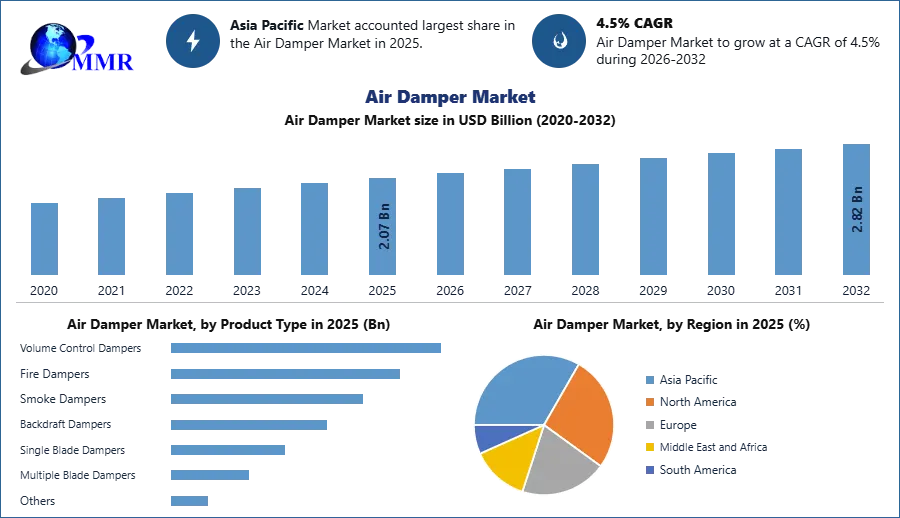 To know about the Research Methodology :- Request Free Sample Report
A damper closes the flue in a chimney to keep the weather (and birds and other animals) out and the warm or cool air in. This is normally done in the summer, although it can also be done between usage in the winter. The damper may also be partially closed in some circumstances to help control the pace of combustion. The damper may only be accessed by hand or with a wood poker reaching up into the fireplace, or by a lever or knob that sticks down or out. It's commonly a handle on the vent duct, like in an air conditioning system, on a wood-burning stove or similar appliance. Failure to open a damper before starting a fire might result in catastrophic smoke damage.
Global Air Damper Market Dynamics:
The increased demand for fire safety measures in industries such as automotive and building and construction has resulted in a global growth in building codes. In order to reduce damage and protect residents, air dampers are put in structures. The air damper aids in the extinguishment of a fire by automatically closing blades to maintain the integrity of the fire-rated separation.
Air dampers are crucial in the chemical industry for maintaining emission levels, particularly in coal-fired power plants, gas turbine exhaust systems, and boiler systems. Plant shutdowns, major consequences on station safety, unit capacity or availability, and plant environment can all be caused by air damper failure in the industrial sector.
High chemical emissions, mostly in gas turbine exhaust systems, boiler systems, and coal-fired power plants, are increasing the demand for air dampers in both household and commercial settings. Growth in building and construction activity, together with advanced technological advancements, is driving product demand in the industry around the world; as a result, air dampers play a significant role in reducing damage and promoting the protection of residents.
Also, an air damper aids in the extinguishment of a fire by mechanically closing blades to maintain the fire-rated separation's reliability. However, market demand is expected to be hampered in the coming years by high machinery costs and a scarcity of skilled workers.
Air Damper Market Recent Industry Developments (2025–2026)
| Exact Date | Company | Development | Impact |
|---|---|---|---|
| 14 February 2025 | Swegon (Investment AB Latour) | Acquired American Geothermal, a US heating and cooling solutions manufacturer, expanding its HVAC and related damper ecosystem footprint. | Strengthens Swegon’s market presence in North America and broadens product portfolio relevant to airflow control and HVAC system integration. |
| 10 June 2025 | Johnson Controls | Announced performance results and expanded heat pump solutions that integrate with building HVAC systems and contribute to broader airflow and efficiency improvements. | Highlights growing deployment of advanced HVAC components that drive energy efficiency, indirectly boosting demand for integrated damper controls and systems. |
| 31 July 2025 | Johnson Controls | Completed divestiture of its Residential and Light Commercial HVAC business including ducted products relevant to airflow and damper components. | Reshapes market focus toward commercial and smart building solutions, potentially reallocating R&D toward advanced damper and airflow control systems. |
| 24 November 2025 | Johnson Controls | Participated in HVACR World 2025, showcasing advanced building technologies and integrated controls that support energy-efficient airflow and system automation. | Reinforced industry leadership in smart HVAC and airflow control technologies, influencing damper market adoption and integration with building management systems. |
Global Air Damper Market Segment Analysis:
Based on Application, the Air Damper market is segmented as, automobile, home appliances, chemical, and others. The automobile segment is expected to dominate the market during the forecast period. Technological advancements, such as the availability of air dampers in various forms based on production model need, have caused this segment to attract the attention of both customers and investors in the market.
The targeted market demand is being boosted by demand for large and light vehicles in a variety of industrial industries. Also, new services linked with the unit, such as superior fan and larger angle with improved airflow, auto cleaning, dirt prevention, and others, are driving market demand and are likely to continue to do so in the future years.
Detailed information about all segments is covered in the MMR’s report.
Global Air Damper Market Regional Insights:
Housing, commercial, and manufacturing sectors in the United States are expected to benefit from growth in the building and construction and chemical industries. This is expected to increase demand for air dampers, which are used to keep buildings safe from fire, smoke, and pollutants.
While the market in Europe is expected to grow at a rapid rate thanks to the expansion of the building and construction sector across the continent. Also, Nordic countries like Sweden, Finland, Norway, and Denmark are likely to see increased migration, which is expected to strengthen Europe's building industry.
In the coming years, rising urbanization in emerging markets such as China, India, and Indonesia are expected to stimulate infrastructure spending. Also, as the chemical industry grows in these countries, demand for air dampers as barriers to chemical vapors and exhaust gases is expected to rise. To meet the demand for air dampers in the Middle East and Africa, as well as Latin America, industrialized countries such as the United States, Germany, and Japan rely on imports.
The objective of the report is to present a comprehensive analysis of the market to the stakeholders in the industry. The past and current status of the industry with the forecasted market size and trends are presented in the report with the analysis of complicated data in simple language. The report covers all the aspects of the industry with a dedicated study of key players that include market leaders, followers, and new entrants.
PORTER, PESTEL analysis with the potential impact of micro-economic factors of the market have been presented in the report. External as well as internal factors that are supposed to affect the business positively or negatively have been analyzed, which will give a clear futuristic view of the industry to the decision-makers.
The report also helps in understanding the global market dynamics, structure by analyzing the market segments and projecting the global market size. Clear representation of competitive analysis of key players by product, price, financial position, product portfolio, growth strategies, and regional presence in the global market makes the report investor's guide.
Global Air Damper Market Scope: Inquire before buying
| Air Damper Market | |||
|---|---|---|---|
| Report Coverage | Details | ||
| Base Year: | 2025 | Forecast Period: | 2026-2032 |
| Historical Data: | 2020 to 2025 | Market Size in 2025: | 2.07 USD Billion |
| Forecast Period 2026-2032 CAGR: | 4.5% | Market Size in 2032: | 2.82 USD Billion |
| Segments Covered: | by Product Type | Volume Control Dampers Fire Dampers Smoke Dampers Backdraft Dampers Single Blade Dampers Multiple Blade Dampers Others |
|
| by Application | Commercial Buildings Industrial Facilities Residential Buildings Institutional / Others |
||
| by Material | Metal (Steel, Aluminum) Plastic Composite / Alloy / Others |
||
| by End User | HVAC Systems Automotive Aerospace Marine / Others |
||
Air Damper Market, by Region
• North America (United States, Canada and Mexico)
• Europe (UK, France, Germany, Italy, Spain, Sweden, Austria and Rest of Europe)
• Asia Pacific (China, South Korea, Japan, India, Australia, Indonesia, Malaysia, Vietnam, Taiwan, Bangladesh, Pakistan and Rest of APAC)
• Middle East and Africa (South Africa, GCC, Egypt, Nigeria and Rest of ME&A)
• South America (Brazil, Argentina Rest of South America)
key players / competitors profiles covered in the Air Damper Market report in strategic perspective
Johnson Controls
Blauberg Group
Lindab AB
Komfovent
Waterloo Air Products
Trolex Corp.
Greenheck Fan Corp.
Vent Products
Hoyme Manufacturing Inc.
Broan Inc.
Taisei Techno Co. Ltd.
Bosch Thermotechnology Corp.
Hansen Corporation
Grainger Inc.
Ruskin Company
TROX GmbH
Systemair AB
Loren Cook Company
Nailor Industries
Titus HVAC
Schneider Electric SE
Siemens AG
Aldes Group
United Enertech Corporation
Krueger-HVAC
Caryaire Equipments
KMC Controls
Belimo Holding AG
Swegon Group AB
Air Master Equipments Emirates LLC
Ventilation Systems JSC
Halton Group