
Adhesive Tapes Market – Global Market Size, Strategic Growth Drivers, Risk Assessment Framework, Regulatory Landscape Review, Competitive Intensity Mapping & Long-Term Industry Outlook to 2032
Overview
The Adhesive Tapes Market size was valued at USD 74.57 Billion in 2024 and the total Adhesive Tapes revenue is expected to grow at a CAGR of 5.9% from 2025 to 2032, reaching nearly USD 117.96 Billion.
Adhesive Tapes Market Overview:
Adhesive tape has a wide range of uses, including packing, sealing, masking, emergency repairs, and many more. Any flexible material, including textile, paper, or polymer sheets, can be converted into a tape. The adhesive used is often a pressure-sensitive bonding agent that enables the tape to be easily removed and/or repositioned. There are many different types of specialized and general-purpose adhesive tapes used today in the fields of medical, business, the arts, and residential settings.
Since mechanical fasteners became the industry norm, the alternatives accessible to engineers for projects that require fastening and joining have significantly increased. Adhesives are quickly replacing other materials as engineers' go-to option for assembly tasks, from joining a washing machine's clear cover to the body to assembling cars and airplanes. All adhesives, including tapes, are created to meet and surpass the performance requirements of engineers, taking into account factors like speed, durability, and degree of customizability for process time concerns. They may be produced into tapes and films, as well as formulations with various viscosities.
Report Scope:
The Adhesive Tapes market is segmented based on Resin, Material, Technology, Type, End-Use Industry, and Region. The growth of various segments helps report users in acquiring knowledge of the many growth factors expected to be prevalent throughout the market and develop different strategies to help identify core application areas and the gap in the target market. The report provides an in-depth analysis of the market and contains meaningful insights, facts, historical data, and statistically supported and industry-validated market statistics. It also includes estimates based on an appropriate set of assumptions and methodologies.
A bottom-up approach has been used to estimate the market size. Key Players in the Adhesive Tapes market are identified through secondary research and their market revenues are determined through primary and secondary research. Secondary research included a review of annual and financial reports of leading manufacturers, while primary research included interviews with important opinion leaders and industry experts such as skilled front-line personnel, entrepreneurs, and marketing professionals. Some of the leading key players in the global Adhesive Tapes market include ABI Tape, Adchem, ADH Tape, and Adhesives Research.
The report is not only a representation of global players but also covers the market holding of local players in each country. Market structure by country with market holding by market leaders, market followers, and local players make this report a comprehensive and insightful industry outlook. The report has covered the mergers and acquisitions, strategic alliances, joint ventures, and partnerships happening in the market by region, by investment, and their strategic intent.
 To know about the Research Methodology :- Request Free Sample Report
Adhesive Tapes Market Dynamics:
Growing demand for Recycled PET packaging tapes:
Both manual and automated dispensers are ideal for using recycled PET packing tape. It performs similarly to PVC or biaxially orientated polypropylene (BOPP) tapes and has high tensile strength. Additionally, it provides high printability with all ink systems, making it suitable for solutions for branding and advertising.
The tapes are usually designed for applications involving light- and medium-weight packing up to 30 kg. The combination of its pressure-sensitive acrylic adhesive and sturdy, abrasion-resistant backing ensures both good adherence to recyclable cardboard and quiet unwinding. As a result, these novel tapes can be a good substitute for the widely used polyvinyl chloride packaging tapes in a variety of industries, including the food and beverage, pharmaceutical, and logistics sectors.
A new packaging adhesive tape is being introduced by Tesa, a global provider of adhesive tapes and self-adhesive system solutions. Seventy percent of the PET used to create the backing of the new Tesa 60412 Recycled PET packaging tape originates from post-consumer recycling. It also has waterborne acrylic adhesive technology. According to Tesa, which is accredited using the INGEDE technique, it may be disposed of in the appropriate paper recycling bin along with the cardboard without endangering the paper recycling process.
Raw Commodity Price Fluctuations: Adhesive Tapes Market
Costs and raw material availability are the most important aspects that adhesive tape producers must consider when determining the cost structure of their goods. Raw materials used in the production of adhesive tapes include rubber, acrylic, silicone, polypropylene (PP), polyvinyl chloride (PVC), adhesives, and release liners. The majority of these basic materials are petroleum-based derivatives that are susceptible to commodity price volatility. Oil prices have historically been very volatile due to rising global demand and upheaval in the Middle East. The market's growth is influenced by the uncertainty and changes in the cost and availability of feedstock.
The adhesives sector has been impacted by rising energy costs, which have resulted in higher manufacturing costs. The growing global demand for chemicals, along with capacity limits in the supply of these main chemicals and resin feedstock, has driven the rise in raw material costs. Supply limitations of monomers required to create adhesive raw materials, such as piperylene and C9 monomers, have boosted raw material pricing. All of these reasons are limiting the market growth.
Current and prospective chemical regulations are impacting the adhesive tape industry:
Global chemical legislations are extremely complicated, with constantly changing rules, directives, and commercial standards. As more chemicals are prohibited or limited, and more sectors of trade are controlled, regulatory affairs will become increasingly important. Adhesive-tape-related companies must adjust quickly to changing legislative requirements to thrive. Large corporations are likely already dealing with regulatory challenges through specific divisions inside their organizations. Integrating a division or team into a firm is more difficult for SMEs. Companies can incorporate regulatory concerns into their business models in a variety of ways.
A major opportunity in Adhesive Tapes Market
Mechanical fasteners such as nuts and bolts, screws and rivets, and mechanical interlocks have long been thought to be the strongest and most durable connecting techniques. However, combining different surfaces is difficult since the material is prone to cracking owing to tensile stress under high pressure, resulting in a lack of stability and long-term attachment. New adhesive tape applications for fixing and fastening are developed by substituting existing fastening techniques with adhesive tapes. These tapes eliminate the problems of traditional fastening solutions and assist to extend the product's lifespan. Tapes also aid in the elimination of rust and corrosion, the reduction of noise and vibration, the reduction of production and assembly time, and the enhancement of product design. These have been shown to improve efficiency and performance while decreasing manufacturing and material costs.
Adhesive Tapes Market Segment Analysis:
By End-Use Industry, the automotive segment is expected to grow at a CAGR of 7.8% during the forecast period. The automotive industry is a broad sector comprised of several organizations, firms, and industrial units that are either directly or indirectly connected with resin and tape manufacturers. These organizations are involved in the design, development, manufacturing, assembling, marketing, and selling of various automobiles. It is estimated that around 800,000-900,000 square meters of adhesive tapes may be used to serve this industry. Every day, these many adhesive tapes are used to connect and assemble the 2 to 5-kilometer wires that run inside a new automobile. Up to 50 adhesive tapes can be simply used in a single new vehicle. Adhesive tapes are commonly used to join various components to safeguard the assembly line process. They are used to fill production-related gaps or to hold trims/sills in place. These tapes are frequently used to grip screws and bolts so that chairs and dashboards may easily stay in place. During the painting of motor vehicles, several design departments utilize industrial tapes.
The building and construction segment is expected to grow at a CAGR of 7.1% during the forecast period. When it comes to constructive bonding in the design or building sector, industrial adhesive tapes are quite beneficial. It is not unreasonable to state that the majority of the components in current design buildings are held together using industrial tapes. Then there are numerous applications in elevators, windows, display windows, doors, glass partitions, skyscraper facades, and solar parts of the structure. Although it is obvious that designs, materials, construction techniques, and other needs are dependent on the architect's vision, when it comes to the development of structures, adhesive industrial tapes must offer a variety of technological options. These tapes are well-known for providing the necessary flexibility, durability, and speed in bonding, planning, and constructing buildings.
Adhesive Tapes Market Regional Insights:
The Asia Pacific adhesive tapes market is expected to grow at a CAGR of 9.1% during the forecast period. This growth can be ascribed to the region's strong need for conventional wound care supplies such as dry dressings, first-aid kits, and adhesive bandages. The growing awareness of improved wound care is expected to boost demand for innovative products in this market. The regional growth is mostly related to the area's strong economic growth rate, which has been accompanied by considerable investments in sectors such as automotive, medical, electrical & electronics, and the construction industry. Multiple firms are establishing new factories or expanding their current adhesive tape manufacturing operations in the region. The benefits of relocating operations to the Asia Pacific include lower production costs and the potential to better service local emerging markets.
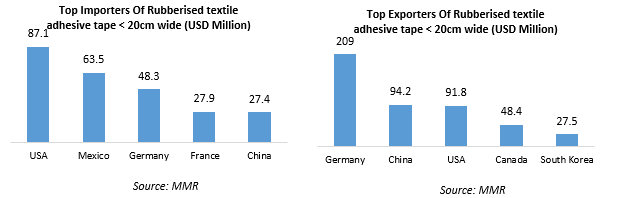 The Europe adhesive tapes market is expected to grow at a CAGR of 9.1% during the forecast period. Germany led the exports of rubberized textile adhesive tapes in 2020. REACH, the European Union's global chemical regulation authority is daunting for regional and global businesses. Scheduled EU prohibitions and limitations on chemicals such as ADCA, DEHP, toluene, and formaldehyde offer significant challenges to the adhesive tape industry. REACH, backed by Scandinavia, has had the greatest influence on European tape companies, which must keep up with talks regarding registered chemicals.
To prosper, adhesive-tape-related enterprises need to adjust quickly to changing legal requirements by incorporating regulatory affairs into their business strategies. Large corporations and small and medium-sized enterprises (SMEs) must establish dedicated divisions or teams to manage regulatory affairs within their organizations; establish a system of cluster analysis with customers; integrate regulatory affairs into product development, sustainable development, product procurement, and, most importantly, sales; offer additional regulatory support for each global region in which companies are present; and use regulatory oversight as a driver of innovation.
ADCA (C, C azodicarbonamide) is a blowing agent that is extensively used in the automobile sector to create PVC, PE, PU, and rubber-based materials. The European Commission (EC) intends to outlaw ADCA throughout the European Union. Because of its distinct qualities, this chemical is difficult to phase out or replace, providing challenges for the European adhesive tape industry. Toluene is a volatile solvent with a limited shelf life. The chemical is used all around the world, and the EU has banned its usage in consumer products. Synthetic chemists all around the world are seeking to replace it with greener alternatives. Formaldehyde is found in binders and adhesives, particularly those used in wood goods and carpeting. Formaldehyde, a proven human carcinogen, is among the compounds included in the Community Rolling Action Plan (CoRAP) to be examined by the Member States. It is unclear if it will be regulated or prohibited.
Adhesive Tapes Industry Ecosystem
Adhesive Tapes Market Scope: Inquire before buying
| Adhesive Tapes Market | |||
|---|---|---|---|
| Report Coverage | Details | ||
| Base Year: | 2024 | Forecast Period: | 2025-2032 |
| Historical Data: | 2019 to 2024 | Market Size in 2024: | USD 74.57 Bn. |
| Forecast Period 2025 to 2032 CAGR: | 5.9% | Market Size in 2032: | USD 117.96 Bn. |
| Segments Covered: | by Resin | Acrylic Rubber Silicone Others |
|
| by Material | Polypropylene (PP) Paper Polyvinyl Chloride (PVC) Others |
||
| by Technology | Solvent-based Hot-Melt based Water-based |
||
| by Type | Commodity Adhesive Tapes Specialty Adhesive Tapes |
||
| by End-Use Industry | Packaging Electrical & Electronics Healthcare Automotive White Goods Paper & Printing Building & Construction Retail Others |
||
Adhesive Tapes Market, by Region
North America (United States, Canada and Mexico)
Europe (UK, France, Germany, Italy, Spain, Sweden, Austria and Rest of Europe)
Asia Pacific (China, South Korea, Japan, India, Australia, Indonesia, Malaysia, Vietnam, Taiwan, Bangladesh, Pakistan and Rest of APAC)
Middle East and Africa (South Africa, GCC, Egypt, Nigeria and Rest of ME&A)
South America (Brazil, Argentina Rest of South America)
Adhesive Tapes Market, Key Players
1. ABI Tape
2. Adchem
3. ADH Tape
4. Adhesives Research
5. Advance
6. AFTC
7. ATP
8. Avery-Dennison
9. Bagla Group
10.Berry Global
11.Bolex
12.BondTape
13.Bron
14.Cantech
15.Cattie Adhesives
16.CCT
17.Champion Tape
18.Coroplast
19.Dewal
20.DIC
21.Dow
22.Essentra
23.Fabrico
24.Gorilla Glue Company
25.Henkel
26.Heskins
27.Inter Polymer Group (IPG)
28.ITC Tapes
29.ITW
30.Jonson Tapes
31.JTape
FAQs:
1. Which region is expected to dominate the Adhesive Tapes Market at the end of the forecast period?
Ans. APAC is expected to dominate the Adhesive Tapes market at the end of the forecast period.
2. What is the growth rate of the APAC Adhesive Tapes Market?
Ans. The Asia Pacific Adhesive Tapes Market is expected to grow at a CAGR of 9.1% during the forecast period.
3. What is expected to drive the growth of the Adhesive Tapes Market in the forecast period?
Ans. Growing demand for Recycled PET packaging tapes is expected to drive the growth of the Adhesive Tapes Market.
4. What is the projected market size & growth rate of the Adhesive Tapes Market?
Ans. The Adhesive Tapes Market size was valued at USD 74.57 Billion in 2024 and the total Adhesive Tapes revenue is expected to grow at a CAGR of 5.9% from 2025 to 2032, reaching nearly USD 117.96 Billion.
5. What segments are covered in the Adhesive Tapes Market report?
Ans. The segments covered are Resin, Material, Technology, Type, End-Use Industry, and Region.