
3D Printing Materials Market Size by Form Type, Application, Type, Technology, End-User, Region – Revenue Pool Analysis, Margin Structure Assessment, Capital Flow Trends, Competitive Benchmarking & Forecast to 2032
Overview
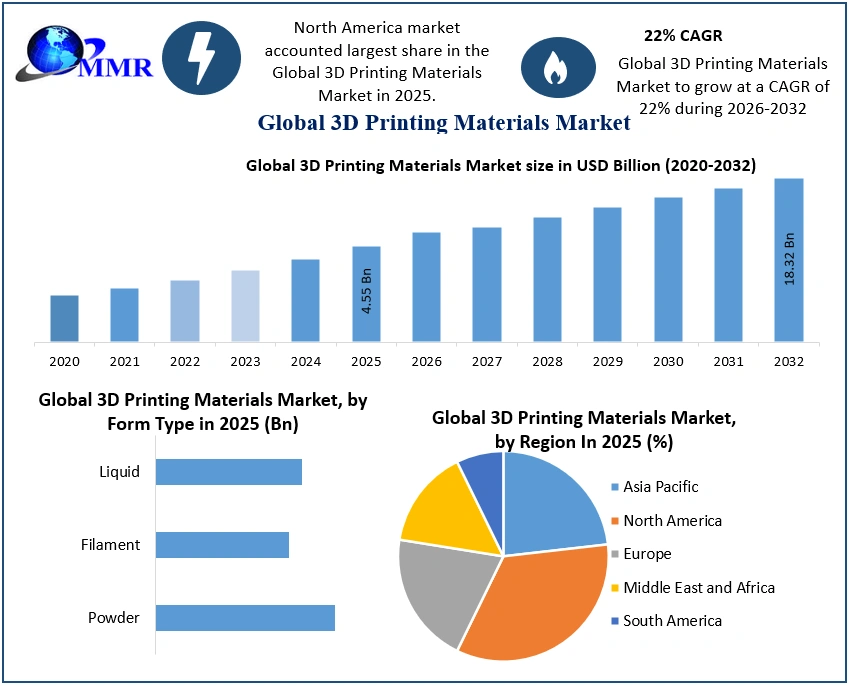
The 3D Printing Materials Market size was valued at USD 4.55 Billion in 2025 and the total 3D Printing Materials revenue is expected to grow at a CAGR of 22% from 2026 to 2032, reaching nearly USD 18.32 Billion by 2032.
3D printing or additive manufacturing is a technique that produces three-dimensional objects, which builds layer upon layer of raw material. Digital 3D files, such as computer-aided design (CAD) or magnetic resonance images (MRI) are used to create objects. Thanks to its versatility, 3D printing also has applications in the medical industry, which increased its demand and growth in the market. In addition, 3D printing has the ability to revolutionize manufacturing, enabling companies to design and manufacture new products innovatively along with reducing material waste, energy saving, and taking less time to launch the product in the market.
3D printing has applications in numerous industries, such as aerospace & defense, automotive, education, healthcare, robotics, and manufacturing, which propel 3D printing demand in the market. Various companies are adopting 3D printing for production purposes at a wide range.
As per the MMR analysis, 32% of respondents from the automotive and aerospace sectors are using 3D Printing Materials for the construction or manufacturing of tools. 3D printers are used in universities for a wide variety of objectives, from Ph.D. students using the printers for research to professors printing pieces for instructional tools to transmit the course plan. In addition, hospitals are beginning to view 3D printing and modeling as a useful tool for any difficult procedure, even surgery on heart, and intricate organ that moves continually. Robotics companies are able to design and fabricate light, complex parts like end-of-arm tooling thanks to 3D printers.
To know about the Research Methodology :- Request Free Sample Report
3D Printing Material Market Dynamics:
Rising adoption of 3D Printing Materials in Aerospace and Defence Industry
The aerospace industry is highly adopting 3D printing materials. 3D printing technology offers the ability to produce lightweight components with enhanced and complicated geometry in the aerospace industry, hence the lowering energy requirements and resource consumption, which is propelling the demand for 3D printing in the aerospace industry and is expected to continue in the near future. In addition, the adoption of 3D printing results in fuel savings since less material is needed to make aircraft parts. However, a lot of aircraft components, like engines, have spare parts made possible by 3D printing technology. Engine parts need to be replaced regularly because they are prone to deterioration, as, a result 3D printing technology offers a practical way to get these replacement parts.
Emerging Technologies in the Healthcare Sector
3D printing technology is used in manufacturing skin drugs and pharmaceuticals, it is also used to produce organs for cancer research, bone and cartilage replacement tissues, and models. 3D printing imitates skin’s natural structure at an affordable cost. The products that are related to chemicals, pharmaceuticals, and cosmetics are tested in the 3D printed skin. As a result, employing skin replicates will assist the researcher in obtaining accurate results. Therefore, because accuracy and proper testing methods of 3D printing increase the demand of the market in the healthcare industry.
In addition, 3D printing is used in orthopedics as cartilage and bone which print using 3D printing technology to fill up skeletal holes, which are created by trauma or illness. The function of tissues improves by 3D printing. However, organ failure brought on by serious issues including illness, accidents are also treated well with the help of 3D printing technology. 3D printing significantly speeds up cancer research by creating highly controlled models of cancer tissues. With the help of 3D printing, patients obtain more precise and dependable data, thus, the adoption rate of 3D printing in the healthcare sector is increasing and propelling the growth of the 3D printing materials market. In addition, neurosurgeons use 3D printing models to aid the learning process while practicing surgical techniques, because 3D model stimulates real patient conditions, which increases the accuracy.
High Material Costs of 3D Printing Materials
3D printing is a simpler method of manufacturing goods, associated with the high cost of materials is a constraint for the growth of the market. The greater purity and composition requirements needed for 3D printing are the cause of these exorbitant costs. The target market for this price range is diverse and includes small and medium-sized enterprises. The printers are priced in an odd range, it is beyond the reach of the average consumer but is affordable for large-scale company. Large-scale manufacturers and professionals depend on 3D printing to run their operations. The average cost of metal materials for 3D printing is USD 500.0 per kg, which makes them prohibitively expensive for use in ordinary applications, because of the excessively high cost of the final product when they are compared to the market products. Therefore, the high cost of 3D printing materials is the major constraint for market growth in underdeveloped and developing countries.
3D Printing Materials Market Trends:
3D printing cutting-edge innovation in the healthcare sector is one of the major factors augmenting the growth of the 3D printing market. 3D printing in targeted regenerative therapeutics is a groundbreaking innovation for the healthcare and the 3D printing market,
it continues to grow the 3D printing material market shortly. It is able to produce personalized orthopedic implants for patients. Regenerative medicine also enhances the patient's recovery from injuries through trauma, and birth defects. In addition, 3D Printing in dental dentistry is a major trend in the market, which is expected to propel the 3D printing material market. 3D printing offers a wide range of applications in dental dentistry such as orthodontic, trays and prosthodontic models, crowns, bridges, dentures, etc.
3D printing technology is used in cancer treatment, to study the mechanism of cell growth and develop it more accurately and systematically. Advancements in 3D printing also led to the discovery of cures for many diseases such as cancer. 3D printing creates a digital model of the liver, heart, and kidney to print them through 3D technique.
3D Printing Materials Segment Analysis:
Based on End-User the Healthcare segment is dominating the 3D printing materials market and is expected to continue the growth of the segment during the forecast period. 3D printing technology is used in the production of several medical products, such as surgical instruments, implants prostheses, and devices for tissue engineering. Moreover, materials for 3D printing have great value in dental, craniomaxillofacial, orthopedic, and other medical fields. The use of printed prostheses by dentists is growing as a result of the creation of customized dental models for crowns, bridges, implants, and dentures. Macroeconomic factors that contribute to tooth disease and tooth loss, such as people's bad eating habits, would increase demand for dental prostheses. Sales of 3D printing materials are anticipated to be driven by medical applications including hip and knee replacements as well as surgical equipment. Surgeons and doctors undertake complex surgical procedures using printed models of surgical instruments. In addition, additive manufacturing is very useful in generating customized devices that correctly match the patient’s anatomy.
The automotive segment is expected to be the fastest-growing segment throughout the forecast period. Emerging technologies in the automotive industry are driving the growth of the segment in the 3D printing materials market. In the automotive industry 3D printing technology has made phenomena to evolve new shines, enabling for lighter and more complex structures. 3D printing has not only transformed cars but also local motors with a wide range of applications by manufacturing a 3D printed bus called OLLI. OLLI is a 3D-printed, electric, recyclable bus. In addition, Ford is a pioneer in the application of 3D printing technology, using it to create prototypes and engine parts. BMW also produces hand tools for automobile testing and assembly using 3D printing technology.

3D Printing Materials Market Regional Insights:
North America, is the significantly leading the 3D printing materials market and is expected to continue to grow throughout the forecast period. North America has a 35% market share in the 3D printing material market. The United States has the largest contribution to the growth of the 3D printing market, as numerous key players investing, and developing in additive manufacturing are headquartered in North America. 3D Systems and Stratasys the trifecta of unicorns are the traditional manufacturing companies that have stepped into the 3D printing. In addition, the 3D printing U.S.-based companies get high investment. In addition, the initiatives taken by the U.S. government and large multinational corporations to support small and medium-sized businesses for 3D printing. Companies like Siemens Energy, Martin, GE Aviation, Lockheed, and Raytheon, are taking the initiative in driving 3D printing in the country in numerous ways, which is propelling the demand for 3D printing market in the region.
In addition, the United States is investing in 3D printing in various sectors, The Biden administration has selected various federal programs that might help to adopt 3D printing in small enterprise manufacturers. Agriculture is expected to offer the rural enterprises to purchase additive manufacturers (AM) equipment and provide training to the staff. To ensure that additive manufacturing (AM) is adopted nationwide, the small-scale business has to work with additive manufacturers (AM) participants to implement its Small Business Investment Company (SBIC) program. In addition, the small enterprise is able to test innovative 3D printing techniques at Oak Ridge National Laboratory.
Key Developments:
1. For instance, in August 2023, 3D Systems a leading 3D Printing manufacturer announced the partnership with Theradaptive a biopharmaceutical company for new groundbreaking targeted regenerative therapeutics. The companies intend to deliver a novel approach to promote bone and tissue growth using Theradaptive unique protein-based material-binding variants to coat 3D Systems.
2. For instance, Ford operates 3D printers autonomously, which increases efficiency and reduces the cost. An autonomous method lowers the cost of custom-printed goods by allowing a 3D printer to operate continuously without requiring human intervention.
3. Stratasys announced the Data Security Platform for the U.S. Navy. Stratasys is supporting the growing U.S. government implementations of 3D printing. Stratasys has been awarded a $20 million U.S. Navy contract. It is set to be fulfilled over the next five years, the Stratasys supply up to 25 F900 3D printers to the U.S. Navy. The benefit of additive manufacturers (AM) to the military is that sustainment activities might take place quickly and virtually from anywhere.
4. November 2023, Markforged announced the launch of Vega, an ultra-high-performance filament designed for aerospace manufacturing on Markforged FX20 printer. Vega allows bringing customers to have substantial advantages in weight reduction, cost-effectiveness, and lead in time savings.
5. October 2021, Markforged creator of integrated metal and carbon fiber additive manufacturing platform. Markforged new production of hardware prints the flame-retardant high-performance thermoplastic material, the combination of Markforged propriety continuous fiber reinforcement printing technology for high-strength, resistant, and high-performance parts that meet the needs of the most demanding industries aerospace, defense, and automotive.
3D Printing Materials Market Scope: Inquiry Before Buying
| 3D Printing Materials Market | |||
|---|---|---|---|
| Report Coverage | Details | ||
| Base Year: | 2025 | Forecast Period: | 2026-2032 |
| Historical Data: | 2020 to 2025 | Market Size in 2025: | USD 4.55 Bn. |
| Forecast Period 2026 to 2032 CAGR: | 22% | Market Size in 2032: | USD 18.32 Bn. |
| Segments Covered: | by Form Type | Powder Filament Liquid |
|
| by Application | Prototyping Manufacturing R7D |
||
| by Type | Plastic Metal Ceramic |
||
| by Technology | Fused Filament Fabrication Selective Laser Sintering Stereolithographic Direct Metal Laser Sintering |
||
| by End-User | Automotive Aerospace & Defence Healthcare Consumer Goods Construction Electronics Education |
||
3D Printing Materials Market, by Region:
North America (United States, Canada, and Mexico)
Europe (UK, France, Germany, Italy, Spain, Sweden, Austria, and the Rest of Europe)
Asia Pacific (China, South Korea, Japan, India, Australia, Indonesia, Malaysia, Vietnam, Taiwan, Bangladesh, Pakistan, and the Rest of APAC)
Middle East and Africa (South Africa, GCC, Egypt, Nigeria, and the Rest of ME&A)
South America (Brazil, Argentina Rest of South America)
3D Printing Materials Market, Key Players:
1. General Electric (U.S)
2. Markforged Inc. (U.S)
3. Impossible Objects Inc. (U.S)
4. Carbon (U.S)
5. Forefront Filament (U.S)
6. Keene Village Plastics (U.S)
7. Airwolf 3D (U.S)
Europe
1. Royal DSM N.V. (Netherland)
2. The Exone Company (UK)
3. Materialize NV (Belgium)
4. Sandvik AB (Sweden)
5. Hoganas AB (Sweden)
6. Evonik Industries AG (Germany)
7. Voxeljet AG (Germany)
8. SLM Solutions Group AG (Germany)
9. LPW Technology Ltd. (U.K)
10. Envisiontec Inc. (Germany)
11. BASF New Business GmbH (Germany)
12. Lithoz GmbH (Austria)
13. Clariant AG (Switzerland)
Asia-Pacific
1. Stratasys Ltd. (Isarel)
FAQs
1. What are the growth drivers for the 3D Printing Materials Market?
Ans. The Rising adoption of 3D Printing Materials in the Aerospace and Defence Industry and emerging technologies in healthcare industries is expected to be the major driver for the 3D Printing Materials market.
2. What is the major restraint for the 3D Printing Materials Market growth?
Ans. The high cost of 3D printing materials is expected to be the major restraining factor for the 3D Printing Materials market growth.
3. Which region is expected to lead the global 3D Printing Materials Market during the forecast period?
Ans. North America is expected to lead the global 3D Printing Materials market during the forecast period.
4. What is the projected market size & growth rate of the 3D Printing Materials Market?
Ans. The 3D Printing Materials Market size was valued at USD 4.55 Billion in 2025 and the total 3D Printing Materials revenue is expected to grow at a CAGR of 22% from 2026 to 2032, reaching nearly USD 18.32 Billion by 2032.
5. What segments are covered in the 3D Printing Materials Market report?
Ans. The segments covered in the 3D Printing Materials market report are Components by Form Type, Application, End-User, Technology, Type, and Region.