
Genetic Engineering Market Size by Product, Techniques, Application, End-User, Region – Revenue Pool Analysis, Margin Structure Assessment, Capital Flow Trends, Competitive Benchmarking & Forecast to 2032
Overview
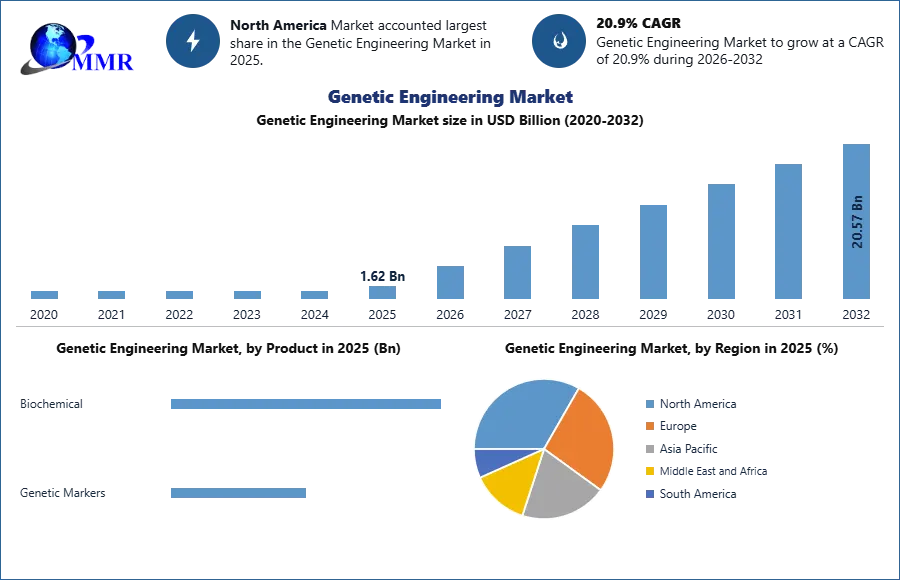
Global Genetic Engineering Market size was valued at USD 1.62 Bn in 2025 and is expected to reach USD 20.57 Bn by 2032, at a CAGR of 20.9%.
Genetic Engineering Market Overview:
Genetic engineering or genetic modification (gene editing) is a process, which is used in laboratory-based technologies for altering the DNA makeup of organisms as well as adding a gene from one species to an organism from a different species to produce a desired trait. Also, it involves changing a single base pair (A-T or C-G), deleting a region of DNA, or adding a new segment of DNA. This technology is used in research and industry, genetic engineering has been applied to the production of cancer therapies, brewing yeasts, genetically modified plants and livestock, and more. Gene therapy and genetic engineering are two closely related technologies that involve altering the genetic material of organisms.
Genetic engineering is a revolutionary field and has huge potential to transform agriculture, medicine, and environmental conservation. It is an advancing sector of biotechnology with the primary objective goal is to introducing new traits or modifying an existing organism. Techniques in Genetic engineering include Recombinant DNA Technology, Gene Editing with CRISPR-Cas9, PCR (Polymerase Chain Reaction),Gene Synthesis and Gene Silencing. These powerful technologies have the potential to boost the Genetic Engineering Market growth during the forecast period.
Aldevron manufactures CRISPR nucleases, including SpyFi Cas9 Nuclease, SpCas9, SaCas9, Cas12a, and associated variants. This company now provides a full RNP service solution to streamline CRISPR reagents into therapies.
To know about the Research Methodology :- Request Free Sample Report
Genetic Engineering Market Dynamics:
High Demand for Genetically Modified Organisms (GMOs) in Agriculture to Influence the Market
The adoption of GMOs by farmers has been steadily increasing in various countries, and this trend is expected to continue as genetic engineering techniques and make more sophisticated. Also, provide specific regional agricultural needs. Genetically modified crops have been developed to exhibit traits such as pest resistance, herbicide tolerance, improved nutritional content, and extended shelf life. These modifications have the potential to increase crop yields or productivity, reduce the use of harmful pesticides, and address food security challenges in the face of a growing global population. The growing research activities with the help of various gene editing tools for developing novel crop varieties. Thus, agriculture is a crucial sector that drives Genetic Engineering Market growth.
Advancements in Gene Editing Technologies to Drive the Market Growth
Advancements in gene editing technologies are another key driver for Genetic Engineering Market growth. This is especially in the development of CRISPR-Cas9, which has revolutionized the field of genetic engineering. CRISPR-Cas9 is a highly efficient and precise gene-editing tool that allows scientists to make targeted modifications in the DNA of organisms. Its simplicity and versatility have made it widely accessible to researchers worldwide, accelerating the pace of genetic engineering research. Genetic modification techniques cover a wide range of studies, including the generation of transgenic animals, functional analysis of genes, model development for diseases, or drug development.
The genome editing strategies have evolved during the last three decades, and nowadays, four types of “programmable” nucleases are available in this field meganucleases, zinc finger nucleases, transcription activator-like effector nucleases, and the clustered regularly interspaced short palindromic repeats (CRISPR)/CRISPR associated protein 9 (Cas9) (CRISPR/Cas-9) system. With CRISPR-Cas9, genetic modifications that used to take months or years can now be achieved in a matter of weeks, making the process more cost-effective and efficient. As the technology continues to improve, it opens up new opportunities for therapeutic applications, personalized medicine, and advancements in agriculture, propelling the growth of the global genetic engineering market.CRISPR gene-editing technology creates precise and permanent modifications to DNA. It has significantly advanced our ability to generate animal disease models for use in biomedical research and also has the potential to revolutionize the treatment of genetic disorders.
Increasing Applications in Healthcare and Medicine to Fuel the Market
Genetic engineering has found numerous applications in healthcare and medicine that are expected to boost Genetic Engineering Market growth. One of the most promising areas is gene therapy, where genetic material is introduced into a patient's cells to treat or prevent diseases caused by genetic mutations. Recent successes in gene therapy trials for conditions such as inherited blindness and certain blood disorders have garnered significant attention and investment from the pharmaceutical industry.
The rising use of genetic engineering in producing biopharmaceuticals, such as insulin and vaccines, has streamlined drug development processes and improved treatment outcomes. As well as the demand for genetic engineering in healthcare is expected to drive market growth during the forecast period.
Global Market Opportunity, Challenge and Restrain Factors:
The global genetic engineering market report presents several growth opportunities that can major impact its growth and development. That, the formation of new precision medicine development is a key opportunity for industry growth. It helps to develop targeted therapies for various genetic disorders and diseases. Similarly, increasing focus on developing personalized treatments for cancer, rare genetic diseases, and other chronic conditions through genetic engineering research is a substantial growth opportunity for the manufacturers. However, it has the potential to sustain the environment over the forecast period. For example, genetically engineered microorganisms can be designed to break down pollutants, such as oil spills and plastic waste, more effectively.
Genetic engineering involves making key changes to the genetic makeup of organisms, which raises complex regulatory and ethical issues. Ethical concerns surrounding topics such as germline editing, designer babies, and potential unintended consequences of genetic modifications have led to public debates and calls for cautious approaches. This concern is expected to hinder the market growth size. Uncertain long-term impacts and ecological risks and intellectual property and access to technology are expected to pose challenges for the Genetic Engineering Market.
Genetic Engineering Market Segment Analysis:
By technique, the gene-splicing segment accounted for the largest Genetic Engineering Market share in 2025. It is known as recombinant DNA technology, which involves cutting and joining DNA fragments. This technique has revolutionized genetic engineering by allowing scientists to modify the genetic makeup of organisms, leading to significant advancements in various applications. The segment growth is driven by Versatility in research and development, genetic testing and gene therapy, biopharmaceutical production and other factors. Also, ongoing advancements in gene sequencing technologies, DNA synthesis techniques, and improvements in the understanding of gene regulation are expected to boost the segment in global market growth.
By application, the medical industry segment dominated the largest Genetic Engineering Market share in 2025 and is expected to grow at a significant CAGR over the forecast period. This segment includes gene therapy, cell therapy, genetic testing, and the production of pharmaceuticals through genetically modified organism medicine applications of genetic engineering are the primary driver for disease treatment and prevention. Such adoption of precision medicine is expected to drive the segment growth in the market growth.
By product, the biochemical segment held the largest Genetic Engineering Market share in 2025 and is expected to sustain its potion over the forecast period. The segment growth is driven by increasing demand for eco-friendly production methods, the need for alternatives and advancements in synthetic biology.
Genetic Engineering Market Regional Insight:
North American market dominated the largest Genetic Engineering Market share in 2025. The regional market growth is driven by the growing popularity of steam cell therapies. The United States is a major player due to the country's heavy investment in genetic technologies. A peak in the need for genetic engineering is imminent. As a result of these reasons, North America will be the global leader in the genetic engineering industry. Investment by pharma in gene editing companies also increased in 2025. The presence of well-established biotechnology and pharmaceutical companies, along with academic and research institutions, is another driver for market growth. The region benefits from a favorable regulatory environment that supports research and innovation in genetic engineering. The increasing investments in precision medicine, gene therapies, and agricultural biotechnology further boost the market. However, the high costs associated with gene therapies and genetic testing to pose challenges to widespread adoption. But, concerns about data privacy and ethical considerations are expected to restrain regional Genetic Engineering Market growth.
Europe held the second-largest Genetic Engineering Market share in 2025 and is expected to grow at a significant CAGR over the forecast period. Developed healthcare infrastructure, and biotechnology industries such as Arctoris, BioNTech, bit.bio, Compass Pathways, CRISPR Therapeutics, CureVac, Phytoform Labs, Gedea Biotechetc. The supportive regulatory landscape, combined with increasing investments in biotechnology and gene therapy research, presents favorable growth opportunities for the genetic engineering market in Europe. The U.K. government launched Project Innovate to support financial technologies by facilitating testing with real consumers and improving communication with regulators. However, the Asia-Pacific region is witnessing substantial growth in the genetic engineering market.
Genetic Engineering Market Competitive Landscape:
The competitive landscape of the global Genetic Engineering Market is dominated by key players, including prominent biotechnology companies, pharmaceutical firms, and research institutions. These players such as Lonza Group Ltd., Horizon Discovery Group plc, GenScript, Biotech Corporation, and CRISPR Therapeutics AG are investing significantly in research and development (R&D), fostering innovation and the development of novel gene-editing technologies and applications.
Market expansion strategies involve entering new geographic regions and strengthening regional presence. Regulatory compliance and intellectual property protection are paramount to ensuring the responsible use of genetic engineering technologies. Customer focus and service excellence are emphasized to build strong customer loyalty. The dynamic competitive landscape drives innovation, ultimately benefiting diverse industries and society at large.
For example, CRISPR is a recently developed method for making targeted changes in the genetic material DNA. It functions as a pair of “genetic scissors”, which can remove, replace or add specific segments of DNA in humans, animals and plants.
Genetic Engineering Market Scope: Inquire before buying
| Genetic Engineering Market | |||
|---|---|---|---|
| Report Coverage | Details | ||
| Base Year: | 2025 | Forecast Period: | 2026-2032 |
| Historical Data: | 2020 to 2025 | Market Size in 2025: | 1.62 USD Billion |
| Forecast Period 2026-2032 CAGR: | 20.9% | Market Size in 2032: | 20.57 USD Billion |
| Segments Covered: | by Product | Biochemical Genetic Markers |
|
| by Techniques | Gene Splicing Artificial Selection Recombinant DNA Technology Synthesizing DNA Gene Editing Other |
||
| by Application | Agriculture Medical Industrial Healthcare and Pharmaceuticals Other |
||
| by End User | Biotechnology Companies Pharmaceutical Manufacturers Academic and Research Institutions Other |
||
Global Genetic Engineering Market, by Region
North America (United States, Canada and Mexico)
Europe (UK, France, Germany, Italy, Spain, Sweden, Austria and Rest of Europe)
Asia Pacific (China, South Korea, Japan, India, Australia, Indonesia, Malaysia, Vietnam, Taiwan, Bangladesh, Pakistan and Rest of APAC)
Middle East and Africa (South Africa, GCC, Egypt, Nigeria and Rest of ME&A)
South America (Brazil, Argentina Rest of South America)
Key Players / Competitors Profiles Covered in Brief in Global Genetic Engineering Market Report in Strategic Perspective:
- Thermo Fisher Scientific Inc.
- Herbert Boyer
- Merck KGaA
- Lonza Group Ltd.
- Horizon Discovery Group plc
- GenScript Biotech Corporation
- CRISPR Therapeutics AG
- Editas Medicine, Inc.
- Sangamo Therapeutics, Inc.
- Intellia Therapeutics, Inc.
- Cellectis S.A.
- Precision BioSciences Inc.
- New England Biolabs, Inc.
- Takara Bio Inc.
- OriGene Technologies, Inc.
- Eurofins Scientific SE
- Transposagen Biopharmaceuticals, Inc.
- Agilent Technologies, Inc.
- Illumina, Inc.
- Cibus Inc.
- Recombinetics Inc.
- Caribou Biosciences, Inc.
- Synthego Corporation
- Inari Agriculture, Inc.
- eGenesis, Inc.