
Food E-Commerce Market - Industry Structure Evaluation, Demand Drivers Analysis, Regional Growth Analysis and Identification, Competitive Positioning Review & Global Market Size Forecast to 2032
Overview
The Food E-Commerce Market size was valued at USD 413.00 Billion in 2025 and the total Food E-Commerce revenue is expected to grow at a CAGR of 20.3% from 2026 to 2032, reaching nearly USD 1505.95 Billion by 2032.
Food E-Commerce Market Overview:
Food e-commerce refers to the sale of items by food companies through an online store or e-commerce platform. Fresh and non-perishable foods, as well as everyday and specialist items, are included. Despite being one of the most important sources of consumer spending, food e-commerce has been slower to take off than other product categories. This is owing to the difficulties of getting perishable products to the end client on time. However, with the rise of same-day delivery and delivery apps like Instacart and UberEats, marketers can now promise quick delivery and near-instant gratification.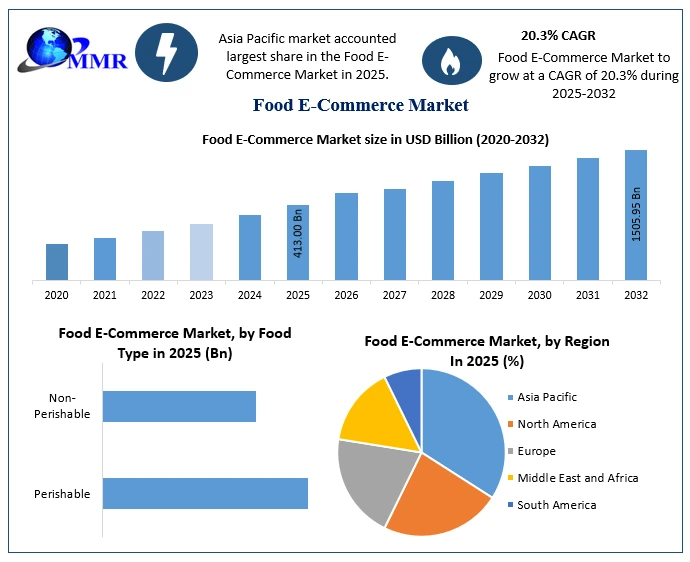 To know about the Research Methodology :- Request Free Sample Report
Food E-Commerce Market Dynamics:
Market Drivers: The growth of online purchasing, which provides various options at a glance, is driving the e-commerce market. Retailers are also utilizing techniques such as same-day delivery to assist increase the e-commerce business. One of the main drivers of e-commerce growth is the development of new preservation strategies for perishable commodities. Ecommerce has been more popular than traditional sellers because of its user-friendly interface, low costs, and every day delivery possibilities. Because processing can be done via mobile phones, which is one of the most common ways of using e-commerce, social media is also playing an essential role in pushing the e-commerce sector.
Opportunity: To ensure food safety and quality, all participants in the food supply chain must continue to follow tight operational procedures. This is unlikely to change in the future, given the risks of supplying outdated or contaminated food to consumers. Each of these developments emphasizes the value of efficiency in the food business.
Challenges: COVID-19 has exacerbated an already challenging position. For years, concerns such as poor
communication between food supply chain partners, rising need for shipping traceability, expanding laws, and a lack of honesty and openness have plagued the F&B supply chain. Changing commodity prices, supply chain disruptions, and shortage of specific products in some regions are making planning, manufacturing, logistics, and pricing decisions more challenging. The new CDC guidelines for long-haul truck drivers, fast-changing local delivery laws, and the requirement to clean and sanitize trucks all placed additional strain on logistic networks.
Covid 19 Impact: The COVID-19 crisis has pushed e-growth commerce to new enterprises, and customers have been able to access a wide choice of items from the comfort and safety of their own homes, while businesses have been able to operate despite contact limits and other restraints. Despite persisting cross-country variations, the COVID-19 crisis has increased dynamism in the e-commerce sector and broadened its scope, including through new enterprises, customer segments (e.g. elderly), and Foods. Meanwhile, e-commerce transactions in many countries have shifted away from luxury commodities and services and toward necessities that affect a large number of people. Because of the prospect of new waves of the epidemic, the convenience of new purchase habits, learning costs, and the incentive for businesses to capitalize on investments in new sales channels, some of these changes in the e-commerce environment will likely be long-term. Despite various governments' efforts to promote e-commerce during the COVID-19 crisis, digital inequalities exist, implying that not everyone has been able to participate. Furthermore, rules that are not adapted to e-commerce may present barriers for businesses when expanding omni-channel sales models or novel ways of delivery.
Recent Development:
Mobile commerce has been on the increase since the introduction of smartphones to global markets. Mobile devices are used by the majority of the world's population, and the majority of internet users purchase online using their smartphones. As a result, the majority of e-commerce companies work around the clock to make their websites and apps mobile-friendly. Headless e-commerce enterprises may provide each of their customers with a more personalized experience. So far in 2020, smaller retailers have been flocking to the headless e-commerce fold.
Google Assistant, Amazon Alexa, and Apple Siri are among the most popular voice assistants among modern customers of all ages. There would be more than 8 billion mobile devices with voice assistants on the market by 2023. E-commerces can fully grasp their clients' needs, wants, desires, and pain areas using machine learning and AI. E-commerce companies can use machine learning and artificial intelligence (AI) to become more customer-centric and maximize their marketing and sales efforts.
Food E-Commerce Market Segment Analysis:
Based on Food Type, foods which require refrigeration are known as perishables. Non-perishable goods, on the other hand, take an extremely long time to spoil and do not require refrigeration. These are significant distinctions. Let's take a look at which foods are perishable. There will be spoilers ahead. Two things can happen when food gets bad. First, pathogen bacteria, which are germs that cause foodborne diseases, could be multiplying. Eating these will make you sick and may even kill you. Second, spoilage bacteria, which are germs that decompose or decay food, damaging the flavor, color, or fragrance, could be forming. This makes the dish taste bad. Given enough time, every food will technically rot and expire.
However, this occurs very quickly with goods classified as perishable foods. In reality, perishable goods must be refrigerated or frozen to prevent disease or spoilage bacteria from growing quickly. Perishable food should be refrigerated at 40 ° F(4.4 ℃) or frozen at 0 ℉ to be deemed safe (-17.8C). Non-perishable items, such as canned products and dried fruit, have a long shelf life and don't need to be refrigerated to stay fresh. They can instead be kept at room temperatures, such as in a pantry or cabinet. They're not only common culinary products, but they're also popular among trekkers and campers who can't bring perishable foods like fresh meats, dairy, and veggies with them on the route. Furthermore, non-perishable foods are preferred by humanitarian organizations that feed or provide groceries to persons experiencing homelessness or food poverty.
By End users Segment, the household food percentage of total expenditure is generally useful, Because of its susceptibility to food price swings, especially for staple goods. This measure also has the advantage of being derived from HCES data, which are often nationally representative. One shortcoming of this indicator is that it may underestimate the food spending share if survey data does not fully represent the value of home production. Because HCES data collection varies by country, differences in food and non-food expenditure definitions, as well as the inclusion (or removal) of consumption from own production and consumption away from home, may restrict the indicator's comparability.
Food E-Commerce Market Regional Insights:
The Asia Pacific region dominated the market with a 55 % share in 2025. The Asia Pacific region is expected to witness significant growth at a CAGR of 7.8% through the forecast period. Factors such as societal changes and the emergence of a time-pressed middle class, revolutionary technology, expanded e-commerce infrastructure, and improved logistics enabling faster and more efficient transactions and deliveries account for the majority of revenue earned in this region. Customers who are strapped for time are looking for greater variety and convenience. In addition, the Asia-Pacific region's demand for food e-commerce is being fueled by rising internet and smartphone usage, as well as the acceptance of digital payment systems.
North America is currently being driven by various factors, including a large urban population, busy lifestyles, and a lack of domestic in nations like the United States and Canada. Various online meal delivery service providers are experimenting with innovative food delivery technologies such as self-driving cars, drones, and robots, influencing the market growth in North America positively. The rising demand for fresh fruits and vegetables, in countries like the United States, is expected to boost revenue in this region. The market's growth in this region may be attributed to huge investments in technology and product quality in the United States.
Europe dominated the market with a revenue share of over 30.0 percent in , Due to increased demand for food on e-commerce as a result of high internet penetration and consumer spending power.
The objective of the report is to present a comprehensive analysis of Food E-Commerce Market to the stakeholders in the industry. The past and current status of the industry with the forecasted market size and trends are presented in the report with the analysis of complicated data in simple language. The report covers all the aspects of the industry with a dedicated study of key players that include market leaders, followers, and new entrants.
PORTER, PESTEL analysis with the potential impact of micro-economic factors of the market have been presented in the report. External as well as internal factors that are supposed to affect the business positively or negatively have been analyzed, which will give a clear futuristic view of the industry to the decision-makers.
The reports also help in understanding the Food E-Commerce Market dynamic, structure by analyzing the market segments and projecting the Food E-Commerce Market size. Clear representation of competitive analysis of key players by Vehicle type, price, financial position, product portfolio, growth strategies, and regional presence in the Food E-Commerce Market make the report investor’s guide.
Food E-Commerce Market Scope: Inquiry Before Buying
| Food E-Commerce Market | |||
|---|---|---|---|
| Report Coverage | Details | ||
| Base Year: | 2025 | Forecast Period: | 2026-2032 |
| Historical Data: | 2020 to 2025 | Market Size in 2025: | USD 413.00 Bn |
| Forecast Period 2026 to 2032 CAGR: | 20.3% | Market Size in 2032: | USD 1505.95 Bn |
| Segments Covered: | by Food Type | Perishable Non-Perishable |
|
| by Product Type | Groceries Beverages Ready-to-Eat Meals Snacks & Confectionery Others |
||
| by Delivery Channel | Store Pickup Home Delivery |
||
| by End Users | Businesses Households |
||
Food E-Commerce Market by Region
North America (United States, Canada and Mexico)
Europe (UK, France, Germany, Italy, Spain, Sweden, Austria and Rest of Europe)
Asia Pacific (China, South Korea, Japan, India, Australia, Indonesia, Malaysia, Vietnam, Taiwan, Bangladesh, Pakistan and Rest of APAC)
Middle East and Africa (South Africa, GCC, Egypt, Nigeria and Rest of ME&A)
South America (Brazil, Argentina Rest of South America)
Food E-Commerce Market Key Players
1. Amazon Fresh
2. Peapod
3. Google Express
4. Walmart
5. Pepsi Co
6. General Mills
7. Nature Box
8. ThrivMarket
9. Costco
10. Kroger
11. Publix.com
12. Tasty
13. Chef’D
14. Instacart
15. Shipt
16. Atkins
17. Hellofresh
18. Bakerdays
Frequently Asked Questions:
1] What segments are covered in the Global Food E-Commerce Market report?
Ans. The segments covered in the Food E-Commerce Market report are based on Food Type, Type, Delivery Chanel, and End User.
2] Which region is expected to hold the highest share in the Global Food E-Commerce Market?
Ans. The Asia Pacific region is expected to hold the highest share in the Food E-Commerce Market.
3] What is the Global Food E-Commerce Market size in 2032?
Ans. The Food E-Commerce Market Size is expected to reach USD 1505.95 Bn in 2032.
4] What is the forecast period for the Global Food E-Commerce Market?
Ans. The forecast period for the Food E-Commerce Market is 2026-2032.
5] What was the Global Food E-Commerce Market size in 2025?
Ans: The Global Food E-Commerce Market size was USD 413.00 Billion in 2025.