Flexible Electronics Market – Industry Structure Evaluation, Demand Drivers Analysis, Regional Growth Analysis and Identification, Competitive Positioning Review & Global Market Size Forecast to 2032

15.2%
CAGR (2026-2032)
36.47 USD Bn.
Forecast Market Size
304
Report Pages
158
Market Tables

Overview

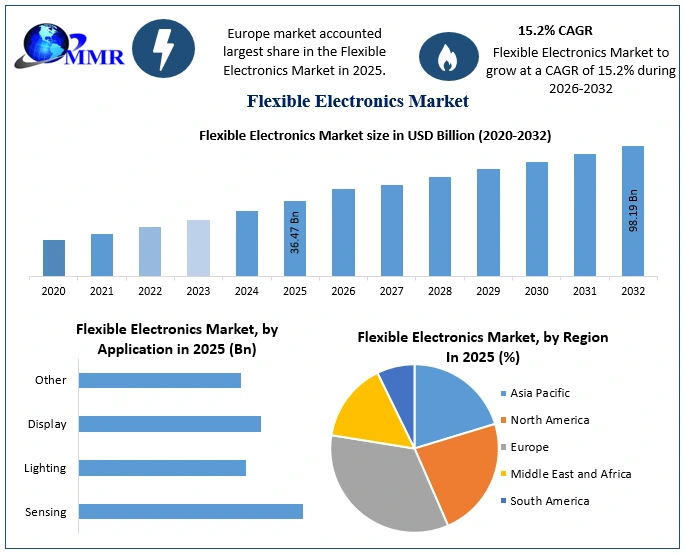
Flexible Electronics Market size was valued at USD 36.47 Bn. in 2025 and the total Flexible Electronics revenue is expected to grow by 15.2% from 2026 to 2032, reaching nearly USD 98.19 Bn.

Flexible Electronics Market Overview:

The global flexible electronics market is experiencing strong growth, driven by increasing demand for lightweight, thin, and bendable electronic devices across consumer electronics, healthcare, automotive, and industrial sectors. Flexible electronics, manufactured on flexible substrates instead of rigid circuit boards, enable innovative applications such as foldable smartphones, wearable devices, flexible displays, smart sensors, and electronic skin. Rising adoption of OLED displays, printed electronics, IoT devices, and wearable healthcare technologies, along with advancements in conductive materials and roll-to-roll manufacturing, is accelerating market expansion.

The market is further supported by growing investments in next-generation consumer electronics, electric vehicles, and smart healthcare solutions. Manufacturers are focusing on developing flexible displays, printed sensors, flexible batteries, and advanced semiconductor technologies to enhance device performance and durability. Although challenges such as high production costs and complex manufacturing processes remain, continuous innovation in materials science and flexible circuit technologies, coupled with increasing demand for compact, energy-efficient, and portable electronic products, is expected to drive sustained growth in the global flexible electronics market.

Flexible Electronics Market GrowthTo know about the Research Methodology :- Request Free Sample Report

Flexible Electronics Market Dynamics:

A major driver of the market growth is that consumer electronics demand is increasing.

Flexible electronics are low-cost, long-lasting, and dependable, and are commonly utilized in cellphones, computers, televisions, laptops, wearable technology, and other consumer electronic products. Flexible screens are used in such gadgets to conserve space, as well as to minimize width and weight. Flexible organic light-emitting diode and flexible OLCD are the two main types of displays often utilized in such applications. The need for flexible electronics is developing in tandem with the desire for consumer electronic gadgets. Despite a drop in smartphone shipping owing to the COVID-19 outbreak, the smartphone market is anticipated to rebound shortly. The high penetration of portable electronic products across industries drives growth in the flexible electronics industry.

Higher Initial Investment costs are a major restraint in the market growth.

When it comes to innovative technologies, price reduction is frequently a driving force behind research and development initiatives. The expense of novel tools and components for flexible electronics innovation, on the other hand, is quite costly. Manufacturers must consequently place a high priority on R&D to produce value that goes beyond cost savings, such as smaller and lighter, more resilient and flexible goods. Material qualities could influence financial decisions in multiple technologies. The introduction of new technologies necessitates the use of precise machinery and qualified employees, which adds to the overall expenditures. As a result, the significant investment required is a hindrance to the flexible electronics market growth.

The key opportunity in the market is that continuous technological advancement is anticipated to generate profitable growth prospects.

Major industry players are extensively spending on R&D to continually develop their goods. In cooperation with Intel, Samsung, for example, reached 300 Gbps on its fifth-generation core. Because of its extremely flexible and adaptable architecture, the businesses intend to offer 5G services more quickly and affordably. Another example would be that Apple received a patent for a foldable smartphone having a flap system that uses moveable flaps to avoid the display from being crumpled or scratched when folded. Through these advancements, big corporations are motivating and challenging one another to capitalize on the advantages of flexible technology. The continual technological advancement in the flexible electronics sector is estimated to create profitable prospects for flexible electronics industry players.

Key Trends in the Global Flexible Electronics Market

  • Growing adoption of foldable and rollable display technologies: The increasing demand for foldable smartphones, tablets, laptops, and rollable televisions is driving innovation in flexible OLED and AMOLED display technologies. Consumer electronics manufacturers are investing heavily in next-generation display solutions to deliver lightweight, durable, and energy-efficient devices.
  • Rising demand for wearable electronics and smart healthcare devices: Flexible electronics are witnessing significant adoption in smartwatches, fitness trackers, electronic skin (e-skin), smart patches, and wearable medical sensors. The growing focus on remote patient monitoring, digital healthcare, and personalized medicine is accelerating the demand for flexible biosensors and printed electronic devices.
  • Increasing integration of printed electronics and IoT technologies: Manufacturers are expanding the use of printed sensors, RFID tags, flexible circuits, and smart labels across industries such as logistics, retail, healthcare, and industrial automation. The rapid growth of the Internet of Things (IoT) ecosystem is further boosting demand for flexible electronic components.
  • Growing investments in flexible batteries and energy harvesting technologies: Companies are developing ultra-thin flexible batteries, printed photovoltaic cells, and energy-harvesting devices to power next-generation wearable electronics, medical devices, and smart sensors. These innovations are improving device portability, efficiency, and operational lifespan.

Flexible Electronics Market Segment Analysis:

By Application,

The Display segment dominated the global flexible electronics market in 2025 and is expected to maintain its leading position throughout the forecast period. The growth of this segment is driven by the increasing adoption of flexible OLED and AMOLED displays in smartphones, tablets, laptops, smartwatches, televisions, and automotive infotainment systems. Leading electronics manufacturers are investing in foldable and rollable display technologies to meet growing consumer demand for lightweight, high-resolution, and energy-efficient devices. The expansion of wearable electronics, digital signage, and augmented and virtual reality (AR/VR) applications is further accelerating demand for flexible display technologies. Continuous advancements in display materials, ultra-thin glass, and printed electronics are also supporting the segment's long-term growth.

Other applications, including flexible sensors, batteries, lighting, photovoltaics, and memory devices, are also witnessing significant growth due to increasing adoption in healthcare monitoring, industrial automation, smart packaging, and Internet of Things (IoT) devices. Growing investments in printed electronics and flexible semiconductor technologies are expected to further expand application areas during the forecast period.

By End User,

The Consumer Electronics segment accounted for the largest share of the global flexible electronics market in 2025, driven by the growing demand for foldable smartphones, wearable devices, tablets, laptops, and smartwatches. Continuous product innovation, rising consumer preference for lightweight and compact electronic devices, and increasing investments in flexible display technologies are supporting market expansion. The widespread adoption of 5G-enabled devices and next-generation OLED displays is further strengthening the segment's growth.

The Healthcare segment is expected to register the fastest growth during the forecast period, supported by the increasing use of flexible sensors, wearable health monitors, smart patches, electronic skin, and medical diagnostic devices. Advancements in printed electronics, flexible biosensors, and smart medical devices are enabling real-time patient monitoring, remote healthcare, and personalized medicine. Furthermore, increasing research in flexible bioelectronics, implantable medical devices, and 3D-printed electronic components is expanding the application of flexible electronics across modern healthcare systems. The Automotive, Industrial, Aerospace & Defense, and Energy sectors are also witnessing rising adoption of flexible electronic components for smart dashboards, advanced sensors, human-machine interfaces (HMIs), and lightweight electronic systems, contributing to the overall growth of the market.

Global Flexible Electronics Market Regional Insights:

Asia-Pacific

Asia-Pacific dominated the global flexible electronics market in 2025 and is expected to maintain its leadership throughout the forecast period. The region's growth is driven by its strong consumer electronics manufacturing base, increasing production of smartphones, wearable devices, and flexible displays, and substantial investments in semiconductor and display technologies. China, South Korea, Japan, and Taiwan are major manufacturing hubs, while India is emerging as a key market due to expanding electronics production, government initiatives supporting domestic manufacturing, and rising demand for smart electronic devices. The presence of leading display and electronics manufacturers further strengthens the region's market position.

North America

North America holds a significant share of the global flexible electronics market, supported by rapid technological innovation, strong research and development activities, and increasing adoption of wearable devices, healthcare technologies, and IoT solutions. The United States leads the regional market owing to growing investments in flexible sensors, printed electronics, smart medical devices, and aerospace applications. Rising demand for advanced consumer electronics and electric vehicles is further driving market growth.

Europe

Europe is witnessing steady growth in the flexible electronics market, driven by increasing adoption in automotive, healthcare, industrial automation, and renewable energy applications. Countries such as Germany, the United Kingdom, France, Italy, and the Netherlands are investing in flexible displays, printed electronics, and smart manufacturing technologies. The region's strong focus on sustainable innovation, Industry 4.0, and electric vehicle development continues to support market expansion.

Middle East & Africa and South America

The Middle East & Africa and South America are expected to experience moderate growth during the forecast period. Increasing digitalization, expanding healthcare infrastructure, rising consumer electronics adoption, and growing investments in smart city projects are supporting market development. Countries such as Brazil, the UAE, Saudi Arabia, and South Africa are gradually increasing the adoption of flexible electronic technologies across healthcare, industrial, and consumer applications, creating new growth opportunities for market participants.

Competitive Landscape – Global Flexible Electronics Market

The global flexible electronics market is highly competitive, with leading electronics manufacturers, semiconductor companies, display technology providers, and material suppliers competing through continuous innovation, strategic partnerships, and production capacity expansion. Companies are investing heavily in flexible OLED and AMOLED displays, printed electronics, flexible sensors, conductive materials, flexible batteries, and next-generation semiconductor technologies to strengthen their market position. The growing demand for foldable smartphones, wearable devices, automotive displays, healthcare sensors, and IoT-enabled electronics is encouraging manufacturers to expand their product portfolios and invest in advanced roll-to-roll manufacturing technologies. In addition, companies are focusing on improving device durability, energy efficiency, and manufacturing scalability while reducing production costs through technological advancements and automation.

Leading market participants, including Samsung Display Co., Ltd., LG Display Co., Ltd., BOE Technology Group Co., Ltd., AUO Corporation, Royole Corporation, E Ink Holdings Inc., Panasonic Holdings Corporation, FlexEnable Limited, Konica Minolta, Inc., and DuPont de Nemours, Inc., are strengthening their competitive positions through research and development, strategic collaborations, and investments in flexible display technologies, advanced materials, and printed electronics. Companies are also expanding manufacturing facilities, developing ultra-thin and foldable display solutions, integrating AI-enabled sensors, and forming partnerships with consumer electronics and automotive manufacturers to accelerate commercialization. Furthermore, increasing investments in sustainable materials, flexible semiconductors, and smart healthcare devices are expected to intensify competition and drive innovation across the global flexible electronics market.

Recent Developments – Global Flexible Electronics Market

June 2025: Samsung Display introduced its next-generation rollable OLED display technologies for consumer electronics and automotive applications, further expanding its flexible display portfolio.
May 2025: LG Display announced advancements in stretchable display technology, improving flexibility, durability, and image quality for wearable devices, automotive interiors, and industrial applications.
April 2025: BOE Technology Group expanded production capacity for flexible AMOLED displays to meet rising global demand from smartphone, tablet, and wearable device manufacturers.
March 2025: DuPont introduced advanced conductive inks and flexible electronic materials designed to enhance the performance and reliability of printed electronics, smart sensors, and wearable devices.
January 2025: Panasonic Holdings Corporation expanded its research and development initiatives focused on flexible printed circuit technologies and advanced electronic materials, supporting the growing demand for next-generation consumer electronics, automotive systems, and industrial IoT applications.

Flexible Electronics Market Scope: Inquire before buying

Flexible Electronics Market
Report Coverage Details
Base Year: 2025 Forecast Period: 2026-2032
Historical Data: 2020 to 2025 Market Size in 2025: USD 36.47 Bn.
Forecast Period 2026 to 2032 CAGR: 15.2% Market Size in 2032: USD 98.19 Bn.
Segments Covered: By Application Sensing
Lighting
Display
Other
By End-User Consumer Electronics
Automotive
Healthcare
Military and Defense
Other
By Vertical Healthcare
Consumer Electronics
Energy & Power
Aerospace
Military
Others

Flexible Electronics Market, by Region

North America (United States, Canada and Mexico)
Europe (UK, France, Germany, Italy, Spain, Sweden, Austria and Rest of Europe)
Asia Pacific (China, South Korea, Japan, India, Australia, Indonesia, Malaysia, Vietnam, Taiwan, Bangladesh, Pakistan and Rest of APAC)
Middle East and Africa (South Africa, GCC, Egypt, Nigeria and Rest of ME&A)
South America (Brazil, Argentina Rest of South America)

Flexible Electronics Market, Key Players:

1. E Ink Holdings Inc.
2. Blue Spark Technologies
3. Samsung Electronics Co. Ltd
4. LG Electronics Inc.
5. OLEDWorks LLC
6. Royole Corporation
7. FlexEnable Ltd
8. PragmatIC Printing Ltd
9. AU Optronics Co. Ltd
10.Imprint Energy Inc.
11.Flex Ltd
12.Flexpoint Sensor Systems Inc.
13.Panasonic Corporation
14.The 3M Company
15.Cymbet Corporation

FAQs:

1. Which is the potential market for Flexible Electronics in terms of the region?
Ans. Europe is the potential market for Flexible Electronics in terms of the region.

2. What are the opportunities for new market entrants?
Ans. The key opportunity in the market is that continuous technological advancement is anticipated to generate profitable growth prospects.

3. What is expected to drive the growth of the Flexible Electronics market in the forecast period?
Ans. A major driver of the market growth is that consumer electronics demand is increasing.

4. What is the projected market size & growth rate of the Flexible Electronics Market?
Ans. Flexible Electronics Market size was valued at USD 36.47 Bn. in 2025 and the total Flexible Electronics revenue is expected to grow by 15.2% from 2026 to 2032, reaching nearly USD 98.19 Bn.

5. What segments are covered in the Flexible Electronics Market report?
Ans. The segments covered are Application, End-User, Vertical and Region.

Table of Contents

1. Flexible Electronics Market Introduction 1.1. Study Assumption and Market Definition 1.2. Scope of the Study 1.3. Executive Summary 2. Global Flexible Electronics Market: Competitive Landscape 2.1. MMR Competition Matrix 2.2. Competitive Landscape 2.3. Key Players Benchmarking 2.3.1. Company Name 2.3.2. Business Segment 2.3.3. End-user Segment 2.3.4. Revenue (2025) 2.3.5. Company Locations 2.4. Leading Flexible Electronics Market Companies, by market capitalization 2.5. Market Structure 2.5.1. Market Leaders 2.5.2. Market Followers 2.5.3. Emerging Players 2.6. Mergers and Acquisitions Details 3. Flexible Electronics Market: Dynamics 3.1. Flexible Electronics Market Trends by Region 3.1.1. North America Flexible Electronics Market Trends 3.1.2. Europe Flexible Electronics Market Trends 3.1.3. Asia Pacific Flexible Electronics Market Trends 3.1.4. Middle East and Africa Flexible Electronics Market Trends 3.1.5. South America Flexible Electronics Market Trends 3.2. Flexible Electronics Market Dynamics by Region 3.2.1. North America 3.2.1.1. North America Flexible Electronics Market Drivers 3.2.1.2. North America Flexible Electronics Market Restraints 3.2.1.3. North America Flexible Electronics Market Opportunities 3.2.1.4. North America Flexible Electronics Market Challenges 3.2.2. Europe 3.2.2.1. Europe Flexible Electronics Market Drivers 3.2.2.2. Europe Flexible Electronics Market Restraints 3.2.2.3. Europe Flexible Electronics Market Opportunities 3.2.2.4. Europe Flexible Electronics Market Challenges 3.2.3. Asia Pacific 3.2.3.1. Asia Pacific Flexible Electronics Market Drivers 3.2.3.2. Asia Pacific Flexible Electronics Market Restraints 3.2.3.3. Asia Pacific Flexible Electronics Market Opportunities 3.2.3.4. Asia Pacific Flexible Electronics Market Challenges 3.2.4. Middle East and Africa 3.2.4.1. Middle East and Africa Flexible Electronics Market Drivers 3.2.4.2. Middle East and Africa Flexible Electronics Market Restraints 3.2.4.3. Middle East and Africa Flexible Electronics Market Opportunities 3.2.4.4. Middle East and Africa Flexible Electronics Market Challenges 3.2.5. South America 3.2.5.1. South America Flexible Electronics Market Drivers 3.2.5.2. South America Flexible Electronics Market Restraints 3.2.5.3. South America Flexible Electronics Market Opportunities 3.2.5.4. South America Flexible Electronics Market Challenges 3.3. PORTER's Five Forces Analysis 3.4. PESTLE Analysis 3.5. Technology Roadmap 3.6. Regulatory Landscape by Region 3.6.1. North America 3.6.2. Europe 3.6.3. Asia Pacific 3.6.4. Middle East and Africa 3.6.5. South America 3.7. Key Opinion Leader Analysis For Flexible Electronics Industry 3.8. Analysis of Government Schemes and Initiatives For Flexible Electronics Industry 3.9. Flexible Electronics Market Trade Analysis 3.10. The Global Pandemic Impact on Flexible Electronics Market 4. Flexible Electronics Market: Global Market Size and Forecast by Segmentation (in USD Billion) 2025-2032 4.1. Flexible Electronics Market Size and Forecast, by Application (2025-2032) 4.1.1. Sensing 4.1.2. Lighting 4.1.3. Display 4.1.4. Other 4.2. Flexible Electronics Market Size and Forecast, by End-User (2025-2032) 4.2.1. Consumer Electronics 4.2.2. Automotive 4.2.3. Healthcare 4.2.4. Military and Defense 4.2.5. Other 4.3. Flexible Electronics Market Size and Forecast, by Vertical (2025-2032) 4.3.1. Healthcare 4.3.2. Consumer Electronics 4.3.3. Energy & Power 4.3.4. Aerospace 4.3.5. Military 4.3.6. Others 4.4. Flexible Electronics Market Size and Forecast, by Region (2025-2032) 4.4.1. North America 4.4.2. Europe 4.4.3. Asia Pacific 4.4.4. Middle East and Africa 4.4.5. South America 5. North America Flexible Electronics Market Size and Forecast by Segmentation (in USD Billion) 2025-2032 5.1. North America Flexible Electronics Market Size and Forecast, by Application (2025-2032) 5.1.1. Sensing 5.1.2. Lighting 5.1.3. Display 5.1.4. Other 5.2. North America Flexible Electronics Market Size and Forecast, by End-User (2025-2032) 5.2.1. Consumer Electronics 5.2.2. Automotive 5.2.3. Healthcare 5.2.4. Military and Defense 5.2.5. Other 5.3. North America Flexible Electronics Market Size and Forecast, by Vertical (2025-2032) 5.3.1. Healthcare 5.3.2. Consumer Electronics 5.3.3. Energy & Power 5.3.4. Aerospace 5.3.5. Military 5.3.6. Others 5.4. North America Flexible Electronics Market Size and Forecast, by Country (2025-2032) 5.4.1. United States 5.4.1.1. United States Flexible Electronics Market Size and Forecast, by Application (2025-2032) 5.4.1.1.1. Sensing 5.4.1.1.2. Lighting 5.4.1.1.3. Display 5.4.1.1.4. Other 5.4.1.2. United States Flexible Electronics Market Size and Forecast, by End-User (2025-2032) 5.4.1.2.1. Consumer Electronics 5.4.1.2.2. Automotive 5.4.1.2.3. Healthcare 5.4.1.2.4. Military and Defense 5.4.1.2.5. Other 5.4.1.3. United States Flexible Electronics Market Size and Forecast, by Vertical (2025-2032) 5.4.1.3.1. Healthcare 5.4.1.3.2. Consumer Electronics 5.4.1.3.3. Energy & Power 5.4.1.3.4. Aerospace 5.4.1.3.5. Military 5.4.1.3.6. Others 5.4.2. Canada 5.4.2.1. Canada Flexible Electronics Market Size and Forecast, by Application (2025-2032) 5.4.2.1.1. Sensing 5.4.2.1.2. Lighting 5.4.2.1.3. Display 5.4.2.1.4. Other 5.4.2.2. Canada Flexible Electronics Market Size and Forecast, by End-User (2025-2032) 5.4.2.2.1. Consumer Electronics 5.4.2.2.2. Automotive 5.4.2.2.3. Healthcare 5.4.2.2.4. Military and Defense 5.4.2.2.5. Other 5.4.2.3. Canada Flexible Electronics Market Size and Forecast, by Vertical (2025-2032) 5.4.2.3.1. Healthcare 5.4.2.3.2. Consumer Electronics 5.4.2.3.3. Energy & Power 5.4.2.3.4. Aerospace 5.4.2.3.5. Military 5.4.2.3.6. Others 5.4.3. Mexico 5.4.3.1. Mexico Flexible Electronics Market Size and Forecast, by Application (2025-2032) 5.4.3.1.1. Sensing 5.4.3.1.2. Lighting 5.4.3.1.3. Display 5.4.3.1.4. Other 5.4.3.2. Mexico Flexible Electronics Market Size and Forecast, by End-User (2025-2032) 5.4.3.2.1. Consumer Electronics 5.4.3.2.2. Automotive 5.4.3.2.3. Healthcare 5.4.3.2.4. Military and Defense 5.4.3.2.5. Other 5.4.3.3. Mexico Flexible Electronics Market Size and Forecast, by Vertical (2025-2032) 5.4.3.3.1. Healthcare 5.4.3.3.2. Consumer Electronics 5.4.3.3.3. Energy & Power 5.4.3.3.4. Aerospace 5.4.3.3.5. Military 5.4.3.3.6. Others 6. Europe Flexible Electronics Market Size and Forecast by Segmentation (in USD Billion) 2025-2032 6.1. Europe Flexible Electronics Market Size and Forecast, by Application (2025-2032) 6.2. Europe Flexible Electronics Market Size and Forecast, by End-User (2025-2032) 6.3. Europe Flexible Electronics Market Size and Forecast, by Vertical (2025-2032) 6.4. Europe Flexible Electronics Market Size and Forecast, by Country (2025-2032) 6.4.1. United Kingdom 6.4.1.1. United Kingdom Flexible Electronics Market Size and Forecast, by Application (2025-2032) 6.4.1.2. United Kingdom Flexible Electronics Market Size and Forecast, by End-User (2025-2032) 6.4.1.3. United Kingdom Flexible Electronics Market Size and Forecast, by Vertical (2025-2032) 6.4.2. France 6.4.2.1. France Flexible Electronics Market Size and Forecast, by Application (2025-2032) 6.4.2.2. France Flexible Electronics Market Size and Forecast, by End-User (2025-2032) 6.4.2.3. France Flexible Electronics Market Size and Forecast, by Vertical (2025-2032) 6.4.3. Germany 6.4.3.1. Germany Flexible Electronics Market Size and Forecast, by Application (2025-2032) 6.4.3.2. Germany Flexible Electronics Market Size and Forecast, by End-User (2025-2032) 6.4.3.3. Germany Flexible Electronics Market Size and Forecast, by Vertical (2025-2032) 6.4.4. Italy 6.4.4.1. Italy Flexible Electronics Market Size and Forecast, by Application (2025-2032) 6.4.4.2. Italy Flexible Electronics Market Size and Forecast, by End-User (2025-2032) 6.4.4.3. Italy Flexible Electronics Market Size and Forecast, by Vertical (2025-2032) 6.4.5. Spain 6.4.5.1. Spain Flexible Electronics Market Size and Forecast, by Application (2025-2032) 6.4.5.2. Spain Flexible Electronics Market Size and Forecast, by End-User (2025-2032) 6.4.5.3. Spain Flexible Electronics Market Size and Forecast, by Vertical (2025-2032) 6.4.6. Sweden 6.4.6.1. Sweden Flexible Electronics Market Size and Forecast, by Application (2025-2032) 6.4.6.2. Sweden Flexible Electronics Market Size and Forecast, by End-User (2025-2032) 6.4.6.3. Sweden Flexible Electronics Market Size and Forecast, by Vertical (2025-2032) 6.4.7. Austria 6.4.7.1. Austria Flexible Electronics Market Size and Forecast, by Application (2025-2032) 6.4.7.2. Austria Flexible Electronics Market Size and Forecast, by End-User (2025-2032) 6.4.7.3. Austria Flexible Electronics Market Size and Forecast, by Vertical (2025-2032) 6.4.8. Rest of Europe 6.4.8.1. Rest of Europe Flexible Electronics Market Size and Forecast, by Application (2025-2032) 6.4.8.2. Rest of Europe Flexible Electronics Market Size and Forecast, by End-User (2025-2032) 6.4.8.3. Rest of Europe Flexible Electronics Market Size and Forecast, by Vertical (2025-2032) 7. Asia Pacific Flexible Electronics Market Size and Forecast by Segmentation (in USD Billion) 2025-2032 7.1. Asia Pacific Flexible Electronics Market Size and Forecast, by Application (2025-2032) 7.2. Asia Pacific Flexible Electronics Market Size and Forecast, by End-User (2025-2032) 7.3. Asia Pacific Flexible Electronics Market Size and Forecast, by Vertical (2025-2032) 7.4. Asia Pacific Flexible Electronics Market Size and Forecast, by Country (2025-2032) 7.4.1. China 7.4.1.1. China Flexible Electronics Market Size and Forecast, by Application (2025-2032) 7.4.1.2. China Flexible Electronics Market Size and Forecast, by End-User (2025-2032) 7.4.1.3. China Flexible Electronics Market Size and Forecast, by Vertical (2025-2032) 7.4.2. S Korea 7.4.2.1. S Korea Flexible Electronics Market Size and Forecast, by Application (2025-2032) 7.4.2.2. S Korea Flexible Electronics Market Size and Forecast, by End-User (2025-2032) 7.4.2.3. S Korea Flexible Electronics Market Size and Forecast, by Vertical (2025-2032) 7.4.3. Japan 7.4.3.1. Japan Flexible Electronics Market Size and Forecast, by Application (2025-2032) 7.4.3.2. Japan Flexible Electronics Market Size and Forecast, by End-User (2025-2032) 7.4.3.3. Japan Flexible Electronics Market Size and Forecast, by Vertical (2025-2032) 7.4.4. India 7.4.4.1. India Flexible Electronics Market Size and Forecast, by Application (2025-2032) 7.4.4.2. India Flexible Electronics Market Size and Forecast, by End-User (2025-2032) 7.4.4.3. India Flexible Electronics Market Size and Forecast, by Vertical (2025-2032) 7.4.5. Australia 7.4.5.1. Australia Flexible Electronics Market Size and Forecast, by Application (2025-2032) 7.4.5.2. Australia Flexible Electronics Market Size and Forecast, by End-User (2025-2032) 7.4.5.3. Australia Flexible Electronics Market Size and Forecast, by Vertical (2025-2032) 7.4.6. Indonesia 7.4.6.1. Indonesia Flexible Electronics Market Size and Forecast, by Application (2025-2032) 7.4.6.2. Indonesia Flexible Electronics Market Size and Forecast, by End-User (2025-2032) 7.4.6.3. Indonesia Flexible Electronics Market Size and Forecast, by Vertical (2025-2032) 7.4.7. Malaysia 7.4.7.1. Malaysia Flexible Electronics Market Size and Forecast, by Application (2025-2032) 7.4.7.2. Malaysia Flexible Electronics Market Size and Forecast, by End-User (2025-2032) 7.4.7.3. Malaysia Flexible Electronics Market Size and Forecast, by Vertical (2025-2032) 7.4.8. Vietnam 7.4.8.1. Vietnam Flexible Electronics Market Size and Forecast, by Application (2025-2032) 7.4.8.2. Vietnam Flexible Electronics Market Size and Forecast, by End-User (2025-2032) 7.4.8.3. Vietnam Flexible Electronics Market Size and Forecast, by Vertical (2025-2032) 7.4.9. Taiwan 7.4.9.1. Taiwan Flexible Electronics Market Size and Forecast, by Application (2025-2032) 7.4.9.2. Taiwan Flexible Electronics Market Size and Forecast, by End-User (2025-2032) 7.4.9.3. Taiwan Flexible Electronics Market Size and Forecast, by Vertical (2025-2032) 7.4.10. Rest of Asia Pacific 7.4.10.1. Rest of Asia Pacific Flexible Electronics Market Size and Forecast, by Application (2025-2032) 7.4.10.2. Rest of Asia Pacific Flexible Electronics Market Size and Forecast, by End-User (2025-2032) 7.4.10.3. Rest of Asia Pacific Flexible Electronics Market Size and Forecast, by Vertical (2025-2032) 8. Middle East and Africa Flexible Electronics Market Size and Forecast by Segmentation (in USD Billion) 2025-2032 8.1. Middle East and Africa Flexible Electronics Market Size and Forecast, by Application (2025-2032) 8.2. Middle East and Africa Flexible Electronics Market Size and Forecast, by End-User (2025-2032) 8.3. Middle East and Africa Flexible Electronics Market Size and Forecast, by Vertical (2025-2032) 8.4. Middle East and Africa Flexible Electronics Market Size and Forecast, by Country (2025-2032) 8.4.1. South Africa 8.4.1.1. South Africa Flexible Electronics Market Size and Forecast, by Application (2025-2032) 8.4.1.2. South Africa Flexible Electronics Market Size and Forecast, by End-User (2025-2032) 8.4.1.3. South Africa Flexible Electronics Market Size and Forecast, by Vertical (2025-2032) 8.4.2. GCC 8.4.2.1. GCC Flexible Electronics Market Size and Forecast, by Application (2025-2032) 8.4.2.2. GCC Flexible Electronics Market Size and Forecast, by End-User (2025-2032) 8.4.2.3. GCC Flexible Electronics Market Size and Forecast, by Vertical (2025-2032) 8.4.3. Nigeria 8.4.3.1. Nigeria Flexible Electronics Market Size and Forecast, by Application (2025-2032) 8.4.3.2. Nigeria Flexible Electronics Market Size and Forecast, by End-User (2025-2032) 8.4.3.3. Nigeria Flexible Electronics Market Size and Forecast, by Vertical (2025-2032) 8.4.4. Rest of ME&A 8.4.4.1. Rest of ME&A Flexible Electronics Market Size and Forecast, by Application (2025-2032) 8.4.4.2. Rest of ME&A Flexible Electronics Market Size and Forecast, by End-User (2025-2032) 8.4.4.3. Rest of ME&A Flexible Electronics Market Size and Forecast, by Vertical (2025-2032) 9. South America Flexible Electronics Market Size and Forecast by Segmentation (in USD Billion) 2025-2032 9.1. South America Flexible Electronics Market Size and Forecast, by Application (2025-2032) 9.2. South America Flexible Electronics Market Size and Forecast, by End-User (2025-2032) 9.3. South America Flexible Electronics Market Size and Forecast, by Vertical (2025-2032) 9.4. South America Flexible Electronics Market Size and Forecast, by Country (2025-2032) 9.4.1. Brazil 9.4.1.1. Brazil Flexible Electronics Market Size and Forecast, by Application (2025-2032) 9.4.1.2. Brazil Flexible Electronics Market Size and Forecast, by End-User (2025-2032) 9.4.1.3. Brazil Flexible Electronics Market Size and Forecast, by Vertical (2025-2032) 9.4.2. Argentina 9.4.2.1. Argentina Flexible Electronics Market Size and Forecast, by Application (2025-2032) 9.4.2.2. Argentina Flexible Electronics Market Size and Forecast, by End-User (2025-2032) 9.4.2.3. Argentina Flexible Electronics Market Size and Forecast, by Vertical (2025-2032) 9.4.3. Rest Of South America 9.4.3.1. Rest Of South America Flexible Electronics Market Size and Forecast, by Application (2025-2032) 9.4.3.2. Rest Of South America Flexible Electronics Market Size and Forecast, by End-User (2025-2032) 9.4.3.3. Rest Of South America Flexible Electronics Market Size and Forecast, by Vertical (2025-2032) 10. Company Profile: Key Players 10.1. E Ink Holdings Inc. 10.1.1. Company Overview 10.1.2. Business Portfolio 10.1.3. Financial Overview 10.1.4. SWOT Analysis 10.1.5. Strategic Analysis 10.1.6. Scale of Operation (small, medium, and large) 10.1.7. Details on Partnership 10.1.8. Regulatory Accreditations and Certifications Received by Them 10.1.9. Awards Received by the Firm 10.1.10. Recent Developments 10.2. Blue Spark Technologies 10.3. Samsung Electronics Co. Ltd 10.4. LG Electronics Inc. 10.5. OLEDWorks LLC 10.6. Royole Corporation 10.7. FlexEnable Ltd 10.8. PragmatIC Printing Ltd 10.9. AU Optronics Co. Ltd 10.10. Imprint Energy Inc. 10.11. Flex Ltd 10.12. Flexpoint Sensor Systems Inc. 10.13. Panasonic Corporation 10.14. The 3M Company 10.15. Cymbet Corporation 11. Key Findings 12. Industry Recommendations 13. Flexible Electronics Market: Research Methodology 14. Terms and Glossary

Custom Market Research Services

We Will Customise The Research For You, In Case The Report Listed Above Does Not Meet With Your Requirements