
Broadcast Cameras Markett– Industry Structure Evaluation, Demand Drivers Analysis, Regional Growth Analysis and Identification, Competitive Positioning Review & Global Market Size Forecast to 2032
Overview
Broadcast Cameras Market was valued at USD 2.49 billion in 2025, and is expected to grow at a CAGR of 3.7 % from 2025 to 2032, reaching nearly USD 3.21 billion in 2032
Broadcast Cameras Market Overview
The Broadcast cameras are high-resolution professional-grade video recording devices used for live events, television studios, newsrooms, film production, and OTT platforms. These cameras feature advanced capabilities such as 4K/8K resolution, IP streaming, HDR, wide color gamut (WCG), and PTZ automation, enabling superior image quality and dynamic content creation.
Rising demand for UHD content across TV, film, and digital streaming platforms, along with innovations in camera sensors, lenses, and image processing technologies. AI and machine learning integration are increasingly vital for real-time editing, image stabilization, and intelligent camera functions. Live production is the leading segment, driven by OTT content demand and live sports coverage. In 2024, North America dominated the Broadcast Cameras Market due to its advanced broadcast infrastructure, widespread adoption of ultra-HD workflows, and growing use of AI-powered PTZ systems in live sports and entertainment. Asia-Pacific, especially China and India, the market growth through media and entertainment infrastructure investments. Leading players such as Sony, Canon, Panasonic, and ARRI dominate through R&D investments, diverse product portfolios, and strategic alliances.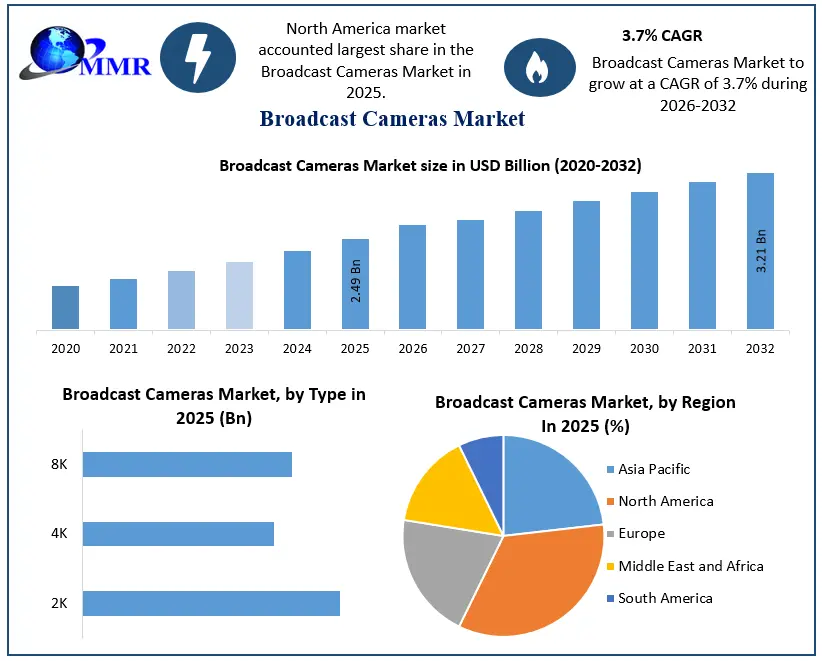 To know about the Research Methodology :- Request Free Sample Report
Broadcast Cameras Market Dynamics
Rising Sports Events and Digital Platforms to Drive the Broadcast Cameras Market Growth
Over 290 major sports events held annually, spanning more than 65 sports disciplines including high-profile competitions such as the Olympics, FIFA World Cup, Grand Slam tennis tournaments, Formula 1, and continental championships the demand for advanced broadcasting equipment is steadily rising. These events attract massive global audiences, boosting the need for high-quality motion picture capture through professional broadcasting and cinematography cameras equipped with specialized lenses and high-density sensors.
The rapid adoption of digital entertainment platforms and the availability of faster internet connectivity offer consumers greater flexibility in accessing diverse media content anytime and anywhere. This shift towards digital consumption such as boosts demand for superior broadcasting technologies to deliver seamless, high-definition sports coverage. The convergence of expanding sports calendars and growing digital media consumption creates a robust market environment, driving innovation and investment in advanced broadcasting cameras to meet evolving industry and consumer needs. There are over 290 major sports events held globally each year, spanning more than 65 sports disciplines and including high-profile competitions such as the Olympics, FIFA World Cup, major tennis and golf championships, motorsport series, and continental tournaments. The increasing number of global sports events is a significant drive the growth of the Broadcast Cameras Market growth.
The high cost and weight of Professional Broadcasting Cameras to limits the Broadcast Cameras Market Growth
TAdvanced 4K and 8K cameras, along with compatible lenses and supporting infrastructure, often require investments running into tens of thousands of dollars per unit. This significant upfront expense limits adoption, especially among smaller broadcasters, independent producers, and regional event organizers for more affordable consumer or semi-professional cameras, or even smartphones, to stay within budget.The heavy weight of professional cameras, largely due to their large lenses and high-performance sensors, poses logistical challenges for live event coverage requiring mobility, such as outdoor sports tournaments. Transporting and setting up these bulky devices are difficult, sometimes forcing organizers to rely on lighter but less capable alternatives or reduce the number of cameras used.
Rapid technological advancements contribute to frequent obsolescence, compelling broadcasters to undertake costly upgrades to keep pace with evolving content quality demands, such as transitioning from HD to 4K/8K. Moreover, the growing quality of cheaper consumer-grade cameras intensifies competitive pressure, especially for budget-constrained events. These factors hinder the broader adoption of high-end broadcasting cameras, impacting the overall growth of Broadcast Cameras Market.
Increased Usage of 3D Cameras to Create Opportunity in the Broadcast Cameras Market Growth
The growing adoption of 3D cameras creates new and exciting opportunities in the Broadcast Cameras Market, thanks to increasing demand for immersive and high-quality content. In live sports and entertainment, broadcasters employ 3D camera systems to deliver multi-angle replays and enriched graphics, creating a more immersive and engaging viewing experience. This attracts bigger audiences and helps increase advertising revenue. With virtual reality (VR) and augmented reality (AR) gaining popularity, many TV networks and streaming platforms are using 3D cameras to create VR-ready broadcasts, such as virtual concerts and sports events. These applications rely on the advanced depth perception and spatial mapping that only 3D cameras provide.
Production houses is important factor driving demand. As more movies, TV shows, and short films are being made, many are using 3D cameras to add depth and realism to their visuals, making content more captivating for viewers.3D cameras are being used for remote event production, allowing concerts and conferences to be broadcast live in a way that makes viewers feel like they’re really there. On the industrial side, AI-powered 3D cameras help automate camera control and motion tracking, making live broadcasts more efficient. Because of all these applications, the 3D camera market is expected to grow rapidly, driving the broader growth of the Broadcast Cameras Market.
Broadcast Cameras Market Segment Analysis
Based on Type, the Broadcast Cameras Market is segmented into 2K, 4K, 8K, and Others. The 4K segment has dominated the largest market share accounting in 2024. Due to its superior image quality and growing industry adoption. Offering four times the resolution of 2K cameras, 4K technology delivers exceptionally sharp and detailed visuals, essential for modern broadcast standards. This high resolution enhances viewer experience across live sports, entertainment, and news broadcasting, driving strong demand from broadcasters aiming to meet audience expectations.
Technological advancements have made 4K cameras more affordable and accessible, encouraging widespread usage. Also, increasing content consumption on large-screen TVs and streaming platforms favors 4K resolution, which ensures clear and immersive visuals. Broadcasters are investing heavily in 4K infrastructure to stay competitive, as 8K remains costly and less established. The balance between quality and cost-effectiveness makes 4K the preferred choice for many broadcasters globally. The supportive government policies and industry regulations promoting high-definition broadcasting further fuel the 4K segment’s leading market share.
Based on Application, the Broadcast Cameras Market has segmented into Cinematography, Live Production, News and Broadcast Production, Others. Live production dominated the application segment in the broadcast cameras market in 2024. Due to the rising demand for real-time content across sports, concerts, and events. Live broadcasts require cameras that deliver high-quality, reliable, and low-latency video feeds to engage audiences instantly. Broadcasters are increasingly investing in advanced camera systems that support multi-angle coverage, slow-motion replays, and augmented reality to enhance viewer experience during live events.
The surge in digital streaming platforms and social media live content has further accelerated the adoption of live production cameras. These platforms prioritize immediacy and immersive experiences, pushing broadcasters to upgrade their equipment. Additionally, the growth of eSports and virtual events has expanded the live production market significantly. Technological innovations such as IP-based workflows and wireless camera solutions have made live production more flexible and scalable, appealing to content creators. The combination of growing live content demand, technological advancements, and audience engagement needs drives the dominance of live production in the broadcast cameras market.
Broadcast Cameras Market Recent Developments:
| Date | Company | Development | Impact |
|---|---|---|---|
| 13 April 2026 | Blackmagic Design | The company introduced the Blackmagic URSA Cine Immersive 100G, the world’s first immersive cinema camera custom-designed for live multi-camera production with Apple Immersive Video ecosystems. | The system utilizes integrated 100G Ethernet workflows and dual 8Kx8K sensors to achieve real-time, high-frame-rate streaming of live stereoscopic content for massive-scale sports broadcasting and live concerts. |
| 16 April 2026 | Sony Electronics | The company announced the upcoming launch of its new R Series system cameras, comprising the HDC-5500R, HDC-5500RV, HDC-3500R, HDC-3500RV, and HDC-3200R models. | Equipped with a 2/3-inch three-chip 4K CMOS sensor and global shutter, the range enables ultra-high dynamic ranges and eliminates rolling shutter distortion during live multi-format outdoor sports and event broadcasts. |
| 24 April 2026 | Grass Valley | The company unveiled two next-generation broadcast cameras at the NAB 2026 exhibition: the triple-speed LDX 110 camera system and the highly compact LDX C180 system camera. | The product launches deliver affordable 3x speed UHD slow-motion captures for mid-to-lower tier sports markets, while the small form factor of the C180 allows production crews to place cinematic-grade hardware much closer to live action. |
Broadcast Cameras Market Regional Analysis
North America dominates the Broadcast Cameras Market in 2025. Due to the technological adoption, strong industry presence, and robust infrastructure investments the region remain forefront. The United States, hosts leading broadcasters such as ESPN, NBC, CBS, and FOX, who continuously upgrade their camera equipment to deliver high-quality sports, news, and entertainment content. This drives substantial demand for advanced cameras supporting HD, 4K, and 8K resolutions.
Technological leadership is another key factor. North American broadcasters were pioneers in deploying cutting-edge innovations such as 8K cameras, HDR imaging, AI-enabled and remote-controlled camera systems. These advancements set global market trends and attract high-volume purchases. Also, significant investments from the government and private sectors in digital broadcast infrastructure enable seamless deployment of high-tech cameras and support real-time streaming nationwide.
The region’s massive content production ecosystem, with the U.S. media and entertainment sector generating over $800 billion annually, sustains continuous demand for state-of-the-art broadcast technology. High-profile events such as the Super Bowl showcase extensive use of 4K and 8K cameras, establishing North America as a global benchmark in live sports coverage. The rapid growth of OTT platforms and live streaming services fuels the need for premium content, further increasing camera demand. Efficient supply chains, strong technical support, and consumer expectations for superior visuals consolidate North America’s dominant position in the broadcast cameras market.
Broadcast Cameras Market Competitive Landscape
The Broadcast Cameras Market is driven by established industry leaders and innovative niche players, driven by rapid technological advancements and diverse application needs. Major companies such as Sony Corporation, Panasonic Corporation, Canon Inc., ARRI AG, Blackmagic Design, Red Digital Cinema, Grass Valley, Hitachi Kokusai Electric, JVCKENWOOD, and Ikegami Tsushinki dominate the market.
The leaders focus on distinct segments including high-end cinematography is led by ARRI, Red Digital Cinema, and Sony’s CineAlta series; live production and broadcast are spearheaded by Sony, Panasonic, and Hitachi; while mid-range and prosumer markets see innovation from Blackmagic Design and AJA Video Systems offering affordable, feature-rich solutions. Key products include Sony’s FX9 6K camera, Canon’s EOS C500 Mark II with 4K HDR, ARRI Alexa LF for premium film and TV, and Blackmagic URSA Broadcast, popular among independent producers. Innovation in 4K/8K resolution, HDR, AI integration, and workflow efficiency fuels intense competition.
Broadcast Cameras Market Key Trends
| Key Trends | Market Implication |
| Shift to 4K & 8K Ultra HD | Broadcasters are upgrading to 4K and 8K cameras to deliver higher resolution and improved viewing experiences, especially for sports and live events. |
| Rise of IP-based Broadcasting | Adoption of IP-enabled cameras for seamless integration with cloud workflows, enabling remote production and cost-efficient content delivery. |
| Growth in Remote & Cloud Production | Increasing use of remote production (REMI) and cloud-based editing tools reduces on-site crew requirements and speeds up content delivery. |
| Demand for High Frame Rate (HFR) & Slow Motion | Sports and live entertainment broadcasting is driving demand for HFR cameras capable of capturing detailed slow-motion replays. |
| Adoption of PTZ & Robotic Cameras | Automated camera systems are being used in studios and live events to reduce manpower and enhance operational efficiency. |
Broadcast Cameras Market Scope: Inquiry Before Buying
| Broadcast Cameras Market | |||
|---|---|---|---|
| Report Coverage | Details | ||
| Base Year: | 2025 | Forecast Period: | 2026-2032 |
| Historical Data: | 2020 to 2025 | Market Size in 2025: | USD 2.49 Bn. |
| Forecast Period 2025 to 2032 CAGR: | 3.7% | Market Size in 2032: | USD 3.21 Bn. |
| Segments Covered: | by Type | 2K 4K 8K |
|
| by Camera Type | System Cameras Camcorders Ptz Cameras |
||
| by Sensor | CCD (Charge-Coupled Device) CMOS (Complementary Metal-Oxide-Semiconductor) |
||
| by Application | Cinematography Live Production News And Broadcast Production Others |
||
Broadcast Cameras Market, By Region
North America (United States, Canada, Mexico)
Europe (United Kingdom, France, Germany, Italy, Spain, Sweden, Russia, Rest of Europe)
Asia Pacific (China, South Korea, Japan, India, Australia, Indonesia, Malaysia, Philippines, Thailand, Vietnam, Rest of Asia Pacific)
Middle East and Africa (MEA) (South Africa, GCC, Nigeria, Rest of MEA)
South America (Brazil, Argentina, Colombia, Chile, Rest of South America)
Broadcast Cameras Market key players
North America
1. Grass Valley (Montreal, Canada)
2. Blackmagic Design USA (Fremont, USA)
3. RED Digital Cinema (Irvine, USA)
4. Ross Video (Ottawa, Canada)
5. AJA Video Systems (Grass Valley, USA)
6. LiveU (Hackensack, USA)
7. Core SWX (Plainview, USA)
8. PTZOptics (Downingtown, USA)
Europe
1. ARRI (Munich, Germany)
2. Ikegami Europe (Neuss, Germany)
3. FOR-A Europe (London, UK)
4. Bright Tangerine (Hampshire, UK)
5. Decimator Europe (London, UK)
6. EVS Broadcast Equipment (Liège, Belgium)
Asia Pacific
1. Sony Corporation (Tokyo, Japan)
2. Panasonic Corporation (Osaka, Japan)
3. Canon Inc. (Tokyo, Japan)
4. Hitachi Kokusai Electric (Tokyo, Japan)
5. Ikegami Tsushinki (Tokyo, Japan)
6. JVC Kenwood (Yokohama, Japan)
7. Kinefinity (Beijing, China)
8. Z CAM (Shenzhen, China)
9. DJI (Shenzhen, China)
10. BirdDog APAC (Melbourne, Australia)
Middle East and Africa
1. Vision Research – Phantom Cameras (Wayne, USA)
2. Telemetrics (Allendale, USA)
Frequently Asked Questions
1. Which region has the largest share in Global Broadcast Cameras Market?
Ans: North America region held the highest share in 2025.
2. What is the growth rate of Global Broadcast Cameras Market?
Ans: The Global Broadcast Cameras Market is growing at a CAGR of 3.7 % during forecasting period 2026-2032.
3. What is scope of the Global Broadcast Cameras Market report?
Ans: Global Broadcast Cameras Market report helps with the PESTEL, PORTER, Recommendations for Investors & Leaders, and market estimation of the forecast period.
4. Who are the key players in Global Broadcast Cameras Market?
Ans: The important key players in the Global Broadcast Cameras Market are – ARRI, Sony Corp, Panasonic Corp, Grass Valley USA LLC, Hitachi Ltd, Blackmagic Design Pty. Ltd, Canon Inc, JVC Kenwood, and Others.