
EV Test Equipment Market Size by Vehicle Type, Equipment Type, Vehicle Top Speed, Vehicle Class, Type, Region – Revenue Pool Analysis, Margin Structure Assessment, Capital Flow Trends, Competitive Benchmarking & Forecast to 2030
Overview
EV Test Equipment Market size was valued at US$ 63.63 Mn. in 2023 and the total revenue is expected to grow at 24.9% of CAGR from 2024 to 2030, reaching US$ 301.74 Mn.
EV Test Equipment Market Overview:
The EV test equipment is used to inspect various EV components such as batteries, motors, and other components to stay ahead of the competition, provide guaranteed performance, and ensure customer safety and satisfaction. To evaluate the overall performance of electric cars, test equipment is utilized for EV battery and charger evaluations, power electronics evaluations, and motor and dynamometer evaluations. Sensors, voltage probes, and other software are used in motor testing equipment to evaluate torque or electric signal as well as the high speed of an electric automobile.
Increased demand for alternative fuel vehicles and connected mobility has boosted sales of electric cars. Almost all the countries covered in the report have introduced regulations that promote the usage of electric vehicles in an effort to reduce automotive emissions and pollution, the report has covered the details legal aspects in each country that will give the insights about the legal aspect helping the EV Test Market.
Increasing demand for EV is driving the EV test equipment market and demand by country and segment is analysed in the report to estimate the market in forecastequipment period for EV test equipment. Additionally, faster charging is made possible by greater voltages, which has led to the development of high-performance batteries, drivetrains, and chargers. As a result, the development of new battery technologies, rising consumer demand for electronic features and functionalities in cars, and stricter pollution regulations all contribute to the demand for EV test tools and software.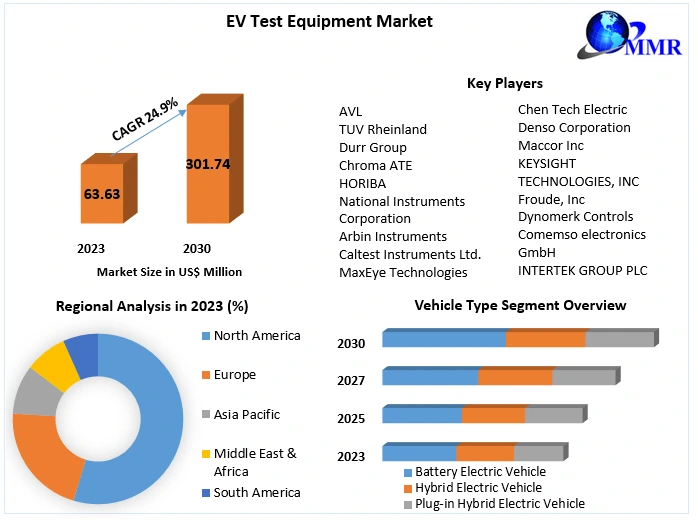 To know about the Research Methodology :- Request Free Sample Report
EV Test Equipment Market Dynamics:
Government regulations to drive the electric equipment market growth
Hybrid and electric vehicles are environmentally beneficial and fuel-efficient, thus governments all over the world are encouraging their use of the same. The development of fuel-efficient technology is being pushed by emission standards that are being adopted by national and regional government agencies. Technology improvements in EV test equipment have accelerated recently and the report has covered the technological development and investment by key players by key countries that will give understanding of the future course of EV test equipment industry.
Companies from UK, Japan and USA are investing in vehicle testing equipment technology and investment by companies are analyzed in the report with its impact on top line of the companies in forecast period. Manufacturers are putting a lot of effort into creating technically advanced and effective test equipment. Modern chassis dynamometers are distinguished by their modular designs. They provide improved performance, which lowers the cost of installation and maintenance. Additionally, these dynamometers can test cars for compliance with Indian emission standards, European Emission Standards (EEC), and US Environmental Protection Agency (EPA) emission laws. The advanced chassis dynamometer may be used for a number of automotive testing procedures, including NVH (noise, vibration, and harshness) testing, performance testing, and emission testing. The market is expected to increase as a result of such testing equipment improvements
Battery test equipment enhance the safety and performance of the electric vehicle
Battery test system (BTS) is used for electric vehicle testing. The system's customization, automation, and data linkage across the whole battery test workflow are designed to help Tier 1 suppliers and automakers adapt to the complexity and size of EV battery testing in order to protect the performance and shorten the time to market.
Batteries are at the center of the transition to electrification and directly affect the performance, safety, sustainability, and, ultimately, customer acceptance of EVs. Engineering resources are, however, put under a tremendous amount of stress during EV battery testing since design and test groups must constantly update and adapt to new test requirements.
"Automakers are investing extensively to complete the requirements for EV manufacturers, which has increased the significance of testing to make sure this technology fits both time commitments and consumer expectations for safety. With the recent acquisition of NH Research Inc. (NHR), Heinzinger Automotive GmbH, and Kratzer Automation, Global Securities' (NI) global capabilities for EV battery test offer automakers a cross-functional, scalable network of products, services, and solutions to satisfy the needs of the current and future EV market. In order to bring modern software engineering tools and practices into battery testing, NI's SystemLinkTM software, BTS software, and data analytics tools collaborate to ensure traceability of test results, repeatability of the tests themselves, and management of the entire test-cell and test lab operation.
High cost and high maintenance costs restrain the market growth
The automotive industry faces high-cost reduction and maintenance issues. Advanced EV test equipment used for electric, or hybrid vehicle testing is more expensive than conventional test equipment. New technologies require time to be adopted, just as manufacturers require time to realize economies of scale. Entry-level passenger cars are in high demand in emerging economies, and automakers must offer their products at competitive prices. As a result, costly test equipment can be a deterrent. There is always a trade-off between the cost of product innovation and cost savings in traditional products. As a result, the challenge is to create EV test equipment that is both efficient and cost-effective.
EV Test Equipment Market Segment Analysis:
By Vehicle Type, the battery electric vehicle market segment held largest share in the global market in 2021. The performance and activity of a battery are examined using battery testing equipment. The battery's energy storage capacity is analysed, and the module and battery pack's temperature, heat, and other characteristics are tested. It is also used to check the battery's charge and discharge.
Numerous positive aspects, including growing demands from the automotive industry, the growing energy and power sector, and an increase in battery safety requirements, are contributing to the growth of the battery testing equipment market. An electric battery's condition is tested using battery testing equipment, which ranges from simple devices for checking the charge present in the cells and/or its voltage output to more thorough tests of the battery's condition, including its capacity for accumulating charge and any potential flaws affecting the battery's performance and security. It monitors, tracks, and controls the battery system's life cycle and provides users with information on voltage, impedance, and storage capacity.
Due to their special qualities and benefits, lithium-ion batteries have recently experienced a substantial rise in demand. As lithium-ion batteries become more affordable and energy-dense, the industry has seen phenomenal growth. Due to their portability and simplicity of usage in a wide range of applications, they are the next trend in the global battery market. The potential of new industries, including electric cars, consumer electronics, and energy storage systems for renewable sources, must be unlocked through the use of rechargeable technology.
The battery sector had an increase in investments and acquisitions in the region of USD 13.7 billion. The significant investments of top companies indicate the global demand for battery testing equipment. For instance, Tesla and Panasonic renewed their supply agreement in January 2021 as a result of the explosive growth in EV sales. Additionally, to hasten the company's transition to renewable energy, Total purchased the French battery producer Saft Group in 2017. These expenditures are a result of the quickly expanding market for battery testing equipment, which is expected to develop significantly in the upcoming years.
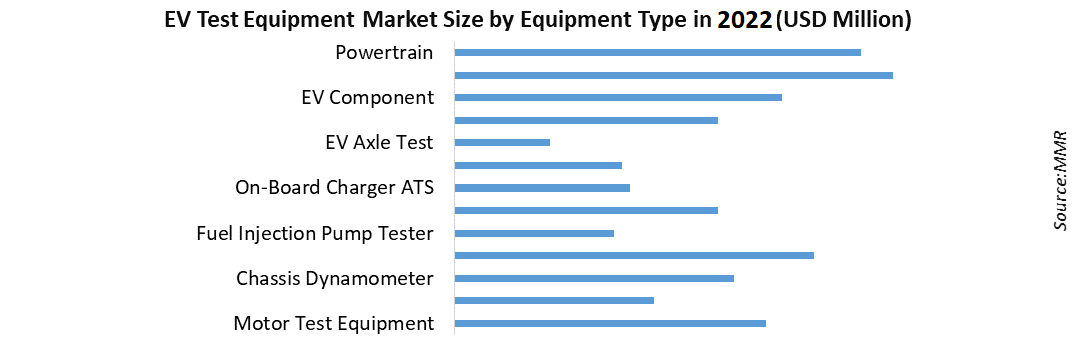
By equipment type, based on equipment EV charging segment held xx% of CAGR in 2021. In the field of EV charging, various ground-breaking innovations have occurred. For instance, a Level 3 or Level 4 charger can fully charge a car in about an hour, allowing it to go more than 200 kilometers. The most recent improvements in EV charging-related test equipment are onboard chargers and AC/DC EVSE ATS. While the on-board charger offers to test for measures such as current, voltage, temperature, speed, and mileage, the AC/DC EVSE ATS offers testing for metrics such as galvanic isolation, a broad variety of input and output voltages, and adjustable technical implementation.
The risk of electric shock to customers increases when EVSE charging connections are damaged with high usage. Utilize the GFCI trip test to protect yourself from electric shock and to monitor the risk. By looking for ground faults, this function confirms that the breaker for the EVSE is connected. The PE grounding protection pre-test also confirms that there isn't any hazardous voltage present at the ground connection.
 e- simulation, According to SAE J1772, an error "E" is a condition that occurs when a charging station is disconnected from the vehicle, disconnected from the utility, loses utility power, or has a short control pilot reference (ground). This error simulation checks the station to make sure that the station and utility will not provide a charge to the car if there is a problem with the CP of the vehicle.
Ground Error, the ground wire is interrupted simulated by the Ground Error button. The pending charge procedure is thereby terminated, and further charging operations are avoided. With the right test and measurement tools, the adapter may also be used for more complex tests including insulation resistance, power quality, a study of the control pilot waveform, and loop impedance. The report covers all detailed analyses of EV charring errors and test equipment methods.
EV Test Equipment Market Regional Insights:
based on region Asia pacific region accounts largest market share in 2021. One of the most important factors influencing the expansion of the region is the enormous population of countries like China and India, which together make up more than 38% of the world's population. Additionally, a number of attractive policy measures taken in these regions to resuscitate the automotive industry which was seriously impacted by the COVID-19 pandemic are expected to boost the expansion of the EV test equipment market. The high use of electric cars will also be fueled by increasing growth and the creation of smart cities, propelling the growth of the market for EV test equipment market.
Governments in the Asia-Pacific region are also putting a lot of effort into the deployment of electric commercial vehicles. For instance, the government of India announced the deployment of 10,000 electric buses and offered incentives for battery-powered vehicles, including two-wheelers and cars, to be used on Indian roadways. As part of its goals to cut oil imports while moving to EVs, the Indian government announced plans to provide incentives of USD 4.6 billion to businesses developing advanced battery production facilities in September 2020.
Similar actions were taken in China, including the exemption of sales taxes, preferential financing, and traffic control measures. Japan has also taken steps, such as raising subsidies for EV consumers, to meet its goal of growing its percentage of EVs and plug-in hybrids to between 20% and 30% by 2030. With the goal of having 430,000 EVs on the road by the end of 2022, the South Korean government has been promoting the use of EVs through subsidies and tax refunds and has also invested in a program to upgrade the nation's charging infrastructure. This has resulted in the Asia Pacific area having a significant need for EV testing equipment. Several US, German, and Chinese businesses that offer testing tools and services to electric car manufacturers dominate the market for EV test equipment in the area. These elements are expected to drive the market in the Asia pacific region
The objective of the report is to present a comprehensive analysis of the EV Test Equipment Market to the stakeholders in the industry. The past and current status of the industry with the forecasted market size and trends are presented in the report with the analysis of complicated data in simple language. The report covers all the aspects of the industry with a dedicated study of key players that include market leaders, followers, and new entrants.
EV Test Equipment Market Scope: Inquire before buying
| EV Test Equipment Market | |||
|---|---|---|---|
| Report Coverage | Details | ||
| Base Year: | 2023 | Forecast Period: | 2024-2030 |
| Historical Data: | 2018 to 2023 | Market Size in 2023: | US $ 63.63 Mn. |
| Forecast Period 2024 to 2030 CAGR: | 24.9% | Market Size in 2030: | US $ 301.74 Mn. |
| Segments Covered: | by Vehicle Type | Battery Electric Vehicle Hybrid Electric Vehicle Plug-in Hybrid Electric Vehicle |
|
| by Equipment Type | AC/DC EVSE ATS Battery Test Equipment Motor Test Equipment Engine Dynamometer Chassis Dynamometer Transmission Dynamometer Fuel Injection Pump Tester Inverter Test On-Board Charger ATS Propulsion test System Axle Test Drivetrain Test Component EV Charging Powertrain |
||
| by Vehicle Top Speed | Less Than 100 MPH 100 to 125 MPH More Than 125 MPH |
||
| by Vehicle Class | Mid-priced Luxury |
||
| by Type | Passenger Car Commercial Vehicle |
||
EV Test Equipment Market, by Region
North America (United States, Canada and Mexico)
Europe (UK, France, Germany, Italy, Spain, Sweden, Austria and Rest of Europe)
Asia Pacific (China, South Korea, Japan, India, Australia, Indonesia, Malaysia, Vietnam, Taiwan, Bangladesh, Pakistan and Rest of APAC)
Middle East and Africa (South Africa, GCC, Egypt, Nigeria and Rest of ME&A)
South America (Brazil, Argentina Rest of South America)
Key Players
1. AVL
2. TUV Rheinland
3. Durr Group
4. Chroma ATE
5. HORIBA
6. National Instruments Corporation
7. Arbin Instruments
8. Caltest Instruments Ltd.
9. MaxEye Technologies
10.DEKRA Technologies
11.Chen Tech Electric
12.Denso Corporation
13.Maccor Inc
14.KEYSIGHT TECHNOLOGIES, INC
15.Froude, Inc
16.Dynomerk Controls
17.Comemso electronics GmbH
18.INTERTEK GROUP PLC
19.TOYO SYSTEM CO., LTD
20.WONIK PNE CO., LTD
Frequently Asked Questions:
1. What is the forecast period considered for the EV Test Equipment Market report?
Ans. The forecast period for the EV Test Equipment Market is 2024-2030.
2. Which key factors are hindering the growth of the EV Test Equipment Market?
Ans. High maintenance costs and equipment costs hinder the market growth.
3. What is the compound annual growth rate (CAGR) of the EV Test Equipment Market for the forecast period?
Ans. 24.9 % of CAGR is the annual growth rate of EV test equipment market.
4. What are the key factors driving the growth of the EV Test Equipment Market?
Ans. Government regulation for safe ev vehicles drives the ev test equipment market.
5. Which are the worldwide major key players covered for the EV Test Equipment Market report?
Ans. AVL (Austria), TUV Rheinland (Germany), Durr Group (Germany), Chroma ATE (Taiwan), HORIBA (Japan)