
Equestrian Apparel Market Size by Apparel Type, Type, Category, Gender, Price, Distribution, Region, Industry-Wide Analysis, Competitive Landscape Assessment & Long-Term Forecast to 2032
Overview
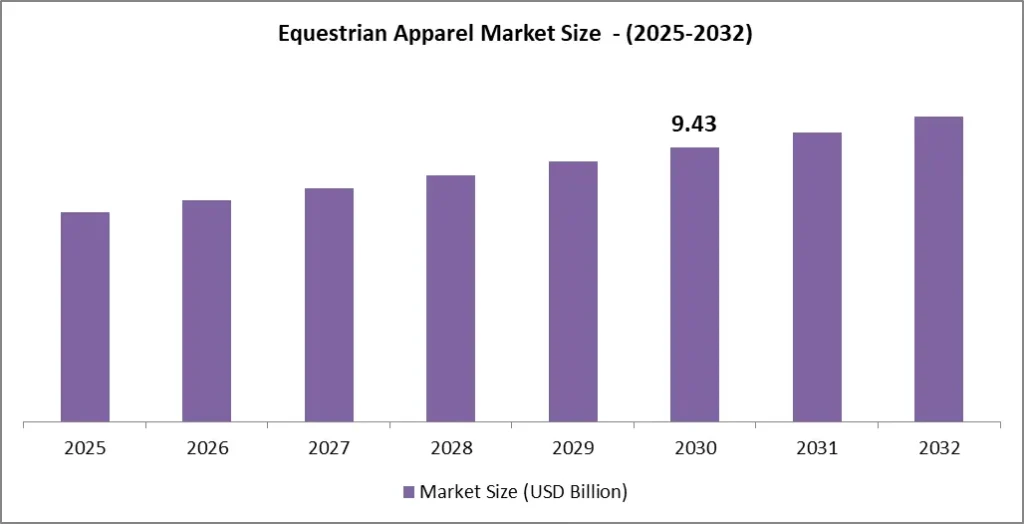
The Equestrian Apparel Market size was valued at USD 7.21 Billion in 2025 and the total Equestrian Apparel revenue is expected to grow at a CAGR of 5.52% from 2026 to 2032, reaching nearly USD 10.51 Billion by 2032.
Equestrian apparel is specialized clothing and accessories designed for horse riding and related activities. It includes clothing items like jackets, breeches, boots, helmets, gloves, and protective gear, tailored for comfort, safety, and performance during equestrian sports or leisure riding. The current scenario of the equestrian apparel market indicates steady growth, primarily driven by increasing participation in equestrian sports globally, rising interest in leisure riding, and growing awareness of safety measures among riders. The Equestrian Apparel Market is estimated to advance at a CAGR of 5.52% from 2026 to 2032.
Key driving factors contributing to the market's growth include a surge in equestrian sporting events, a rise in disposable incomes, technological advancements in apparel design for improved performance and safety, and an increasing emphasis on eco-friendly and sustainable manufacturing practices.

To know about the Research Methodology :- Request Free Sample Report
Trends shaping the equestrian apparel market involve a shift towards personalized and custom-fit gear, integration of technology such as smart fabrics and wearables for enhanced functionality, and a growing focus on sustainability with the use of eco-friendly materials. Opportunities in the Equestrian Apparel Market lie in tapping into emerging markets like the Asia-Pacific region for equestrian sport development and catering to therapeutic riding centers with specially designed gear. Equestrian Apparel Market players have adopted various strategies and innovations to capture Equestrian Apparel Market share. These include leveraging online platforms for global reach, offering tailored and personalized apparel options, integrating smart technology for innovative gear, adopting sustainable production practices, and collaborating with influencers or equestrian organizations for brand visibility and consumer engagement.
Equestrian Apparel Market Dynamics:
Rising interest in equestrian sports fuels specialized apparel demand:
- Growing involvement in equestrian sports worldwide, like show jumping and dressage, drives demand for specialized equestrian apparel. For instance, the rising popularity of equestrian events like the Kentucky Derby fuels demand for high-quality riding gear. Higher disposable incomes allow enthusiasts to invest in premium equestrian apparel, fostering Equestrian Apparel Market growth. As incomes increase, consumers opt for top-tier brands offering advanced functional apparel and riding equipment, boosting the Equestrian Apparel Market revenue. Ongoing innovation in fabric technologies enhances product durability, breathability, and flexibility. The utilization of advanced materials like moisture-wicking fabrics or lightweight, stretchable textiles improves rider comfort, encouraging purchases of high-performance equestrian wear.
- Evolving fashion preferences among riders drive demand for trendy yet functional equestrian apparel. For example, stylish designs coupled with functional features in riding jackets or breeches cater to the aesthetic preferences of riders, augmenting Equestrian Apparel Market growth. Growing consciousness regarding health and fitness influences the demand for comfortable and ergonomically designed equestrian clothing. Consumers seek apparel that offers both performance benefits and promotes physical well-being during riding activities, spurring market growth.
- The surge in online retail platforms facilitates easier access to a wide range of equestrian apparel globally. Companies leveraging e-commerce channels witness increased sales due to convenience and a broader customer reach, fostering Equestrian Apparel Market growth. The increasing popularity of equestrian tourism encourages the purchase of specialized apparel for riders exploring horse-related travel experiences. Destinations offering horseback riding tours or holidays contribute to elevated demand for appropriate riding gear, boosting Equestrian Apparel Market growth. The growing participation of youth in equestrian activities and the establishment of riding academies foster the demand for beginner-friendly, durable, and cost-effective riding apparel.
- Brands catering specifically to novice riders or offering budget-friendly options experience increased sales, supporting market growth. Rising concern for eco-friendly products and sustainable manufacturing processes drives the adoption of environmentally conscious equestrian apparel. Companies producing eco-friendly riding gear using recycled materials or sustainable practices gain consumer preference, contributing to Equestrian Apparel Market growth. The influence of social media platforms and influencer marketing significantly impacts equestrian apparel sales. Endorsements by equestrian influencers or riders on platforms like Instagram and YouTube often lead to increased brand visibility and consumer interest, driving market growth.
Accessibility Barriers in Equestrian Facilities Impact Market Growth:
- Restricted access to horse riding facilities and training centers in certain regions hampers Equestrian Apparel Market growth. For instance, areas with fewer equestrian clubs limit exposure to riding, reducing demand for specialized apparel. The initial investment in equestrian sports, including equipment and training, poses a financial barrier. Expensive gear and coaching costs deter newcomers, limiting the market's growth. Equestrian apparel caters to a specific audience, resulting in a comparatively smaller consumer base. This niche focus limits Equestrian Apparel Market scalability, unlike the broader apparel segments. Equestrian activities are often seasonal, impacting the consistent demand for riding gear. Seasonal variations lead to fluctuations in sales volume, challenging Equestrian Apparel Market stability. Limited knowledge about the benefits of equestrian activities or inadequate promotion restrains Equestrian Apparel Market growth. For instance, insufficient educational programs hinder the adoption of equestrian sports, impacting apparel sales.
- Stringent regulations regarding safety standards for equestrian gear production pose challenges. Compliance with safety norms, while crucial, increases production costs, affecting market competitiveness. Economic downturns impact consumer discretionary spending, affecting purchases of non-essential items like equestrian apparel. Financial uncertainty prompts consumers to cut back on high-end riding gear. Competing with versatile sportswear brands offering multi-sport apparel poses challenges.
- Broader sportswear brands encroach on the Equestrian Apparel Market share of specialized equestrian apparel. Disruptions in the supply chain, such as raw material shortages or transportation issues, impede production and lead to inventory challenges, affecting market growth. Balancing performance with eco-friendly manufacturing processes in equestrian apparel production remains a challenge. Adopting sustainable practices while maintaining high-performance standards presents hurdles for the market.
Personalized Offerings Drive Brand Loyalty and Market Growth:
- Leveraging online platforms enables broader Equestrian Apparel Market access. Brands like Horze utilize e-commerce channels to reach global consumers, fostering sales growth and market growth. Offering tailored apparel options such as custom-fit boots or personalized saddle pads caters to individual preferences. Tailored offerings by Ariat attract consumers seeking personalized riding gear, fostering brand loyalty and Equestrian Apparel Market growth. Integrating technology like smart fabrics or wearables enhances product functionality. Examples include companies like Equilab, utilizing smart tech for horse-riding tracking, and opening avenues for innovative apparel development.
- Embracing sustainable practices in production appeals to eco-conscious consumers. Brands like Patagonia, adopting eco-friendly materials, resonate with environmentally aware riders, creating growth opportunities. Exploring untapped segments like leisure riders or therapeutic horseback activities expands Equestrian Apparel Market reach. Targeting therapeutic riding centers for specially designed gear, as seen with Back On Track, diversifies the consumer base.
- Raising awareness about the benefits of equestrian activities stimulates market growth. Initiatives like BHS (British Horse Society) promoting riding safety and gear importance drive consumer interest in specialized apparel. Collaborating with influencers or equestrian organizations amplifies brand visibility. Partnerships like Tredstep Ireland with renowned riders amplify brand reach and foster market growth. Innovating functional gear, such as anti-impact helmets by Charles Owen, attracts safety-conscious riders, driving market growth through enhanced product performance. Targeting emerging Asia-Pacific Equestrian Apparel Market for equestrian sport development opens new growth avenues. Establishing riding schools in countries like China and India expands the consumer base. Offering beginner-friendly, affordable gear encourages new riders' participation. Brands like Dublin provide cost-effective yet quality gear, promoting Equestrian Apparel Market growth through increased entry-level consumers.
Equestrian Apparel Market Segment Analysis:
Based on Product Type
The Equestrian Apparel Market is segmented into apparel types. Boots and Clothes segment dominated the market in 2025. Boots are an essential component due to their functional significance in riding, offering safety and comfort. They are expected to maintain their dominance owing to continuous technological advancements, including innovative materials, improved design for enhanced performance, and growing consumer demand for specialized riding boots tailored for various equestrian disciplines.
Clothes, including riding jackets, breeches, and show coats, hold a substantial Equestrian Apparel Market share due to their widespread application across riding disciplines and leisure activities. Their dominance is expected to persist as the demand for fashionable yet functional equestrian apparel rises, particularly among professional riders and enthusiasts seeking both style and functionality in their attire.
While Boots and Clothes reign in dominance, Helmets and Gloves hold promising growth prospects. Helmets, crucial for rider safety, witness a growing emphasis on safety standards and regulations, propelling their adoption. With increasing awareness about head injury prevention, advancements in design, and comfort features, helmets are anticipated to witness significant Equestrian Apparel Market growth. Gloves, essential for better grip and protection, are gradually gaining traction due to technological advancements offering improved functionality and comfort.
Based On Material Type
the material type segment of the global equestrian apparel market is dominated by polyester, which accounted for the largest market share in 2025 and is expected to maintain its dominance throughout the 2025–2032 forecast period. Its leadership is attributed to its lightweight nature, durability, moisture-wicking properties, wrinkle resistance, and ease of maintenance, making it the preferred material for riding shirts, breeches, jackets, and other performance apparel.
Cotton is going to witness steady demand due to its breathability and comfort, particularly in casual riding apparel and training wear. Nylon is widely used in performance apparel because of its superior strength, flexibility, and abrasion resistance.

Leather is continue to remain as the preferred material for premium riding boots, gloves, and protective accessories owing to its durability and classic aesthetic appeal. Meanwhile, blended and technical fabrics are projected to register the fastest growth during the forecast period, driven by increasing demand for stretchability, moisture management, UV protection, and temperature regulation. Continuous advancements in sustainable and high-performance textiles are further supporting innovation and expanding the adoption of advanced equestrian apparel across both professional and recreational riding activities.
Equestrian Apparel Market Regional Insights:
North America holds a dominant position in the equestrian apparel market. North America has witnessed significant traction due to a robust equestrian culture, a high level of participation in horse-related activities, and a strong presence of key Market players. The U.S. specifically contributes significantly to the overall market size, with a robust demand for specialized riding apparel and accessories. The region benefits from a well-established equestrian sports infrastructure, favorable economic conditions, and a growing trend in leisure riding and competitive events.
Europe has emerged as a prominent region in the market. While North America dominates presently, Europe showcases substantial potential for growth. Countries like the United Kingdom, Germany, and France contribute significantly to the regional Market due to their strong equestrian heritage, equestrian events, and a growing emphasis on leisure riding. The rising adoption of e-commerce platforms for the sale of equestrian apparel, coupled with increasing awareness of specialized gear, is expected to bolster Market growth in Europe.
Besides North America and Europe, there's growing attention to the Asia-Pacific region. While not currently dominating the Market, Asia-Pacific exhibits considerable growth potential due to the burgeoning interest in equestrian sports, leisure riding, and increased disposable income in countries like China and India. As these nations witness a rise in riding clubs, horse-related activities, and investments in equestrian infrastructure, the demand for specialized riding apparel is projected to surge.
Equestrian Apparel Market Competitive Landscape:
he global equestrian apparel market is moderately fragmented, with competition among established international brands, premium equestrian apparel manufacturers, and regional players. Market participants compete based on product quality, innovation, safety compliance, sustainability, brand reputation, and distribution networks. Companies are increasingly investing in advanced performance fabrics, ergonomic designs, and eco-friendly materials to cater to the evolving needs of both professional and recreational riders.
| Tier | Companies |
| Market Leaders | Ariat International, Pikeur Reitmoden, Horseware Ireland, Dover Saddlery |
| Strong Global Players | Kingsland Equestrian, Horze International, Decathlon (Fouganza), Shires Equestrian |
| Emerging & Regional Players | Kerrits Performance Equestrian Apparel, Cavallo GmbH & Co. KG, along with several regional equestrian apparel brands |
Key Competitive Strategies :
- Product innovation and performance enhancement: Companies are introducing moisture-wicking, stretchable, UV-protective, and weather-resistant fabrics to improve rider comfort and performance.
- Expansion of e-commerce and omnichannel retail: Leading brands are strengthening their online presence while expanding partnerships with specialty equestrian retailers to improve global reach.
- Sustainability initiatives: Manufacturers are increasingly adopting recycled polyester, eco-friendly materials, and sustainable manufacturing processes to meet growing consumer demand for environmentally responsible products.
- Strategic partnerships and sponsorships: Companies collaborate with professional riders, equestrian teams, riding clubs, and international equestrian events to enhance brand visibility and customer loyalty.
- Geographic expansion: Major players are expanding into emerging markets, particularly in Asia-Pacific and Latin America, where participation in equestrian sports is steadily increasing.
Equestrian Apparel Market Scope: Inquire before buying
| Equestrian Apparel Market | |||
|---|---|---|---|
| Report Coverage | Details | ||
| Base Year: | 2025 | Forecast Period: | 2026-2032 |
| Historical Data: | 2020 to 2025 | Market Size in 2025: | USD 7.21 Bn. |
| Forecast Period 2026 to 2032 CAGR: | 5.52% | Market Size in 2032: | USD 10.51 Bn. |
| Segments Covered: | by Apparel Type | Sustainable Unsustainable |
|
| by Type | Boots Helmets Gloves Clothes |
||
| by Category | Professional Riders Recreational Rider |
||
| by Gender | Men Women Children |
||
| by Price | Low Medium High |
||
| by Distribution | Hypermarket / Supermarket Convenience Store Speciality Store Others |
||
Equestrian Apparel Market, by Region
North America (United States, Canada and Mexico)
Europe (UK, France, Germany, Italy, Spain, Sweden, Austria and Rest of Europe)
Asia Pacific (China, South Korea, Japan, India, Australia, Indonesia, Malaysia, Vietnam, Taiwan, Bangladesh, Pakistan and Rest of APAC)
Middle East and Africa (South Africa, GCC, Egypt, Nigeria and Rest of ME&A)
South America (Brazil, Argentina Rest of South America)
Equestrian Apparel Market, Key Players are:
1. Ariat International (United States)
2. Back on Track (Sweden)
3. Cavalleria Toscana (Italy)
4. Cheval (Germany)
5. Devoucoux (France)
6. Dover Saddlery (United States)
7. Equilibrium (Germany)
8. Equiline (Italy)
9. Flexon (United States)
10. GPA (France)
11. HKM (Germany)
12. Horseware Ireland (Ireland)
13. Horze (Germany)
14. Kerrits (United States)
15. Mountain Horse (Canada)
16. Ovation Riding (United States)
17. Pikeur (Germany)
18. Pikeur Sportswear (Germany)
19. Schockemohle (Germany)
20. Smartpak Equine (United States)
21. Stübben (Germany)
22. Tredwear (United States)
23. Under Armour (United States)
24. Uvex (Germany)
25. Weatherbeeta (United Kingdom)
26. William Cavendish Ltd (United Kingdom)
FAQs:
1. What are the growth drivers for the Equestrian Apparel Market?
Ans. Rising interest in equestrian sports fuels specialized apparel demand and operational efficiency is expected to be the major driver for the Equestrian Apparel Market.
2. What are the major restraints for the Equestrian Apparel Market growth?
Ans. Accessibility Barriers in Equestrian Facilities Impact Market Growth and are expected to be a major restraint in the Equestrian Apparel Market.
3. Which country is expected to lead the global Equestrian Apparel Market during the forecast period?
Ans. North America is expected to lead the Equestrian Apparel Market during the forecast period.
4. What is the projected market size and growth rate of the Market?
Ans. The Equestrian Apparel Market size was valued at USD 7.21 Billion in 2025 and the total Equestrian Apparel revenue is expected to grow at a CAGR of 5.52% from 2026 to 2032, reaching nearly USD 10.51 Billion by 2032.
5. What segments are covered in the Equestrian Apparel Market report?
Ans. The segments covered in the Market report are by Apparel Type, Type, Category, Gender, Price, Distribution, and Region.