
End User Computing Market Size – Industry Structure Evaluation, Demand Drivers Analysis, Regional Growth Analysis and Identification, Competitive Positioning Review & Global Market Size Forecast to 2030
Overview
The End User Computing Market size was valued at USD 4.41 Billion in 2023 and the total Magnetic Sensor revenue is expected to grow at a CAGR of 6.6% from 2024 to 2030, reaching nearly USD 6.9 Billion by 2030
End-user computing (EUC) covers the tools and systems utilized by IT professionals to effectively deploy, oversee, and safeguard the devices, applications, and data essential for employees to carry out their duties. The evolution of the end-user computing (EUC) market covers a variety of tools and technologies aimed at enhancing the management and accessibility of desktops, applications, and data. These tools cover a wide range of functionalities, including monitoring and managing both physical and virtual desktops and applications. Additionally, through techniques such as app refactoring, virtualization is leveraged to create mobile-friendly versions of Windows and web applications, ensuring seamless access across various devices. Unified endpoint management (UEM) plays a pivotal role by enabling IT professionals to apply and enforce Mobile Device Management (MDM) policies on PCs, ensuring consistency and security across the organization's endpoints. Furthermore, the emergence of workspace suites provides centralized consoles where end-users can conveniently access all required applications and data. At the same time, IT maintains robust control over access management and security protocols. These advancements signify a paradigm shift towards streamlining end user computing market experiences, promoting productivity, and bolstering security measures in today's dynamic work environments.
 To know about the Research Methodology:- Request Free Sample Report
End User Computing Market Dynamics:
The Evolution of End User Computing Empowering Hybrid Work Environments Propel the End User Computing Market
End User Computing (EUC) market is the shift towards hybrid work environments and digital-first business models. As organizations increasingly prioritize digital transformation, the evolution of unified workspaces becomes crucial for enabling seamless collaboration and productivity across diverse devices and locations. Technologies such as Virtual Desktop Infrastructure (VDI) and Desktop as a Service (DaaS) play a key role in supporting this evolution by providing flexible and scalable solutions for remote access to applications and data. Additionally, the adoption of workspace analytics allows organizations to anticipate end-user needs and deliver personalized experiences, enhancing user satisfaction and productivity. Moreover, the emphasis on security and compliance drives the implementation of condition access policies, ensuring that authorized users can securely access cloud applications from any device. Partnerships between tech giants like Google and Microsoft with EUC firms further catalyze innovation in remote application delivery, improving user experiences and simplifying IT managemen for End User Computing Market.
The importance of optimizing staff mobility and remote access. This reflects a growing need within organizations to enable their workforce to work from anywhere, anytime, leading to an increased demand for end-user computing solutions that support remote access and mobility. Additionally, the mention of virtualization through virtual machines and containers underscores the significance of abstracting away infrastructure details to implement EUC solutions that are hardware-agnostic, promoting flexibility and scalability in IT frameworks. Moreover, the adoption of cloud/hybrid architectures provides organizations with more options for hosting, storage, and service delivery, driving the adoption of end-user computing solutions that leverage cloud technologies to enhance scalability, accessibility, and cost-effectiveness for End User Computing Market.
Inadequate Change Control Policies in EUC Solutions which Hamper the Growth of End User Computing Market
The inherent limitations and risks associated with spreadsheet applications and other end-user-developed applications. The prevalence of errors in spreadsheets poses a considerable challenge. Studies indicate that a vast majority of spreadsheets contain errors, and even experienced users struggle to identify them accurately. These errors can arise from data entry mistakes, flawed formulas, incorrect spreadsheet logic, or faulty links to external data sources. Such inaccuracies not only compromise data integrity but also hinder decision-making processes within organizations. The lack of proper version and change control mechanisms exacerbates the problem. Unlike traditional IT-developed applications, spreadsheet applications are more difficult to control, making it challenging to enforce change control policies effectively. This leads to a higher risk of unintended changes or modifications going unnoticed, further compromising data accuracy and reliability for End User Computing Market.
Another significant restraint is the issue of poor documentation. Inadequate documentation of spreadsheets makes it challenging for users to understand and utilize them correctly, particularly after changes in ownership or when used by individuals unfamiliar with the original design. This lack of clarity increases the likelihood of errors and misinterpretations, impacting the overall efficiency and effectiveness of EUC solutions. Furthermore, the lack of security measures poses a serious threat to data confidentiality and integrity. Unsecured files can be easily shared among users, increasing the risk of unauthorized access or modification. This not only raises concerns about data privacy but also exposes organizations to potential regulatory violations and financial losses. Additionally, the absence of a comprehensive audit trail compounds these issues. Without proper tracking and monitoring mechanisms, it becomes difficult to trace changes made to critical data within spreadsheets, posing challenges for internal governance and compliance with regulatory requirements for End User Computing Market.
Agility, Security, and Mobility Seizing Opportunities in End-User Computing Market
The emphasis on agility enables organizations to rapidly scale up or down and provision Virtual Desktop Infrastructure (VDI) to new workers irrespective of their location. This agility extends to IT departments, allowing them to easily introduce new applications, update existing ones, and conduct testing and iteration seamlessly. This flexibility is crucial in today's fast-paced business environment, where organizations need to adapt quickly to changing requirements and End-User Computing Market conditions. Therefore, the agility provided by end-user computing solutions drives their adoption as organizations seek to remain competitive and responsive to evolving business needs for End User Computing Market.
The increasing demand for secure and agile solutions. As organizations prioritize security and agility in their digital transformation efforts, there is a growing need for EUC solutions that offer comprehensive data services, simple management, and effortless scalability. Cloud-based EUC services, such as those offered by AWS, provide organizations with the flexibility to scale resources up or down on demand, enabling them to adapt quickly to changing workforce needs for End User Computing Market. Additionally, the emphasis on security, with services deployed within a Virtual Private Cloud (VPC) to ensure secure connections and data protection, addresses the growing concerns around cybersecurity and data privacy. The reliability and cost optimization benefits offered by cloud-based EUC services present opportunities for organizations to streamline their operations, reduce infrastructure and management costs, and improve the overall efficiency of their end-user computing environments.
With the increasing trend of remote work and the use of multiple devices, there is a growing demand for solutions that enable seamless access to virtual apps and desktops from any location and any device. This presents an opportunity for EUC solutions providers to offer comprehensive and user-friendly solutions that enhance workforce mobility while simplifying endpoint management and improving the overall user experience. As organizations migrate to newer operating systems like Windows 10 and beyond, there is a need for smooth and efficient migration processes that minimize disruption to the user experience. EUC solutions can capitalize on this opportunity by offering seamless integration with new operating systems, ensuring a familiar and productive user experience across devices. The high cost and complexity associated with traditional hardware refresh cycles present an opportunity for EUC solutions providers to offer alternatives such as software-based thin client technology. By repurposing existing hardware and extending the life of endpoints, organizations can reduce costs while maintaining performance and security which drives End User Computing Market.
With the increasing cybersecurity threats targeting endpoint devices, there is a need for solutions that offer built-in security features to protect users and data. EUC solutions providers can leverage this opportunity by offering endpoint devices with embedded security features, such as automatic support for safety measures like two-factor authentication and smart card readers. The complexity and cost of managing a large estate of endpoints drive the need for more efficient and cost-effective management solutions. Cloud-based desktops and desktop-as-a-service (DaaS) solutions offer opportunities for organizations to streamline endpoint management while enhancing policy control, management efficiency, and security Boost the End User Computing Market.
End User Computing Market Scope:Inquire before buying
| End User Computing Market | |||
|---|---|---|---|
| Report Coverage | Details | ||
| Base Year: | 2023 | Forecast Period: | 2024-2030 |
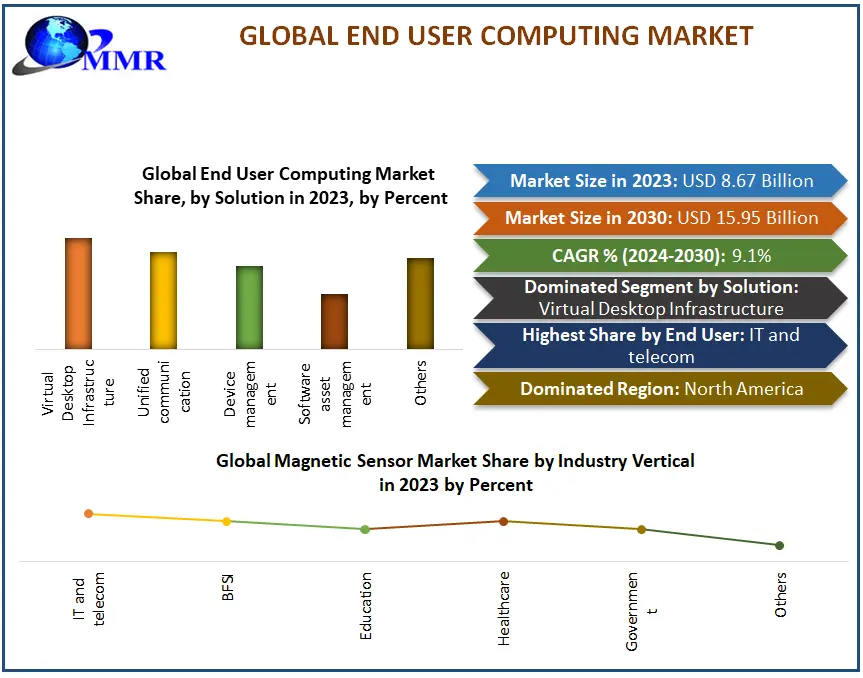
| Historical Data: | 2018 to 2023 | Market Size in 2023: | US $ 8.67 Bn. |
| Forecast Period 2024 to 2030 CAGR: | 9.1% | Market Size in 2030: | US $ 15.95 Bn. |
| Segments Covered: | by Solution | Virtual Desktop Infrastructure Unified communication Device management Software asset management Others |
|
| by Service | Consulting Support and maintenance Training and education System integration Managed services |
||
| by Service Model | Infrastructure as a Service Platform as a Service Software as a Service |
||
| by Industry vertical | IT and telecom BFSI Education Healthcare Government Others |
||
End User Computing Market, by Region
North America (United States, Canada and Mexico)
Europe (UK, France, Germany, Italy, Spain, Sweden, Austria and Rest of Europe)
Asia Pacific (China, South Korea, Japan, India, Australia, Indonesia, Malaysia, Vietnam, Taiwan, Bangladesh, Pakistan and Rest of APAC)
Middle East and Africa (South Africa, GCC, Egypt, Nigeria and Rest of ME&A)
South America (Brazil, Argentina Rest of South America)
End User Computing Market Key Players:
Major Contributors in the End User Computing Market in North America:
1. Microsoft Corporation (Redmond, Washington, USA)
2. Apple Inc. (Cupertino, California, USA)
3. Dell Technologies Inc. (Round Rock, Texas, USA)
4. HP Inc. (Palo Alto, California, USA)
5. Cisco Systems, Inc. (San Jose, California, USA)
6. VMware, Inc. (Palo Alto, California, USA)
7. Citrix Systems, Inc. (Fort Lauderdale, Florida, USA)
8. Google LLC (Mountain View, California, USA)
9. IBM Corporation (Armonk, New York, USA)
10. Oracle Corporation (Redwood City, California, USA)
11. Intel Corporation (Santa Clara, California, USA)
12. NVIDIA Corporation (Santa Clara, California, USA)
13. BlackBerry Limited (Waterloo, Ontario, Canada)
Major Leading Players in the End User Computing Market in Asia Pacific:
1. Lenovo Group Limited (Beijing, China)
2. Samsung Electronics Co., Ltd. (Suwon, South Korea)
3. Fujitsu Limited (Tokyo, Japan)
4. NEC Corporation (Minato, Tokyo, Japan)
5. ASUSTek Computer Inc. (Beitou District, Taipei, Taiwan)
6. Toshiba Corporation (Minato, Tokyo, Japan)
7. Xiaomi Corporation (Beijing, China)
FAQs:
1. What are the growth drivers for the End User Computing Market?
Ans. Increasing demand for remote work solutions and virtual desktop infrastructure (VDI) due to the rise of remote work culture and the need for flexible working environments. Advancements in technology such as cloud computing, edge computing, and mobile devices, driving the adoption of end-user computing solutions for enhanced productivity and accessibility.
2. What are the major restraints for the End User Computing market growth?
Ans. Security concerns surrounding data breaches and cyber threats pose a significant restraint on the growth of the end-user computing market, leading to increased investment in cybersecurity measures.
3. Which region is expected to lead the global End User Computing market during the forecast period?
Ans. North America was expected to lead the global end-user computing market during the forecast period. This is primarily due to the strong presence of key players, technological advancements, higher adoption rates of end-user computing devices and solutions, and robust investment in IT infrastructure.
4. What is the projected market size and growth rate of the End User Computing Market?
Ans. The End User Computing Market size was valued at USD 8.67 Billion in 2023 and the total End User Computing revenue is expected to grow at a CAGR of 9.1% from 2024 to 2030, reaching nearly USD 15.95 Billion by 2030.
5. What segments are covered in the End User Computing Market report?
Ans. The segments covered in the End User Computing report are Solution, Service, Service Model, Industry vertical, and Region.