
Electronic Shelf Label (ESL) Market - Industry Structure Evaluation, Demand Drivers Analysis, Regional Growth Analysis and Identification, Competitive Positioning Review & Global Market Size Forecast to 2030
Overview
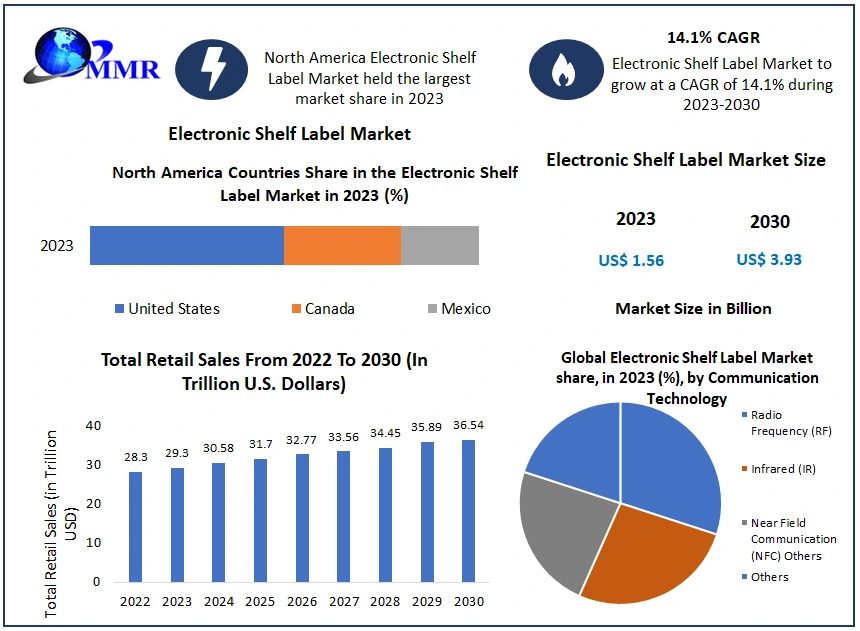
Global Electronic Shelf Label Market size was valued at USD 1.56 Bn in 2023 and is expected to reach USD 3.93 Bn by 2030, at a CAGR of 14.1%.
Electronic Shelf Label Market Overview
Electronic Shelf Labels (ESLs) are digital display systems used in retail environments to replace traditional paper-based price tags. These labels utilize e-ink displays and wireless communication technology to enable automatic, real-time updates of product prices and information across the store. ESLs enhance operational efficiency by eliminating manual price updates, reducing errors, and facilitating dynamic pricing strategies which drive Electronic Shelf Label Market growth. They also bridge the gap between offline and online commerce by synchronizing pricing with e-commerce platforms and supporting personalized promotions. ESLs improve customer satisfaction by ensuring accurate pricing, providing product information, and creating a seamless shopping experience. Advanced ESL solutions incorporate features such as long battery life, strong security measures, and simplified radio design to maximize reliability and ease of implementation for retailers.
 To know about the Research Methodology :- Request Free Sample Report
The Electronic Shelf Label Market has experienced significant growth driven by the increasing adoption of automation and digitization in the retail sector. ESLs are digital price tags used by retailers to display product pricing and information in real time. They offer several advantages over traditional paper labels, including improved pricing accuracy, dynamic pricing capabilities, and operational efficiency. The increasing demand for enhancing the in-store shopping experience, streamlining pricing management processes and reducing labor costs associated with manual price labeling boosts the Electronic Shelf Label industry growth. ESLs enable retailers to implement dynamic pricing strategies, optimize inventory management, and seamlessly update product information across multiple locations. Technological advancements in display technologies, the rising trend of omnichannel retailing, and the need for sustainable and eco-friendly retail solutions contribute to the Electronic Shelf Label Market growth. Key players in the ESL market are continuously innovating to offer advanced features such as wireless connectivity, e-ink displays for better visibility and energy efficiency, and integration with inventory management systems and point-of-sale solutions.
Electronic Shelf Label Market Trend
Integration with IoT and Automation
Integration with IoT and Automation emerges as the prevailing trend in the Electronic Shelf Label (ESL) Market, revolutionizing retail operations through streamlined processes and enhanced efficiencies. With the primary aim of reducing human intervention in manufacturing processes, industrial automation leverages advancements in machine capabilities including feedback controllers, robotics, and digital computing to optimize production workflows. This integration enables ESLs to function as fixed, programmable, or flexible applications, each offering distinct advantages in terms of speed, safety, and resource utilization which drive Electronic Shelf Label Market growth. The proliferation of IoT devices interconnected through the Internet underscores the transformative power of automation across industries.
The increasing number of Internet of Things (IoT) connected devices, expected to surpass billions, is driving integration with IoT and automation technologies in the Electronic Shelf Label Market. This integration enhances ESL functionality, enabling real-time updates, dynamic pricing, and improved inventory management. As a result, ESL systems become more efficient, responsive, and capable of meeting the evolving needs of retailers and consumers in the digital age.
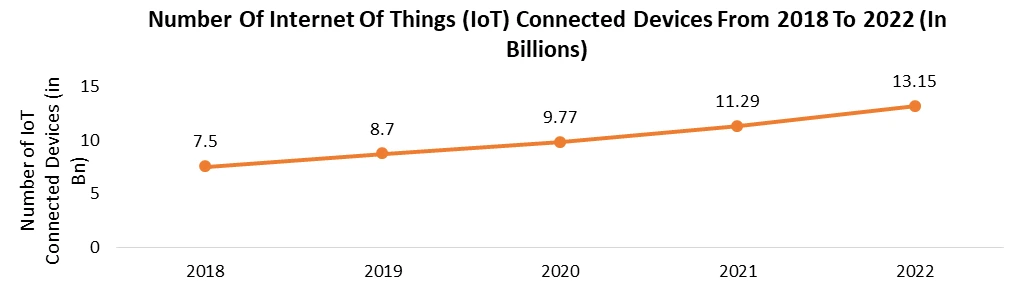
The growth of IoT surpasses that of non-IoT devices, indicating a seismic shift towards interconnected smart devices in modern retail environments. Through sensors, actuators, and IoT gateways, automation seamlessly connects IoT devices, enabling data collection, remote access, and automated decision-making processes. This convergence of IoT and automation fosters numerous advantages for businesses, including scalable production, increased uptime, operational efficiency, improved safety compliance, and enhanced customer insights, which drive the Electronic Shelf Label Market growth. By harnessing the power of automation, ESLs deliver tangible benefits such as optimized pricing strategies, real-time inventory management, and personalized shopping experiences. Automation IoT software empowers retailers to adapt to evolving consumer demands, drive operational excellence, and maintain a competitive edge in the dynamic retail landscape. From enhancing system uptime to strengthening security access and control, the integration of IoT and automation revolutionizes retail operations, paving the way for a smarter, more efficient shopping experience for both retailers and consumers.
Electronic Shelf Label Market Dynamics
Increasing Demand for Automation and Digitization in The Retail Sector
The surge in demand for automation and digitization within the retail sector has significantly propelled the growth of the Electronic Shelf Label (ESL) market. This trend is primarily driven by evolving consumer expectations and the need for retailers to adapt to a rapidly changing landscape. With the advent of e-commerce giants and technological advancements, consumers now expect a seamless shopping experience both online and in-store. ESLs offer retailers a solution to enhance operational efficiency, improve pricing accuracy, and provide dynamic product information to customers in real-time which boosts Electronic Shelf Label Market growth. By replacing traditional paper labels with electronic displays, retailers easily update product prices, promotions, and other relevant information across their entire store network with just a few clicks, eliminating the need for manual price changes and reducing the risk of errors. This agility in pricing and information dissemination enables retailers to respond swiftly to market dynamics, optimize pricing strategies, and stay competitive in today's fast-paced retail environment.
The rising demand for automation and digitization in the retail sector is propelling growth in the Electronic Shelf Label (ESL) Market. As retailers prioritize efficiency and customer experience, ESLs play a crucial role by enabling real-time updates, dynamic pricing, and streamlined inventory management, aligning with the broader trend toward digital transformation in retail.
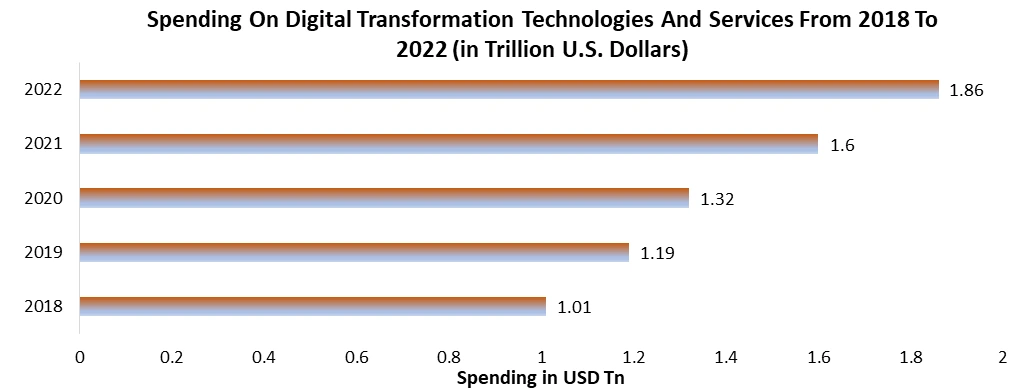
The integration of ESLs with inventory management systems and other retail technologies enables retailers to streamline their operations and enhance the overall shopping experience. Automated price updates ensure consistency between online and in-store prices, eliminating discrepancies that lead to customer dissatisfaction. ESLs facilitate efficient inventory management by providing real-time visibility into stock levels and product availability, enabling retailers to optimize replenishment processes and minimize out-of-stock situations which drive Electronic Shelf Label Market growth. The ability to display detailed product information, such as nutritional facts, origin, and sustainability attributes, directly on the shelf label enhances transparency and helps consumers make informed purchasing decisions.
ESLs leveraged to deliver personalized promotions and targeted advertising based on shopper demographics, preferences, and purchase history, driving sales and enhancing customer loyalty. As retailers continue to invest in digitization and automation to meet evolving consumer demands, the Electronic Shelf Label market is expected to substantial growth, offering retailers a versatile solution to optimize operations, improve customer engagement, and drive business success in the digital age.
Initial Implementation Cost and Infrastructure Requirements to Hamper Market Growth
The significant restraint of the Electronic Shelf Label (ESL) Market lies in the formidable initial implementation costs and infrastructure requirements associated with adopting this technology. Despite offering long-term benefits such as labor cost reductions, operational efficiency improvements, and dynamic pricing capabilities, the upfront investment in ESL hardware, software, and infrastructure poses a substantial financial burden for retailers, particularly those with large-scale operations. The implementation process entails not only the acquisition of ESLs but also the installation, integration with existing systems, and training of staff to operate and maintain the new technology which hampers Electronic Shelf Label Market growth.
The transition from traditional paper-based labels to electronic ones necessitates adjustments to store layouts and fixtures, escalating the implementation expenses. Many retailers exhibit reluctance to embrace ESLs due to budgetary constraints or uncertainty regarding the return on investment, especially in industries characterized by tight profit margins or undergoing economic challenges that impede Electronic Shelf Label Market growth. The ongoing costs associated with maintenance and support, as well as the potential for compatibility issues with legacy systems or existing infrastructure, further compound the barriers to adoption.
Electronic Shelf Label Market Segment Analysis
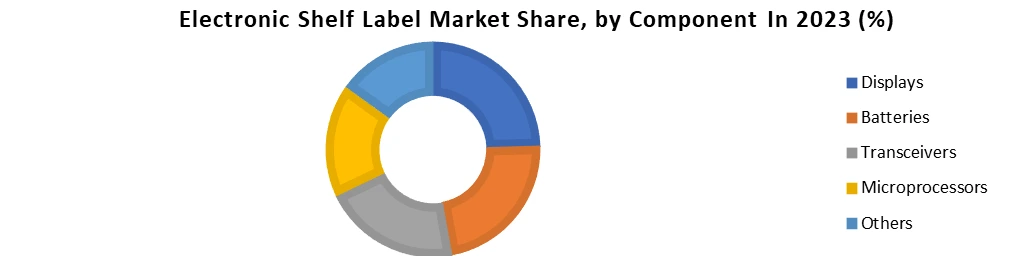
Based on Component, the market is categorized into Displays, Batteries, Transceivers, Microprocessors and Others. Displays are expected to dominate the Electronic Shelf Label Market over the forecast period. In the retail environment, displays serve as the primary interface for conveying critical information such as product pricing, promotions, and details to shoppers. As such, the quality, readability, and functionality of displays significantly impact the overall effectiveness of ESL systems in enhancing the shopping experience and driving operational efficiency for retailers.
With advancements in display technology, such as LCD (Liquid Crystal Display) and E-Ink (Electronic Ink), ESLs offer high-resolution displays capable of showcasing detailed product information and pricing changes instantaneously. This dynamic updating capability enables retailers to adapt pricing strategies quickly, respond to market conditions in real-time and deliver personalized promotions to customers based on factors like time of day or inventory levels which drive Electronic Shelf Label Market growth. Displays play a crucial role in optimizing pricing strategies, maximizing sales opportunities, and improving overall revenue for retailers.
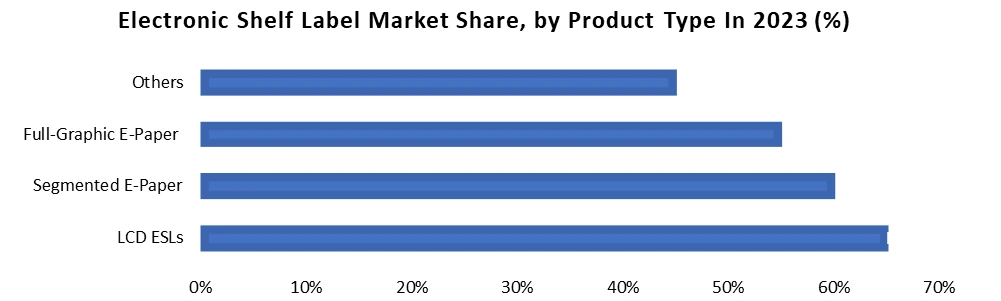
Based on Product Type, the market is segmented into LCD ESLs, Segmented E-Paper, Full-Graphic E-Paper and Others. LCD ESLs dominated the Electronic Shelf Label Market in 2023. LCD ESLs offer a proven and reliable display technology that has been widely adopted by retailers across several sectors. With high-resolution displays and vibrant colors, LCD ESLs effectively showcase product information, pricing, and promotions, enhancing the visibility and appeal of merchandise on store shelves. LCD ESLs provide dynamic updating capabilities, enabling retailers to remotely and instantaneously update pricing and product information in real-time, thereby streamlining operations and improving efficiency.
LCD ESLs offer versatility in terms of display size and format, allowing retailers to choose from a range of options that best suit their specific requirements and preferences. Whether used in supermarkets, specialty stores, or large-scale retail environments, LCD ESLs provide consistent and readable displays that enhance the overall shopping experience for customers and drive Electronic Shelf Label Market growth. The established ecosystem of suppliers and manufacturers supporting LCD ESL technology ensures a reliable supply chain and consistent product quality, contributing to its dominance in the market.
Electronic Shelf Label Market Regional Insights
North America dominated the Electronic Shelf Label Market in 2023 and is expected to continue its dominance over the forecast period. North America boasts a highly developed and technologically advanced retail sector, characterized by a large number of established brick-and-mortar stores, supermarkets, hypermarkets, and specialty retailers. These retailers are continuously seeking innovative solutions to improve customer experiences, enhance operational efficiency and stay competitive in the rapidly evolving retail landscape. ESLs offer a compelling solution to address these needs by enabling real-time pricing updates, dynamic product information displays, and seamless integration with inventory management systems. The regional retailers are often early adopters of new technologies, driven by a culture of innovation, consumer demand for convenience, and a willingness to invest in cutting-edge solutions to gain a competitive edge.
The strong economic conditions and favorable regulatory environment in North America create conducive conditions for the widespread adoption of ESLs which helps to boost the regional Electronic Shelf Label Market. The region's strong economy, coupled with high levels of disposable income and consumer spending, provides retailers with the financial resources and incentive to invest in advanced retail technologies such as ESLs. The regulatory frameworks in North America are conducive to technological innovation and business growth, with minimal barriers to entry for new market players and favorable policies supporting the adoption of emerging technologies. This supportive regulatory environment fosters a competitive market landscape characterized by innovation, collaboration, and investment in research and development, driving the growth of the ESL market in the region. North America's mature retail sector, the culture of innovation, strong economic conditions, and supportive regulatory environment position it as the dominant region for the Electronic Shelf Label Market, driving widespread adoption and growth across various retail segments.
Electronic Shelf Label Market Scope: Inquire before buying
| Global Electronic Shelf Label Market | |||
|---|---|---|---|
| Report Coverage | Details | ||
| Base Year: | 2023 | Forecast Period: | 2024-2030 |
| Historical Data: | 2018 to 2023 | Market Size in 2023: | US $ 1.56 Bn. |
| Forecast Period 2024 to 2030 CAGR: | 14.1% | Market Size in 2030: | US $ 3.93 Bn. |
| Segments Covered: | by Component | Displays Batteries Transceivers Microprocessors Others |
|
| by Product Type | LCD ESLs Segmented E-Paper Full-Graphic E-Paper Others |
||
| by Display Size | Less than 3 Inch 3 Inch to 7 Inch 7 Inch to 10 Inch More than 10 Inch |
||
| by Communication technology | Radio Frequency (RF) Infrared (IR) Near Field Communication (NFC) Others |
||
| by Store Type | Hypermarkets Supermarkets Non-Food Retail Stores Specialty Stores Others |
||
Electronic Shelf Label Market, by Region
North America (United States, Canada and Mexico)
Europe (UK, France, Germany, Italy, Spain, Sweden, Austria and Rest of Europe)
Asia Pacific (China, South Korea, Japan, India, Australia, Indonesia, Malaysia, Vietnam, Taiwan, Bangladesh, Pakistan and Rest of APAC)
Middle East and Africa (South Africa, GCC, Egypt, Nigeria and Rest of ME&A)
South America (Brazil, Argentina Rest of South America)
Electronic Shelf Label Key Players
The key competitors in the electronic shelf label industry are highly competitive, with key players such as Opticon, Displaydata, and VusionGroup leading the industry. Product competition centers on innovation, such as advanced display technology and integration with IoT. Brand competition centres on reputation and customer service. Customer analysis reveals a growing preference for sustainable solutions. Companies employ growth strategies such as partnerships and geographic expansion to enhance market position. Technological developments, including AI integration and eco-friendly options, are shaping product offerings. Overall, the ESL industry is dynamic, driven by evolving consumer needs and competitive pressures among leading manufacturers.
Global
1. SES-imagotag (France)
2. Pricer AB (Sweden)
3. Displaydata Ltd. (United Kingdom)
4. E Ink Holdings Inc. (Taiwan)
5. Altierre Corp. (United States)
North America
1. Altierre Corp. (United States)
2. Advantech U.S., Inc. (United States)
3. Diebold Nixdorf, Incorporated (United States)
4. Planar Systems, Inc. (United States)
Europe
1. SES-imagotag (France)
2. Pricer AB (Sweden)
3. Displaydata Ltd. (United Kingdom)
4. T-Systems International GmbH (Germany)
5. TroniTAG GmbH (Germany)
6. SES RFID Solutions GmbH (Germany)
Asia Pacific
1. Samsung Electro-Mechanics (South Korea)
2. Teraoka Seiko Co., Ltd. (Japan)
3. M2Communication Inc. (South Korea)
4. LG Innotek Co., Ltd. (South Korea)
5. Panasonic Corporation (Japan)
6. Censtar Science & Technology Co., Ltd. (China)
7. Huawei Technologies Co., Ltd. (China)
8. LG Display Co., Ltd. (South Korea)
9. Solum Co., Ltd. (South Korea)
10. Toshiba Corporation (Japan)
Frequently Asked Questions:
1] What is the growth rate of the Global Electronic Shelf Label Market?
Ans. The Global Electronic Shelf Label Market is growing at a significant rate of 14.1% during the forecast period.
2] Which region is expected to dominate the Global Electronic Shelf Label Market?
Ans. North Ameica is expected to dominate the Electronic Shelf Label Market during the forecast period.
3] What is the expected Global Electronic Shelf Label Market size by 2030?
Ans. The Electronic Shelf Label Market size is expected to reach USD 3.93 Billion by 2030.
4] Which are the top players in the Global Electronic Shelf Label Market?
Ans. The major top players in the Global Electronic Shelf Label Market are SES-imagotag (France), Pricer AB (Sweden), Displaydata Ltd. (United Kingdom), E Ink Holdings Inc. (Taiwan),Altierre Corp. (United States), Advantech U.S., Inc. (United States)and Others.
5] What are the factors driving the Global Electronic Shelf Label Market growth?
Ans. Enhanced customer experience and improved inventory management are expected to drive market growth during the forecast period.