
Direct To Consumer Technology Market Type, End-User, and Region – Global Market Size Estimation, Industry-Wide Analysis, Competitive Landscape Assessment & Long-Term Forecast to 2032
Overview
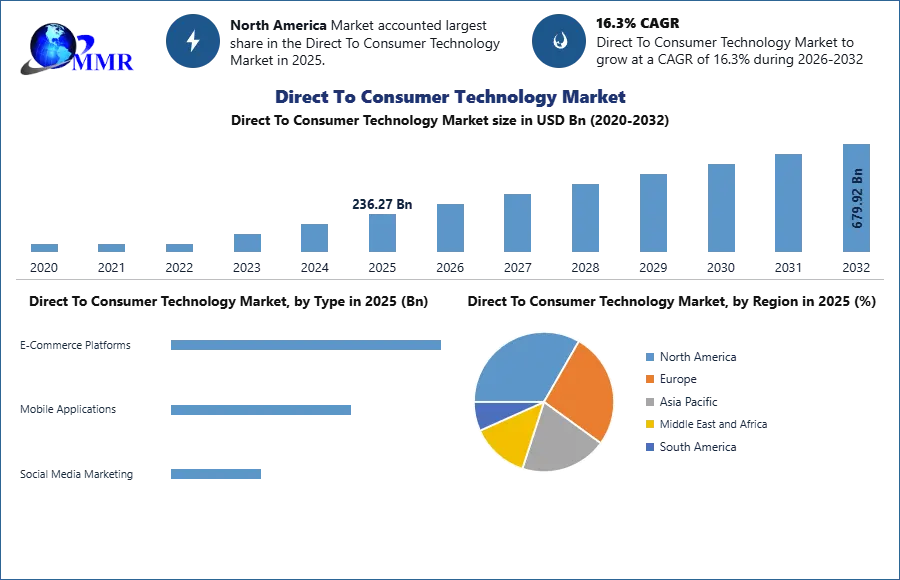
Global Direct-to-consumer Consumer Technology Market Size was valued at USD 236.27 Bn. in 2025 and the Direct to Consumer Technology Market is expected to grow by 16.3 % from 2026 to 2032, reaching nearly USD 679.92 Bn.
Direct To Consumer Technology Market Overview:
The Direct Consumer Technology Market refers to the realm of digital solutions, strategies, and platforms that empower businesses to engage directly with end consumers, bypassing traditional intermediaries such as retailers or wholesalers. This market encompasses an array of technological tools and approaches aimed at enhancing customer interactions, streamlining purchasing processes, and collecting data-driven insights. By leveraging e-commerce platforms, mobile apps, social media, data analytics, and supply chain innovations, companies can establish personalized connections with consumers, offering tailored experiences, products, and services while gaining deeper insights into consumer preferences and behaviors. This market plays a transformative role in reshaping business-consumer dynamics, enhancing brand loyalty, and enabling businesses to adapt to evolving consumer Demands.
To know about the Research Methodology :- Request Free Sample Report
Direct To Consumer Technology Market Dynamics:
Evolving Consumer Preferences to Boost the Direct To Consumer Technology Market Growth
One of the primary drivers is the shifting preferences of modern consumers. Today's customers demand convenience, personalization, and seamless interactions. They seek direct engagement with brands, the ability to explore products on their terms, and the convenience of making purchases without intermediaries. DTC technology enables businesses to cater to these preferences by offering frictionless online experiences, personalized product recommendations, and streamlined purchase processes, all contributing to enhanced customer satisfaction. Advancements in technology play a pivotal role in driving the DTC Technology Market. E-commerce platforms, mobile applications, data analytics, and AI-driven solutions have reached unprecedented levels of sophistication. The integration of augmented reality (AR), virtual reality (VR), and artificial intelligence (AI) further augments the appeal of DTC strategies, enhancing consumer engagement and providing innovative ways to experience products virtually.
The wealth of data available through DTC interactions fuels informed decision-making. Businesses can analyze consumer behavior, purchase patterns, preferences, and feedback to refine product offerings, optimize marketing strategies, and develop targeted campaigns. This data-driven approach reduces guesswork and fosters more accurate product-market fit, ultimately leading to higher conversion rates and improved customer retention. DTC strategies empower brands with greater control over their narratives and brand experiences. By interacting directly with consumers, businesses can convey their unique value propositions, articulate their brand stories, and establish authentic connections. This level of brand control fosters consumer loyalty, as customers are more such as to support brands they identify with and trust.
The elimination of traditional intermediaries is a significant driver in the DTC Technology Market. By cutting out middlemen, businesses can reduce distribution costs, eliminate markups, and retain more of their profits. This cost-efficiency allows for competitive pricing, direct investment in customer experience enhancements, and the potential to offer products at more accessible price points. DTC technology transcends geographical boundaries, providing businesses with unprecedented global reach. Small and medium-sized enterprises (SMEs) can now access international markets without the need for extensive physical presence. This driver democratizes commerce, allowing businesses of all sizes to tap into diverse consumer bases and expand their customer reach. The DTC model fosters agility and innovation. Businesses can swiftly respond to changing market trends, introduce new products, experiment with offerings, and gather real-time feedback from consumers. This adaptability is crucial in an ever-evolving business landscape where staying relevant requires continuous innovation.
Competition and Saturation to Restraint the Direct To Consumer Technology Market Growth
Differentiating products and establishing a unique value proposition becomes more challenging in such a scenario. The implementation of robust DTC technology requires significant investments in infrastructure, software development, e-commerce platforms, mobile apps, and data analytics tools. For smaller businesses or startups, these upfront costs can be a significant barrier to entry. The need to maintain and update these technologies also incurs ongoing expenses that may strain resources. Direct consumer engagement demands a high level of trust and transparency. Consumers share sensitive data during online transactions, and any perceived breaches in data security can erode consumer confidence. Businesses must invest in robust cybersecurity measures to safeguard customer information and ensure secure transactions, especially given the increasing frequency of cyberattacks and data breaches. Direct-to-consumer models require efficient supply chain management to ensure timely and accurate product delivery. Managing logistics, warehousing, and last-mile delivery can be complex, especially for businesses expanding into international markets. Ensuring reliable and cost-effective fulfillment while meeting customer expectations for speed and quality is a delicate balancing act.
While DTC strategies aim to eliminate intermediary costs, customer acquisition costs can offset these savings. Building brand awareness, driving website traffic, and converting visitors into paying customers require significant investments in marketing and advertising. Businesses need to optimize their marketing strategies to achieve a favorable balance between customer acquisition costs and revenue generation. Direct consumer engagement places a heightened emphasis on customer experience. Ensuring seamless online experiences, responsive customer support, and hassle-free return processes are essential. Failure to provide an exceptional customer journey can lead to negative reviews, diminished brand reputation, and decreased customer loyalty. As businesses grow, scalability becomes a critical factor. Scaling up DTC operations requires adequate resources for technology upgrades, inventory management, logistics, and customer support. Inadequate scalability planning can lead to operational inefficiencies and service disruptions as the business expands.
Opportunity in the Global Direct To Consumer Technology Market:
The DTC model offers businesses an unparalleled opportunity to directly engage with their customers, fostering deeper connections and brand loyalty. By understanding individual preferences, purchase history, and interactions, companies can tailor their offerings and communication to provide personalized experiences. Engaged and loyal customers are more likely to make repeat purchases, share positive reviews, and become advocates for the brand. The DTC approach generates a wealth of consumer data that can fuel innovation and informed decision-making.
Direct engagement with consumers enables agile product development and testing. Businesses can gather real-time feedback on prototypes, gather insights on feature preferences, and iterate quickly based on consumer responses. This iterative approach minimizes the risk of product failures and enhances the likelihood of introducing products that resonate with the target audience. DTC strategies enable businesses to have greater control over their brand identity and messaging. This control extends to every touchpoint of the customer journey, ensuring consistent brand experiences. Companies can showcase their unique value proposition, brand story, and ethos directly to consumers, creating a strong brand identity that resonates with their target audience.
Advancements in e-commerce technology have democratized access to global markets. Through DTC channels, businesses of all sizes can tap into international markets without the need for extensive physical presence. This opens avenues for growth and expansion beyond traditional geographic limitations. The DTC model enables businesses to offer customizable products or services directly to consumers. From personalized product recommendations to allowing customers to design their own products, customization enhances the customer experience and provides a competitive edge by catering to unique preferences.
Direct To Consumer Technology Market Segment Analysis:
Based on the Type Segment, the market is segmented into E-Commerce Platforms, Mobile Applications, and Social Media Marketing. E-commerce platforms form a fundamental type segment in the DTC Technology Market. These platforms serve as digital storefronts where businesses showcase and sell their products directly to consumers. E-commerce solutions offer features such as product catalog management, secure payment processing, checkout functionality, and order tracking. They facilitate seamless online transactions and enhance customer experience. Mobile applications are a distinct type within the DTC landscape, allowing businesses to engage consumers directly through their smartphones and tablets this segment is expected to boost the forecast period. Mobile apps provide a personalized and convenient platform for browsing products, making purchases, receiving notifications, and accessing exclusive offers. This type leverages the prevalence of mobile devices to offer on-the-go shopping experiences.
Based on the end user, the market is segmented into Retail and Fashion, Consumer Electronics, and Technology, Personal Care, Food and Beverage, Health and Wellness, Home Goods and Furniture, Subscription Services and Entertainment, Sports and Outdoor Activities.
The retail and fashion sector represents a significant end-user segment in the DTC Technology Market expected to hold the largest market share over the forecast period. Retailers and fashion brands utilize DTC strategies to create personalized shopping experiences, showcase their latest collections, and directly engage with consumers. This segment leverages e-commerce platforms, mobile apps, and social media marketing to offer seamless online shopping experiences and stay at the forefront of evolving fashion trends.
The consumer electronics and technology sector capitalizes on DTC approaches to introduce and market the latest gadgets, devices, and innovations. This segment utilizes online platforms and mobile apps to provide detailed product information, comparisons, and reviews. Direct engagement with tech-savvy consumers through DTC channels fosters brand loyalty and keeps consumers informed about cutting-edge technologies.
Direct To Consumer Technology Market Regional Insights:
North America stands as a frontrunner in the DTC Technology Market due to its advanced technological infrastructure, widespread internet connectivity, and consumer willingness to adopt digital shopping experiences. The United States, in particular, has witnessed a surge in DTC brands across various industries, ranging from fashion and beauty to consumer electronics and subscription services. E-commerce giants such as Amazon have set the precedent for seamless online shopping, driving innovation in supply chain management and last-mile delivery. Mobile apps and social media are integral to North American DTC strategies, leveraging the region's high smartphone penetration and social media engagement rates. Data analytics and personalization solutions thrive here, as businesses aim to cater to diverse consumer preferences and behavior patterns.
Europe showcases a diverse DTC landscape shaped by the region's unique cultural and regulatory nuances. The United Kingdom and France have embraced DTC strategies across sectors such as fashion, beauty, and home goods. However, stringent data protection regulations like the General Data Protection Regulation (GDPR) impact the way businesses collect and utilize consumer data for personalization. The use of emerging technologies like AR and VR to enhance consumer experiences is gaining traction in Europe. The region's emphasis on sustainability and ethical practices aligns well with DTC’s approaches that promote transparent sourcing and environmentally conscious products.
The Asia-Pacific region is a burgeoning DTC market driven by a digitally savvy consumer base and the rapid adoption of e-commerce. Countries like China, India, and South Korea have witnessed a surge in DTC brands, fueled by a young demographic that embraces online shopping and mobile apps. Mobile-first strategies dominate the Asia-Pacific landscape, with consumers using smartphones for browsing, purchasing, and engaging with brands. Social media platforms like WeChat and Instagram play a pivotal role in brand discovery and engagement. E-commerce platforms are capitalizing on the region's dense urban populations and offering tailored solutions for last-mile delivery in congested cities.
Recent Industry Developments (2025–2026)
| Exact Date | Company | Development | Impact |
|---|---|---|---|
| 10 March 2026 | Dixon Technologies | The company received official government approval for its joint venture with HKC Overseas to manufacture advanced display modules in India. | This move strengthens the domestic component ecosystem for consumer electronics, reducing reliance on international display imports. |
| 05 March 2026 | Apple | Apple officially launched the MacBook Neo, a new entry-level laptop featuring the A18 Pro silicon and integrated Apple Intelligence features. | The launch represents an aggressive pricing strategy to capture the mass-market consumer segment and disrupt the budget Windows ecosystem. |
| 23 May 2025 | Nike | Nike announced it would resume direct sales on Amazon in the U.S. after a six-year hiatus to expand its digital reach. | This strategy shift aims to recover market share by meeting consumers on high-traffic platforms while maintaining its core DTC focus. |
| 15 January 2025 | Samsung Electronics | Samsung partnered with IBM to develop custom AI foundation models for product formulation and hyper-personalized consumer experiences. | This collaboration accelerates R&D cycles and improves the delivery of tailored digital-first consumer products. |
Direct To Consumer Technology Market Scope: Inquire before buying
| Direct To Consumer Technology Market | |||
|---|---|---|---|
| Report Coverage | Details | ||
| Base Year: | 2025 | Forecast Period: | 2026-2032 |
| Historical Data: | 2020 to 2025 | Market Size in 2025: | 236.27 USD Bn |
| Forecast Period 2026-2032 CAGR: | 16.3% | Market Size in 2032: | 679.92 USD Bn |
| Segments Covered: | by Type | E-Commerce Platforms Mobile Applications Social Media Marketing |
|
| by End User | Retail and Fashion Consumer Electronics and Technology Personal Care Food and Beverage Health and Wellness Home Goods and Furniture Subscription Services and Entertainment Sports and Outdoor Activities |
||
| by Enterprise Size | Small and Medium Enterprises (SMEs) Large Enterprises |
||
Direct To Consumer Technology Market, by Region:
North America (United States, Canada, and Mexico)
Europe (UK, France, Germany, Italy, Spain, Sweden, Austria, and the Rest of Europe)
Asia Pacific (China, South Korea, Japan, India, Australia, Indonesia, Malaysia, Vietnam, Taiwan, Bangladesh, Pakistan, and the Rest of APAC)
Middle East and Africa (South Africa, GCC, Egypt, Nigeria, and the Rest of ME&A)
South America (Brazil, Argentina Rest of South America)
Key Players / Competitors Profiles Covered in Brief in Global Direct To Consumer Technology Market Report in Strategic Perspective:
- Nike
- Adidas
- Puma
- Under Armour
- Reebok
- Lenskart
- BoAt
- Mamaearth
- L'Oreal
- Amazon
- Walmart
- LVMH Moët Hennessy Louis Vuitton
- Samsung Electronics
- Apple
- Ikea
- Zomato Ltd.
- Nykaa (FSN E-commerce Ventures Ltd.)
- Indiamart
- Allbirds
- Warby Parker
- Casper
- Chewy
- Hims & Hers Health
- Peloton Interactive
- Glossier