
Decanter Centrifuge Market Size by Type, Design Type, Applications, Region, Industry-Wide Analysis, Competitive Landscape Assessment & Long-Term Forecast to 2032
Overview
Global Decanter Centrifuge Market size was valued at USD 1.89 Bn. in 2024 and the total Decanter Centrifuge Market revenue is expected to grow by 4.9% from 2025 to 2032, reaching nearly USD 2.77 Bn.
Decanter Centrifuge Market Overview:
A decanter centrifuge is an industrial separation device that uses high-speed rotation (1000-6000 G-force) to continuously separate solids from liquids or immiscible liquids via sedimentation. It features a rotating bowl and an internal screw conveyor that eject solids while clarifying liquid overflows, making it ideal for wastewater treatment, mining, and food processing. Additionally, decanters offer high efficiency, low operational cost, and handle abrasive slurries effectively. Their role in sludge dewatering, achieving 20-40% dry solids while their reliance on particle size and density differences.
The global decanter centrifuge market is growing at a CAGR of 4.9%, driven by stringent environmental regulations and the increased demand for industrial wastewater treatment—especially in the chemical sector, which accounts for over 30% of market applications. Two-phase decanter centrifuges hold a dominant 55% market share due to their adaptability across various industries. The Asia Pacific region is at the forefront of global demand, driven by rapid industrialization and the enforcement of zero-liquid-discharge policies in countries such as China and India. Emerging opportunities lie in circular economy applications, with the potential to recover up to 90% of valuable materials from waste streams. Additionally, smart decanter centrifuges equipped with IoT capabilities are gaining momentum, offering benefits like predictive maintenance and energy savings of 20–25%. The market is led by Alfa Laval and GEA Group—Alfa Laval holds a strong position in the pharmaceutical and food sectors with its IoT-enabled, high-precision systems, while GEA leads in the mining and chemical industries with its robust, energy-efficient models.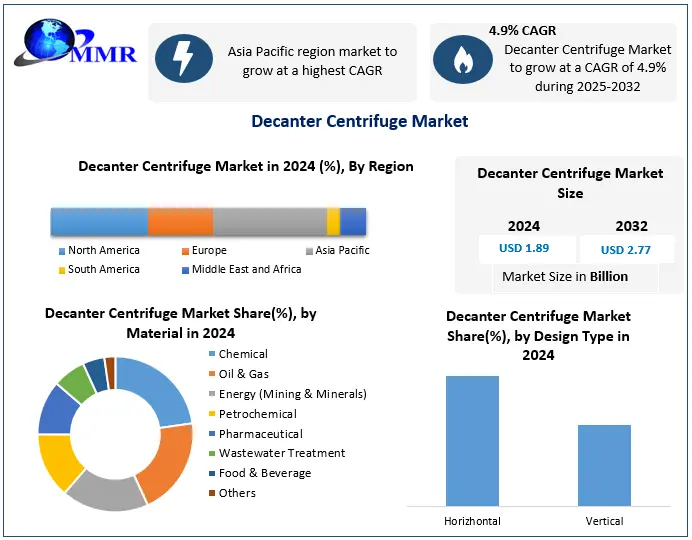 To know about the Research Methodology :- Request Free Sample Report
Decanter Centrifuge Market Dynamics
Rising Demand for Solid-Liquid Separation Across Industries to Drive Decanter Centrifuge Market Growth
Economic factors and demand-supply dynamics are driving the development and growth of decanter centrifuges in industries such as Chemicals, oils, pharmaceuticals food and beverages, and mining. As industrial operations enlarge, the necessity for efficient solid-liquid separation technologies increases, which ensures process efficiency, waste reduction, and resource recovery. Moreover, consumer behavior trends in processed food and sustainable products further drive demand for centrifuge-based separation in food processing and wastewater treatment. For instance, In food processing, decanter centrifuges handle up to 50,000 liters per hour in edible oil refining, while dairy industries use them to recover 95% of protein from whey further enhancing the growth of the decanter centrifuge market.
Stringent Environmental Regulations and Shift Towards Sustainability to Drive Decanter Centrifuge Market Growth
The push for sustainability and low carbon footprints has become a prominent Decanter Centrifuge Market driver, influencing industries to implement energy-efficient and environmentally friendly separation solutions. Decanter centrifuges mainly make various companies comply with strict environmental laws, particularly in wastewater treatment, oil and gas, and industrial processing. For instance, nn wastewater treatment, decanter centrifuges reduce sludge volume by 60–80%, considerably cutting disposal costs, with the U.S. EPA reporting that over 8,000 municipal plants use them for compliance with Clean Water Act regulations raising global concern about the climate change and resource conservation, companies are heavily investing in a centrifuge that delivers reduced energy consumption and lesser emission. This shift is further accelerated by government policies and corporate sustainability commitments.
Growth in Industrialization and Infrastructure Development in Emerging Markets Driving the Decanter Centrifuge Market
Rapid industrialization in evolving economies such as China, India, and Southeast Asia is reshaping demand and supply in the decanter centrifuge market. Economic factors, like increasing investments in industrial infrastructure, rising production capacities, and urbanization, contribute to the increasing need for wastewater treatment and resource recovery systems. Market drivers are also in close competitive forces, as global manufacturers enlarge their footprints in developing markets to cater to the increasing demand for efficient separation technologies.
High Capital and operating costs associated with these machines discourage potential buyers, specifically in small and medium-sized enterprises. Moreover, the complexity of the decanter centrifuge system needs a skilled workforce for its operation and maintenance, which is limited in certain regions. Fluctuating raw materials prices also impact manufacturing expenses, potentially leading to higher end-user prices. Additionally, completion from alternative separation technologies and market saturation in developed regions cause additional market growth and expansion restraints. Falling oil prices have also been identified as a factor that negatively affect the Decanter Centrifuge industry.
Opportunities and Recent Trends in the Decanter Centrifuge Market
The decanter centrifuge market is experiencing substantial growth and development which is driven by the integration of automation and Internet of Things technologies, along with rapid industrialization and urbanization. Modern decanter centrifuges are now equipped with sensors and advanced software, enabling real-time monitoring and control of separation processes. This technological advancement facilitates predictive maintenance, remote operations, and precise process control, leading to increased reliability and reduced operational risk. Additionally, industries are increasingly focusing on automation and efficiency, enlarging IOT and artificial intelligence to optimize operations.
Moreover, the rapid industrialization and urbanization in evolving economics, specifically in countries like China and India, have escalated the demand for efficient separation technologies. As these regions develop, the necessity for advanced decanter centrifugation becomes more pronounced to support expanding industrial activities and infrastructure projects. Recent trends include the integration of IOT and automation. Leading manufacturers like Alfa Laval and GEA Group have introduced smart decanter centrifuges with real-time monitoring and predictive maintenance, reducing downtime by up to 30%. Likewise, Flottweg launched a next-gen centrifuge with 12,000 RPM for finer separation in the pharmaceutical and chemical industries. These developments further enhance the growth of the Decenter Centrifuge market.
Decanter Centrifuge Market Segment Analysis
Based on Type, the market is segmented into Two-phase centrifuge, and Three-phase centrifuge. The Two-Phase Centrifuge Segment has dominated the market in 2024 and is expected to hold the largest market share over the forecast period. The two-phase decanter centrifuge segment holds approximately 55% of the market share in 2024. Because of its broad industrial applications, cost-effectiveness, and efficiency. Widely used in wastewater treatment, oil and gas, food and beverages, and chemical processing industries. The increasing need for effective wastewater treatment, driven by industrialization, urbanization, and stricter environmental regulations, has substantially increased demand for two-phased centrifuges.
For Instance, The U.S. EPA and EU wastewater directives emphasize sludge dewatering, boosting demand for two-phase systems. Compared to three-phased centrifuges, which are mainly used in niche applications such as edible oil recovery and biodiesel production, additionally, two-phase models offer lower costs, simpler operation, and reduced maintenance, making them a preferred choice for industry-optimizing operational expenses. For instance, Two-phase decanters have fewer mechanical components than three-phase models, reducing maintenance costs by 20-25%. Moreover, developments and advancements in automation and IOT integration have enhanced process control, predictive maintenance, and energy efficiency, further maintaining their market leadership.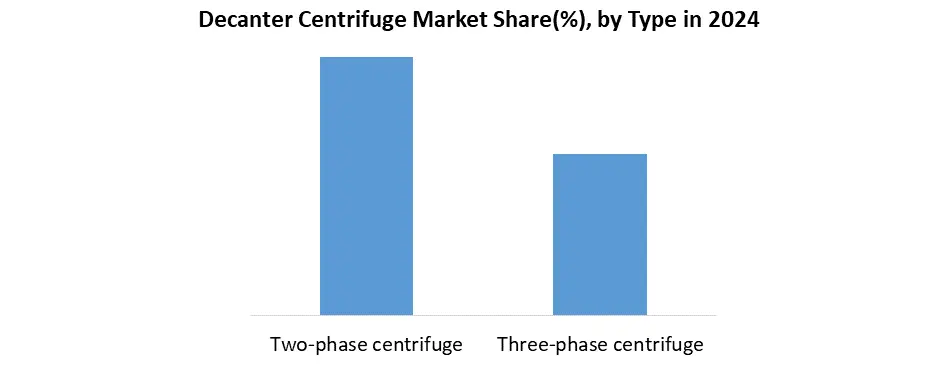 Based on application, the market is segmented into Chemical, Oil & Gas, Energy (Mining & Minerals), Petrochemical, Pharmaceutical, Wastewater Treatment, Food & Beverage and Others. The Chemical application Segment has dominated the market in 2024 and is expected to hold the largest Decanter Centrifuge market share over the forecast period. The chemical industry dominates the market because of its critical need for efficient solid-liquid separation in compliance with stringents environmental regulations such as EPA and REACH standards.
Decenter centrifuge excels in chemical applications by achieving 95-99% solids removal, enabling waste minimization and valuable material recovery through both two-phase and three-phase separation systems. Their versatility allows for handling diverse chemical streams mainly from petrochemical to bio-based materials with adjustable G-forces and throughput capacities of 10-100 m³/h, perfectly matching continuous chemical production needs. Advanced features like IOT-enabled predictive maintenance, while corrosion-resistant material withstand harsh chemical environments. The technology supports mainly the key industry trends containing specialty chemical production, and zero liquid discharge specifically in Asia’s growing chemical sector. With 25% better energy efficiency than older models and 20-30% lower operational cost compared to traditional filtration
Decanter Centrifuge Market Regional Insights:
The Asia Pacific dominated the global decanter centrifuge market in 2024, capturing over 40% of global demand, fueled by its 6 to 8% annual industrial output growth, necessitating advanced separation technologies for efficient processing and waste management. Along with stringent environmental regulations and severe water scarcity challenges. China's rapidly expanding chemical industry and strict zero liquid discharge policies have made decanter centrifuges indispensable for wastewater treatment, while India’s booming pharmaceutical sector and revised waste management rules have substantially raised implementation. Additionally, local manufacturers like TEMA Systems gained traction by offering cost-effective decanters, undercutting Western competitors by 15–20%. The region’s dominance was further fueled by Japan and South Korea’s adoption of smart, IoT-enabled centrifuges for precision chemical and pharmaceutical manufacturing, With Australia and Indonesia's mining industries needing better water recovery solutions, and 60% of the world's water-stressed population living in the region, decanter centrifuges, which recover 70-80% of water, have become essential.
Decanter Centrifuge Market Competitive Landscape
The Decanter centrifuge market is dominated by Alfa Laval and GEA groups, each leading in different segments. Alfa Laval with a 25% market share specializes in high-precision pharmaceutical and food applications with its IOT-enabled NX series(12,000 RPM) offering 30% downtime reduction and a strong presence in the Asia Pacific region.
In contrast, GEA group having 20% of market share leads in mining and chemical sectors with energy-efficient centrays model having 30% lower power consumption, winning major contracts like a $50M ustrelian mining deal. While Alfa Laval focuses on smart, regulated-industry solutions, GEA emphasizes durability and sustainability, driving competition in automation and hybrid technologies.
Decanter Centrifuge Market Scope: Inquire before buying
| Decanter Centrifuge Market | |||
|---|---|---|---|
| Report Coverage | Details | ||
| Base Year: | 2024 | Forecast Period: | 2025-2032 |
| Historical Data: | 2019 to 2024 | Market Size in 2024: | USD 1.89 Bn. |
| Forecast Period 2025 to 2032 CAGR: | 4.9% | Market Size in 2032: | USD 2.77 Bn. |
| Segments Covered: | by Type | Two-phase centrifuge Three-phase centrifuge |
|
| by Design Type | Horizontal Vertical |
||
| by Applications | Chemical Oil & Gas Energy (Mining & Minerals) Petrochemical Pharmaceutical Wastewater Treatment Food & Beverage Others |
||
Decanter Centrifuge Market, by Region
North America (United States, Canada, and Mexico)
Europe (UK, France, Germany, Italy, Spain, Sweden, Austria, and the Rest of Europe)
Asia Pacific (China, South Korea, Japan, India, Australia, ASEAN, and the Rest of APAC)
Middle East & Africa (South Africa, GCC, Nigeria, Rest of ME&A)
South America (Brazil, Argentina Rest of South America)
North America Decanter Centrifuge Market Key Players
1. TEMA Systems Inc. – Ohio, USA
2. Siemens Water Solutions – Pennsylvania, USA
3. Ferrotec (USA) Corp. – California, USA
4. Hiller Separation & Process – Ontario, Canada
5. Grupo Rotoplas – Mexico City
Europe Decanter Centrifuge Market Key Players
1. Alfa Laval – Lund, Sweden
2. GEA Group – Düsseldorf, Germany
3. Andritz Separation – Graz, Austria
4. Flottweg SE – Vilsbiburg, Germany
5. Pieralisi Group – Jesi, Italy
6. Hiller Separation & Process – Vilsbiburg, Germany
7. Veolia Water Technologies – Paris, France
Asia Pacific Decanter Centrifuge Market Key Players
1. Shanghai Centrifuge Institute Co. (SCI) - China
2. TEMA Systems China - China
3. Tomoe Engineering Co. - Japan
4. Mitsubishi Kakoki Kaisha (MKK) - Japan
5. Hanil Centrifuge - South Korea
6. Pharma Fabrik - India
7. Evoqua Water Technologies - Australia
Frequently Asked Questions:
1. Which region has the largest share in the Global Decanter Centrifuge Market?
Ans: The Asia Pacific region held the highest share in 2032.
2. What is the growth rate of the Global Decanter Centrifuge Market?
Ans: The Global Market is expected to grow at a CAGR of 4.9% during the forecast period 2025-2032.
3. What is the scope of the Global Decanter Centrifuge Market report?
Ans: The Global Decanter Centrifuge Market report helps with the PESTEL, PORTER, Recommendations for Investors and leaders, and market estimation for the forecast period.
4. Who are the key players in the Global Decanter Centrifuge Market?
Ans: The important key players in the Global Decanter Centrifuge Market are – Alfa Laval (Sweden), GEA Group (Germany), Andritz Separation (Austria), Flottweg (Germany), Pieralisi Group (Italy), Hiller Separation & Process (Germany), Tomoe Engineering (Japan).
5. What is the study period of this market?
Ans: The Global Decanter Centrifuge Market is studied from 2025 to 2032.