
Crotonaldehyde Market Size Industry-Wide Analysis, Competitive Landscape Assessment & Long-Term Forecast to 2032
Overview
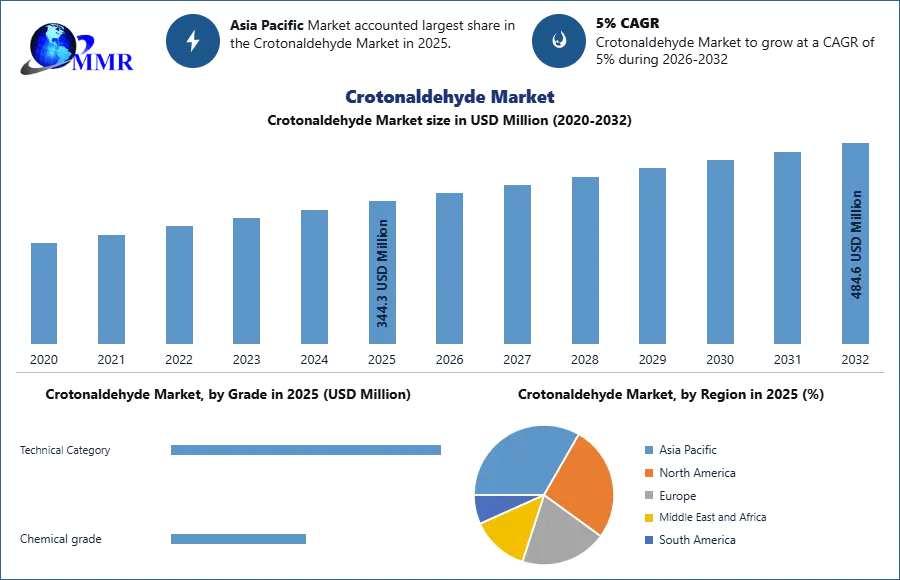
The global Crotonaldehyde Market was valued at USD 344.3 million in 2025 and is projected to reach USD 484.6 million by 2032. The market is expected to grow at a CAGR of 5.0% during the forecast period (2026–2032).
Crotonaldehyde Market Overview:
Crotonaldehyde is an unsaturated aldehyde used mainly as a reactive intermediate in the manufacture of sorbic acid, crotonic acid, pyridines, pharmaceutical intermediates, dyes, pesticides, and rubber chemicals. In 2025, market expansion was supported by steady demand from chemical processing, food preservation, agrochemical synthesis, and specialty formulations. Growth was linked to the broader use of sorbic acid and sorbate preservatives in processed food systems, while pharmaceutical and crop-protection producers continued using crotonaldehyde as a building block for intermediate synthesis. Technological progress in the market remained centered on higher-purity grades, safer handling systems, process-yield optimization, and interest in more sustainable or bio-based production pathways. Demand outlook stayed positive because downstream sectors required reliable aldehyde intermediates with consistent quality for regulated and performance-driven applications. Asia-based manufacturing concentration, particularly in China, continued shaping supply economics, while buyers in pharmaceuticals, food additives, and specialty chemicals increasingly favored suppliers able to meet purity, traceability, and export compliance requirements.
To know about the Research Methodology :- Request Free Sample Report
Crotonaldehyde Market Dynamics:
Chemical Production Applications are Increasing:
Crotonaldehyde creates an azeotrope constituted of 25% water when combined with water at normal atmospheric pressure based on the chemical characteristics. Crotonaldehyde can engage in a variety of reactions thanks to its aldehyde function and a conjugated double bond inside the aldehyde, making it an important starting product in chemical synthesis.
Crotonaldehyde dissolves a wide range of vegetable and mineral oils, fats, waxes, natural and manmade resins, and elementary sulphur. Because of the aforementioned characteristics, it is an excellent component for use in the synthesis of a variety of chemical additives. Crotonaldehyde generates a peroxide and then crotonic acid when it comes into contact with oxygen, while it polymerizes in the presence of mineral acids.
Crotonaldehyde has become an attractive component for many reactions and chemical processes in the chemical industry thanks to its dual reactivity. It may be polymerized, and dehydration with a variety of compounds makes it easier to use in the plastic and paper sectors, where it is made to copolymerize with PVC and engage in the manufacturing of plasticizers.
Production of Chemical Additives:
Crotonaldehyde's major application is expected to remain as a fine chemical precursor during the time frame. Crotonaldehyde is a necessary component in the manufacture of sorbic acid, a natural organic molecule consumed in the food and beverage industry as a food preservative. Because of consumers' hectic lifestyles around the globe, packaged food demand has seen a significant increase in recent years.
The need for boric acid is likely to rise in the future as more consumers want packaged foods with long shelf lives, which is expected to drive the demand for crotonaldehyde.
Crotonaldehyde is also used to make trimethylhydroquinone, which is a precursor to Vitamin E, and crotonic acid, which is a commoner. In addition, crotonaldehyde is used as a flow promoter for alkyd resins. Chemical components such as crotyl alcohol, nu-butanal, and n-butanol, which are generated from the reduction of crotonaldehyde and are then employed as solvents in varnish manufacture, chemical synthesis, and as a fuel, are similar.
Health Hazards of Crotonaldehyde:
Crotonaldehyde is an extremely dangerous chemical that, when inhaled in large amounts, can cause serious health problems in people. During the forecast period, the component's health hazard is likely to offer an obstacle to adoption to some level.
Inhaling crotonaldehyde has been linked to skin irritations and chemical burns, according to several investigations. Long-term exposure to crotonaldehyde can cause a build-up of fluid in the lungs and, in severe circumstances, death. This is likely to hamper adoption in the end-use industry, as it poses a danger to the health and safety of the workers engaged.
Direct contact with crotonaldehyde can produce moderate to severe irritations and allergies on the face, throat, and stomach, though the severity varies from person to person. These physical dangers can be reduced if those who deal closely with the chemical take the necessary precautions to avoid these side effects.
Deep inhalation of the chemical, on the other hand, will cause long-term respiratory diseases. This has become a source of concern for both consumers and manufacturers, who are looking for safer alternatives.
Global Crotonaldehyde Market Segment Analysis:
Crotonaldehyde Market Segmentation, By Type
Based on type, the market had been divided into Technical Grade, High Purity, Industrial Grade, and other purity bands. Among these, the Technical Grade / Industrial Grade sub-segment was projected to generate the maximum revenue. The segment witnessed the highest market share in the global crotonaldehyde market in 2025 because it was widely used across large-volume industrial synthesis routes, especially in agrochemicals, polymers, coatings, and chemical intermediates. Competitive benchmarks indicated that technical grade held more than 58.5% share in 2023, while industrial grade accounted for 72% in 2024, showing that volume demand remained concentrated in broadly usable commercial grades rather than highly specialized premium chemistries. This dominance had been supported by cost efficiency, ease of scale-up, and suitability for sorbic acid, crotonic acid, and derivative production. In 2025, buyers had continued prioritizing commercial-grade crotonaldehyde for bulk manufacturing where throughput, reactivity, and supply continuity were more decisive than ultra-specialty customization.
Crotonaldehyde Market Segmentation, By Application
Based on application, the market had been divided into Chemical Intermediates, Pharmaceutical Intermediates, Sorbic Acid Production, Alcohol Denaturants, Warning Agents, Surfactant Production, Rubber Accelerators, Dyes And Pesticides, and others. Among these, the Chemical Intermediates sub-segment was projected to generate the maximum revenue. This segment witnessed the highest market share in the global crotonaldehyde market in 2025 because crotonaldehyde remained a core feedstock for sorbic acid, crotonic acid, butyl acrylate, pyridine derivatives, and other downstream compounds used across food, coatings, textiles, and fine chemicals. Market references showed chemical intermediates represented about 40% of the market in 2022 and as much as 52% of consumption in 2025, confirming structural leadership. In 2025, the segment had dominated because end users preferred multifunctional intermediates that could serve several downstream value chains at once. Its broad industrial relevance, high repeat purchase pattern, and direct integration into high-volume preservation and synthesis chemistry had kept this segment ahead of niche application areas.
Crotonaldehyde Market Regional Analysis
Asia Pacific region dominated the market in the year 2025 and was expected to continue its dominance during the forecast period. The crotonaldehyde market in Asia Pacific had witnessed notable strength because the region, led by China, functioned as the main production and consumption hub for crotonaldehyde and its downstream derivatives. Competitive benchmarks indicated that China alone accounted for more than 90% of global consumption in some industry assessments, while China was also identified as the largest country market in the region. This dominance in 2025 had been supported by concentrated chemical manufacturing infrastructure, strong intermediate demand from sorbic acid, agrochemicals, and pharmaceuticals, and cost advantages in integrated production chains. The region also benefited from proximity to downstream preservative and specialty chemical manufacturers, enabling large-scale procurement and export-oriented supply. Compared with North America and Europe, Asia Pacific had stronger manufacturing density, broader domestic demand, and greater production flexibility, which collectively sustained its leadership position in global revenue and volume terms.
Recent Development
April 2024: Celanese completed a series of strategic actions across its global acetyl chain at Clear Lake, Texas, and Nanjing, China. The move improved operational flexibility, cost competitiveness, and sustainability of its intermediates platform, which is relevant for crotonaldehyde supply economics because acetyl-chain integration affects upstream feedstock efficiency and long-term regional supply positioning.
October 2025: BASF celebrated the expansion and tenth anniversary of its DMAPA and PEA plants in Nanjing. The project strengthened BASF’s intermediates footprint in Asia Pacific, reduced carbon intensity, and improved responsiveness to customers in the region. For the crotonaldehyde market, this signaled continued investment momentum in adjacent aldehyde and intermediate chemical value chains.
October 2025: The European Commission authorized the use of sorbic acid and potassium sorbate in non-heat-treated plant-based mousses. This regulatory step was important for crotonaldehyde demand because sorbic acid is a key downstream derivative. The approval widened preservative application scope and supported incremental consumption potential across processed and plant-based food formulations.
The objective of the report is to present a comprehensive analysis of the market to the stakeholders in the industry. The past and current status of the industry with the forecasted market size and trends are presented in the report with the analysis of complicated data in simple language. The report covers all the aspects of the industry with a dedicated study of key players that include market leaders, followers, and new entrants.
PORTER, PESTEL analysis with the potential impact of micro-economic factors of the market have been presented in the report. External as well as internal factors that are supposed to affect the business positively or negatively have been analyzed, which will give a clear futuristic view of the industry to the decision-makers.
The report also helps in understanding the global market dynamics, structure by analyzing the market segments and projecting the global market size. Clear representation of competitive analysis of key players by product, price, financial position, product portfolio, growth strategies, and regional presence in the global market makes the report investor's guide.
Global Crotonaldehyde Market Scope: Inquire before buying
| Crotonaldehyde Market | |||
|---|---|---|---|
| Report Coverage | Details | ||
| Base Year: | 2025 | Forecast Period: | 2026-2032 |
| Historical Data: | 2020 to 2025 | Market Size in 2025: | 344.3 USD Million |
| Forecast Period 2026-2032 CAGR: | 5% | Market Size in 2032: | 484.6 USD Million |
| Segments Covered: | by Grade | Technical Category Chemical grade |
|
| by Product Type | Liquid Form Powder Form |
||
| by Application | Chemical Intermediates Pharmaceutical Intermediates Warning Agents Alcohol Denaturants Surfactant Production Insecticides Others |
||
| by End Use Industry | Food And Beverage Pharmaceuticals And Life Sciences Agrochemicals Rubber And Polymers Coatings And Resins Specialty Chemicals Other Industries |
||
Crotonaldehyde Market, By Region
• North America
• Europe
• Asia Pacific
• The Middle East and Africa
• South America
Key players/Competitors profiles covered in the Crotonaldehyde market report in strategic perspective
-
Celanese Corporation
-
Jinyimeng Group
-
Jilin Songtai Chemical Co., Ltd.
-
China Overseas Pioneer Chemicals Ltd.
-
Shandong Kunda Biotechnology Co., Ltd.
-
Jixing Yibang
-
Tokyo Chemical Industry Co., Ltd.
-
Central Drug House
-
Haihang Industry Co., Ltd.
-
SimSon Pharma Limited
-
Vizag Chemical
-
Actylis
-
KANTO CHEMICAL CO., INC.
-
TRInternational, Inc.
-
Loba Chemie Pvt. Ltd.
-
Merck KGaA
-
Thermo Fisher Scientific
-
Alfa Aesar
-
Spectrum Chemical
-
Santa Cruz Biotechnology
-
Toronto Research Chemicals
-
TCI America
-
MP Biomedicals