Cooling Oil Market Size – Industry Structure Evaluation, Demand Drivers Analysis, Regional Growth Analysis and Identification, Competitive Positioning Review & Global Market Size Forecast to 2032

5.6%
CAGR (2026-2032)
4.50 USD Bn.
Market Size
319
Report Pages
149
Market Tables

Overview

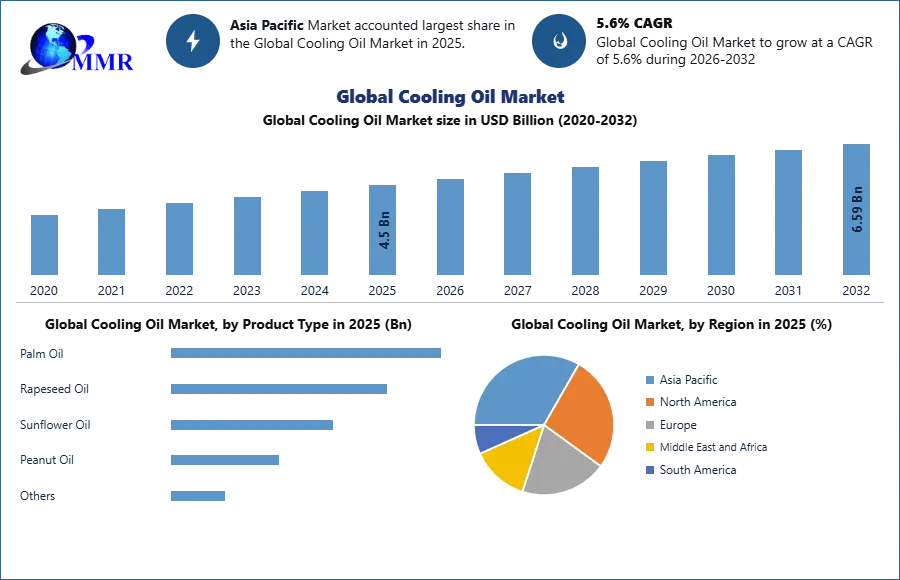
Global Cooling Oil Market is anticipated to reach US$ 6.59 Bn by 2032 from US$ 4.50 Bn in 2025 at a CAGR of 5.6% during a forecast period.

Global Cooling Oil Market Overview

The growing relevance of vegetable oils as crucial functional elements that lessen the risk of cardiovascular disease and breast cancer is expected to continue to be a positive growth driver. Furthermore, due to the increased popularity of omega-3 fatty acid as a nutritious component in the food sector due to its remarkable anti-inflammatory effects, oil derived from soybean, canola, and flax seeds is expected to gain traction.
Global Cooling Oil Market

To know about the Research Methodology :- Request Free Sample Report

Global Cooling Oil Market Dynamics

The demand for cooking oils is being fueled by increased household use of cooking oils in food services. The rise in the global population has increased the consumption of cooking oils, as is main components of a person's daily diet are cooking oils. Furthermore, oils and fats are calorie-dense macronutrients that are the primary sources of essential fatty acids as well as potent carriers of fat-soluble vitamins A, D, E, and K, and are widely used in the bakery and dairy industries. This, in turn, is propelling the growth of the cooking oils market.

Similarly, the utility of edible oils is expected to increase as the number of hotels and restaurant chains from developing countries such as China and India grows as a result of supportive government policies aimed at improving city infrastructure. Manufacturers of cooking oils, such as Unilever PLC and Cargill, Inc., have increased their spending on the development of low-cholesterol products in recent years. Also, changing dietary patterns and a hectic lifestyle among working-class professionals are expected to alter consumer preferences and drive demand for cooking oils such as sunflower and coconut. Coconut oil is high in fatty acids, which help to protect you from bacteria and other pathogens.

Factors contributing to increased cooking oil prices

As a result of adverse weather in key producing countries and the increased use of biofuels, edible oil prices have climbed by as much as 62 % in 2019. India imports around 65 % of its annual cooking oil need of 14.5 million tons. International prices are rising as a result of decreasing supply in key producers such as Indonesia, Malaysia, Argentina, Ukraine, and Russia, which is mostly due to unfavorable weather.

Palm oil production has decreased due to a labor shortage in Malaysia, the world's second-largest producer. Similarly, the B30 and B20 biofuel requirements in Indonesia and Malaysia, which raised the number of vegetable oils included in petrol, boosted domestic consumption, resulting in a decreased exportable surplus.
Because of dry weather in Argentina, the world's largest exporter, and increased demand from key users India and China, soybean oil prices are rising. Similarly, sunflower oil prices have risen as a result of drought-like circumstances in Ukraine and Russia, the commodity's main producers and exporters. According to CRISIL Research, 85 % of soybean oil is imported from Argentina and Brazil, while 90 % of sunflower oil is imported from Ukraine and Russia in 2019.

Global Cooling Oil Market Segmentation Analysis

By Product Type, the Palm oil segment is expected to grow at the largest CAGR of nearly XX% during the forecast period. Palm oil is in high demand from a variety of end-user industries throughout the world since it costs 20% less than other cooking oils. It's also quite adaptable. Palm oil output has increased dramatically in recent years, with Malaysia and Indonesia meeting nearly all of the demand. In most industrialized regions, there is a growth in demand for biofuel. As a result, demand for palm oil is increasing.

Global Cooling Oil Market

By End User, residential, food services and food processing are the three segments of the market. In terms of market share, the residential segment dominates, accounting for about half of all cooking oil sales. During the projected period, however, the food services industry is predicted to increase at the quickest rate.

By Sales Channel, Offline channels generated revenue exceeding USD 50 billion in 2019. Online channel market revenues are expected to reach a level of 8.0% from 2026 to 2032, owing to the growing significance of e-commerce portals as the major selling medium among buyers because of the excellent value-added services such as cash-on-delivery (COD) and coupon advantages. In addition to cooking oil supplies at homes, the use of the internet sales channel offers further advantages. There are profitable discounts and promotional deals available for different brands of cooking oil. The rise of sales of cooking oils across areas has been accelerated.

Competitive Landscape

Major manufacturers use a variety of techniques, including new product launches, mergers and acquisitions, and foraying into new markets to grow their footprints. As an example, The NPEW '20 oil portfolio is introduced on 27 Feb 2020 by Bunge Limited to recreate the flavor, texture, and cooking experience of herbal meats.

On 19 Sep 2019, CHS Inc. is launching new production plans for the soybean processing facility to enhance the capacity of production of soybean oil. Avnash Industries Ghana Ltd. has introduced Lafia cooking oil that is rich in nutrients and is a refined version of palm oil supplemented with Vitamin A.

Recent Development: Cooling Oil Market

Exact Date Company Development Impact
28 January 2026 Oleon & Iceotope The companies formed a strategic collaboration to integrate renewable QLOE™ dielectric fluids with precision liquid cooling systems for AI and edge computing. This partnership accelerates the adoption of sustainable thermal management in high-density data centers by improving cooling efficiency.
28 January 2026 Ergon & Japan Sun Oil The firms signed a transformer oil distribution agreement to supply high-performance insulating fluids across the Japanese power market. The deal reinforces Ergon’s global presence and ensures a steady supply of specialty cooling oils for Japan’s critical grid infrastructure.
08 January 2026 HF Sinclair Corporation The corporation officially closed its acquisition of Industrial Oils Unlimited (IOU), expanding its portfolio of specialty industrial cooling and lubricants. This acquisition allows HF Sinclair to diversify into high-margin specialty markets and strengthen its industrial lubricant footprint in the U.S.
15 November 2025 Nynas AB & KONČAR A 630 kVA distribution transformer was successfully commissioned in Zagreb using NYTRO® BIO 300X, a fully bio-based transformer fluid. This milestone demonstrates the commercial viability of 100% renewable insulating liquids in supporting decarbonization of the electrical grid.
12 October 2025 ExxonMobil The company launched its next-generation Univolt transformer oil featuring enhanced oxidation stability and high-purity formulations. The new product is designed to extend transformer lifespan and improve reliability for utilities facing higher thermal loads from renewable integration.
18 May 2025 Hitachi Energy The company successfully tested the world's first 765 kV transformer utilizing natural ester cooling oil as the primary insulating medium. This achievement proves that eco-friendly ester oils can handle ultra-high voltage, reducing fire risks and environmental impact in large-scale power projects.

Global Cooling Oil Market Regional Analysis

Asia Pacific led the market, accounting for more than 30% of the global share. As a consequence of population expansion, increased disposable income, and urbanization in emerging economies such as China, India, and Bangladesh, the market is predicted to develop at an attractive CAGR.

Furthermore, the increased popularity of low-calorie content oil among the above-mentioned nations' middle-income age groups is expected to have a beneficial influence on the market. China accounts for the lion's share of vegetable oil consumption and production in Asia-Pacific. Despite a high production volume, consumption outnumbers production, resulting in higher import volumes when compared to export volumes. China is a country that relies heavily on imports.

Europe is expected to exceed USD 25 billion by the end of 2026. The popularity of the Mediterranean diet among consumers in Spain, Italy, and France is expected to increase the demand for specialty oils such as olive oil.

The objective of the report is to present a comprehensive analysis of the Global Cooling Oil Market to the stakeholders in the industry. The past and current status of the industry with forecasted market size and trends are presented in the report with the analysis of complicated data in simple language.

The report covers all the aspects of the industry with a dedicated study of key players that include market leaders, followers, and new entrants. PORTER, SVOR, PESTEL analysis with the potential impact of micro-economic factors of the market have been presented in the report. External as well as internal factors that are supposed to affect the business positively or negatively have been analyzed, which will give a clear futuristic view of the industry to the decision-makers.

The report also helps in understanding Global Cooling Oil Market dynamics, structure by analyzing the market segments and project the Global Cooling Oil Market size. Clear representation of competitive analysis of key players by product, price, financial position, product portfolio, growth strategies, and regional presence in the Global Cooling Oil Market make the report investor’s guide.

Global Cooling Oil Market Scope: Inquire before buying

Global Cooling Oil Market
Report Coverage Details
Base Year: 2025 Forecast Period: 2026-2032
Historical Data: 2020 to 2025 Market Size in 2025: 4.5 USD Billion
Forecast Period 2026-2032 CAGR: 5.6% Market Size in 2032: 6.59 USD Billion
Segments Covered: by Product Type Palm Oil
Rapeseed Oil
Sunflower Oil
Peanut Oil
Others
by Viscosity Class Low Viscosity Oils
Medium Viscosity Oils
High Viscosity Oils
by End Use Residential
Food services
Food processing
by Sales Channel Offline
Online

Global Cooling Oil Market by Region

• North America
• Asia pacific
• Europe
• Middle East and Africa
• South America

Global Cooling Oil Market Key Players

  • ExxonMobil Corporation
  • Royal Dutch Shell plc
  • BP p.l.c.
  • Chevron Corporation
  • TotalEnergies SE
  • Indian Oil Corporation Ltd.
  • Valvoline Inc.
  • Castrol Limited (BP Group)
  • Chevron Phillips Chemical Company LLC
  • Fuchs Petrolub SE
  • Lubrizol Corporation
  • Petronas Chemicals Group Berhad
  • Sasol Limited
  • Phillips 66 Company
  • Havoline (Caltex/ExxonMobil brand)
  • Shell Deutschland Oil GmbH
  • LyondellBasell Industries N.V.
  • PetroChina Company Limited
  • Pertamina (PT Pertamina (Persero))
  • Reliance Industries Ltd.
  • China National Petroleum Corporation (CNPC)
  • China Petroleum & Chemical Corporation (Sinopec Group)
  • Idemitsu Kosan Co. Ltd.
  • ENO (Engineered Nano-Oils & Fluids Ltd.)
  • KLÜBER LUBRIFICATION München SE & Co. KG
  • MOL Group
  • Petrobras (Petróleo Brasileiro S.A.)
  • Royal Vopak

Frequently Asked Questions:

1. Which region has the largest share in Cooling Oil Market?
Ans: Asia Pacific region holds the highest share in 2025.

2. What is the growth rate of Cooling Oil Market?
Ans: The Cooling Oil Market is growing at a CAGR of 5.6% during forecasting period 2026-2032.

3. What is scope of the Global Cooling Oil market report?
Ans: Global Cooling Oil market report helps with the PESTEL, PORTER, COVID-19 impact analysis, recommendations for investors and leaders, and market estimation of the forecast period.

4. Who are the key players in Cooling Oil market?
Ans: The important key players in the Cooling Oil Market are Archer Daniels Midland Company, Cargill Incorporated, Bunge Limited, Olam international Limited, Fuji Oil Holding Inc,, American Vegetable Oils, Inc

5. What is the study period of this market?
Ans: The Cooling Oil Market is studied from 2025 to 2032.

Table of Contents

1. Global Cooling Oil Market Introduction
1.1. Study Assumption and Market Definition
1.2. Scope of the Study
1.3. Executive Summary
2. Global Global Cooling Oil Market: Competitive Landscape
2.1. MMR Competition Matrix
2.2. Competitive Landscape
2.3. Key Players Benchmarking
2.3.1. Company Name
2.3.2. Business Segment
2.3.3. End-user Segment
2.3.4. Revenue (2025)
2.3.5. Company Locations
2.4. Leading Global Cooling Oil Market Companies, by market capitalization
2.5. Market Structure
2.5.1. Market Leaders
2.5.2. Market Followers
2.5.3. Emerging Players
2.6. Mergers and Acquisitions Details
3. Global Cooling Oil Market: Dynamics
3.1. Global Cooling Oil Market Trends by Region
3.1.1. North America Global Cooling Oil Market Trends
3.1.2. Europe Global Cooling Oil Market Trends
3.1.3. Asia Pacific Global Cooling Oil Market Trends
3.1.4. Middle East and Africa Global Cooling Oil Market Trends
3.1.5. South America Global Cooling Oil Market Trends
3.2. Global Cooling Oil Market Dynamics by Region
3.2.1. North America
3.2.1.1. North America Global Cooling Oil Market Drivers
3.2.1.2. North America Global Cooling Oil Market Restraints
3.2.1.3. North America Global Cooling Oil Market Opportunities
3.2.1.4. North America Global Cooling Oil Market Challenges
3.2.2. Europe
3.2.2.1. Europe Global Cooling Oil Market Drivers
3.2.2.2. Europe Global Cooling Oil Market Restraints
3.2.2.3. Europe Global Cooling Oil Market Opportunities
3.2.2.4. Europe Global Cooling Oil Market Challenges
3.2.3. Asia Pacific
3.2.3.1. Asia Pacific Global Cooling Oil Market Drivers
3.2.3.2. Asia Pacific Global Cooling Oil Market Restraints
3.2.3.3. Asia Pacific Global Cooling Oil Market Opportunities
3.2.3.4. Asia Pacific Global Cooling Oil Market Challenges
3.2.4. Middle East and Africa
3.2.4.1. Middle East and Africa Global Cooling Oil Market Drivers
3.2.4.2. Middle East and Africa Global Cooling Oil Market Restraints
3.2.4.3. Middle East and Africa Global Cooling Oil Market Opportunities
3.2.4.4. Middle East and Africa Global Cooling Oil Market Challenges
3.2.5. South America
3.2.5.1. South America Global Cooling Oil Market Drivers
3.2.5.2. South America Global Cooling Oil Market Restraints
3.2.5.3. South America Global Cooling Oil Market Opportunities
3.2.5.4. South America Global Cooling Oil Market Challenges
3.3. PORTER's Five Forces Analysis
3.4. PESTLE Analysis
3.5. Technology Roadmap
3.6. Regulatory Landscape by Region
3.6.1. North America
3.6.2. Europe
3.6.3. Asia Pacific
3.6.4. Middle East and Africa
3.6.5. South America
3.7. Key Opinion Leader Analysis For Global Cooling Oil Industry
3.8. Analysis of Government Schemes and Initiatives For Global Cooling Oil Industry
3.9. Global Cooling Oil Market Trade Analysis
3.10. The Global Pandemic Impact on Global Cooling Oil Market
4. Global Cooling Oil Market: Global Market Size and Forecast by Segmentation (in USD Billion) 2025-2032
4.1. Global Cooling Oil Market Size and Forecast, by Product Type (2025-2032)
4.1.1. Palm Oil
4.1.2. Rapeseed Oil
4.1.3. Sunflower Oil
4.1.4. Peanut Oil
4.1.5. Others
4.2. Global Cooling Oil Market Size and Forecast, by Viscosity Class (2025-2032)
4.2.1. Low Viscosity Oils
4.2.2. Medium Viscosity Oils
4.2.3. High Viscosity Oils
4.3. Global Cooling Oil Market Size and Forecast, by End Use (2025-2032)
4.3.1. Residential
4.3.2. Food services
4.3.3. Food processing
4.4. Global Cooling Oil Market Size and Forecast, by Sales Channel (2025-2032)
4.4.1. Offline
4.4.2. Online
4.5. Global Cooling Oil Market Size and Forecast, by Region (2025-2032)
4.5.1. North America
4.5.2. Europe
4.5.3. Asia Pacific
4.5.4. Middle East and Africa
4.5.5. South America
5. North America Global Cooling Oil Market Size and Forecast by Segmentation (in USD Billion) 2025-2032
5.1. North America Global Cooling Oil Market Size and Forecast, by Product Type (2025-2032)
5.1.1. Palm Oil
5.1.2. Rapeseed Oil
5.1.3. Sunflower Oil
5.1.4. Peanut Oil
5.1.5. Others
5.2. North America Global Cooling Oil Market Size and Forecast, by Viscosity Class (2025-2032)
5.2.1. Low Viscosity Oils
5.2.2. Medium Viscosity Oils
5.2.3. High Viscosity Oils
5.3. North America Global Cooling Oil Market Size and Forecast, by End Use (2025-2032)
5.3.1. Residential
5.3.2. Food services
5.3.3. Food processing
5.4. North America Global Cooling Oil Market Size and Forecast, by Sales Channel (2025-2032)
5.4.1. Offline
5.4.2. Online
5.5. North America Global Cooling Oil Market Size and Forecast, by Country (2025-2032)
5.5.1. United States
5.5.1.1. United States Global Cooling Oil Market Size and Forecast, by Product Type (2025-2032)
5.5.1.1.1. Palm Oil
5.5.1.1.2. Rapeseed Oil
5.5.1.1.3. Sunflower Oil
5.5.1.1.4. Peanut Oil
5.5.1.1.5. Others
5.5.1.2. United States Global Cooling Oil Market Size and Forecast, by Viscosity Class (2025-2032)
5.5.1.2.1. Low Viscosity Oils
5.5.1.2.2. Medium Viscosity Oils
5.5.1.2.3. High Viscosity Oils
5.5.1.3. United States Global Cooling Oil Market Size and Forecast, by End Use (2025-2032)
5.5.1.3.1. Residential
5.5.1.3.2. Food services
5.5.1.3.3. Food processing
5.5.1.4. United States Global Cooling Oil Market Size and Forecast, by Sales Channel (2025-2032)
5.5.1.4.1. Offline
5.5.1.4.2. Online
5.5.2. Canada
5.5.2.1. Canada Global Cooling Oil Market Size and Forecast, by Product Type (2025-2032)
5.5.2.1.1. Palm Oil
5.5.2.1.2. Rapeseed Oil
5.5.2.1.3. Sunflower Oil
5.5.2.1.4. Peanut Oil
5.5.2.1.5. Others
5.5.2.2. Canada Global Cooling Oil Market Size and Forecast, by Viscosity Class (2025-2032)
5.5.2.2.1. Low Viscosity Oils
5.5.2.2.2. Medium Viscosity Oils
5.5.2.2.3. High Viscosity Oils
5.5.2.3. Canada Global Cooling Oil Market Size and Forecast, by End Use (2025-2032)
5.5.2.3.1. Residential
5.5.2.3.2. Food services
5.5.2.3.3. Food processing
5.5.2.4. Canada Global Cooling Oil Market Size and Forecast, by Sales Channel (2025-2032)
5.5.2.4.1. Offline
5.5.2.4.2. Online
5.5.3. Mexico
5.5.3.1. Mexico Global Cooling Oil Market Size and Forecast, by Product Type (2025-2032)
5.5.3.1.1. Palm Oil
5.5.3.1.2. Rapeseed Oil
5.5.3.1.3. Sunflower Oil
5.5.3.1.4. Peanut Oil
5.5.3.1.5. Others
5.5.3.2. Mexico Global Cooling Oil Market Size and Forecast, by Viscosity Class (2025-2032)
5.5.3.2.1. Low Viscosity Oils
5.5.3.2.2. Medium Viscosity Oils
5.5.3.2.3. High Viscosity Oils
5.5.3.3. Mexico Global Cooling Oil Market Size and Forecast, by End Use (2025-2032)
5.5.3.3.1. Residential
5.5.3.3.2. Food services
5.5.3.3.3. Food processing
5.5.3.4. Mexico Global Cooling Oil Market Size and Forecast, by Sales Channel (2025-2032)
5.5.3.4.1. Offline
5.5.3.4.2. Online
6. Europe Global Cooling Oil Market Size and Forecast by Segmentation (in USD Billion) 2025-2032
6.1. Europe Global Cooling Oil Market Size and Forecast, by Product Type (2025-2032)
6.2. Europe Global Cooling Oil Market Size and Forecast, by Viscosity Class (2025-2032)
6.3. Europe Global Cooling Oil Market Size and Forecast, by End Use (2025-2032)
6.4. Europe Global Cooling Oil Market Size and Forecast, by Sales Channel (2025-2032)
6.5. Europe Global Cooling Oil Market Size and Forecast, by Country (2025-2032)
6.5.1. United Kingdom
6.5.1.1. United Kingdom Global Cooling Oil Market Size and Forecast, by Product Type (2025-2032)
6.5.1.2. United Kingdom Global Cooling Oil Market Size and Forecast, by Viscosity Class (2025-2032)
6.5.1.3. United Kingdom Global Cooling Oil Market Size and Forecast, by End Use (2025-2032)
6.5.1.4. United Kingdom Global Cooling Oil Market Size and Forecast, by Sales Channel (2025-2032)
6.5.2. France
6.5.2.1. France Global Cooling Oil Market Size and Forecast, by Product Type (2025-2032)
6.5.2.2. France Global Cooling Oil Market Size and Forecast, by Viscosity Class (2025-2032)
6.5.2.3. France Global Cooling Oil Market Size and Forecast, by End Use (2025-2032)
6.5.2.4. France Global Cooling Oil Market Size and Forecast, by Sales Channel (2025-2032)
6.5.3. Germany
6.5.3.1. Germany Global Cooling Oil Market Size and Forecast, by Product Type (2025-2032)
6.5.3.2. Germany Global Cooling Oil Market Size and Forecast, by Viscosity Class (2025-2032)
6.5.3.3. Germany Global Cooling Oil Market Size and Forecast, by End Use (2025-2032)
6.5.3.4. Germany Global Cooling Oil Market Size and Forecast, by Sales Channel (2025-2032)
6.5.4. Italy
6.5.4.1. Italy Global Cooling Oil Market Size and Forecast, by Product Type (2025-2032)
6.5.4.2. Italy Global Cooling Oil Market Size and Forecast, by Viscosity Class (2025-2032)
6.5.4.3. Italy Global Cooling Oil Market Size and Forecast, by End Use (2025-2032)
6.5.4.4. Italy Global Cooling Oil Market Size and Forecast, by Sales Channel (2025-2032)
6.5.5. Spain
6.5.5.1. Spain Global Cooling Oil Market Size and Forecast, by Product Type (2025-2032)
6.5.5.2. Spain Global Cooling Oil Market Size and Forecast, by Viscosity Class (2025-2032)
6.5.5.3. Spain Global Cooling Oil Market Size and Forecast, by End Use (2025-2032)
6.5.5.4. Spain Global Cooling Oil Market Size and Forecast, by Sales Channel (2025-2032)
6.5.6. Sweden
6.5.6.1. Sweden Global Cooling Oil Market Size and Forecast, by Product Type (2025-2032)
6.5.6.2. Sweden Global Cooling Oil Market Size and Forecast, by Viscosity Class (2025-2032)
6.5.6.3. Sweden Global Cooling Oil Market Size and Forecast, by End Use (2025-2032)
6.5.6.4. Sweden Global Cooling Oil Market Size and Forecast, by Sales Channel (2025-2032)
6.5.7. Austria
6.5.7.1. Austria Global Cooling Oil Market Size and Forecast, by Product Type (2025-2032)
6.5.7.2. Austria Global Cooling Oil Market Size and Forecast, by Viscosity Class (2025-2032)
6.5.7.3. Austria Global Cooling Oil Market Size and Forecast, by End Use (2025-2032)
6.5.7.4. Austria Global Cooling Oil Market Size and Forecast, by Sales Channel (2025-2032)
6.5.8. Rest of Europe
6.5.8.1. Rest of Europe Global Cooling Oil Market Size and Forecast, by Product Type (2025-2032)
6.5.8.2. Rest of Europe Global Cooling Oil Market Size and Forecast, by Viscosity Class (2025-2032)
6.5.8.3. Rest of Europe Global Cooling Oil Market Size and Forecast, by End Use (2025-2032)
6.5.8.4. Rest of Europe Global Cooling Oil Market Size and Forecast, by Sales Channel (2025-2032)
7. Asia Pacific Global Cooling Oil Market Size and Forecast by Segmentation (in USD Billion) 2025-2032
7.1. Asia Pacific Global Cooling Oil Market Size and Forecast, by Product Type (2025-2032)
7.2. Asia Pacific Global Cooling Oil Market Size and Forecast, by Viscosity Class (2025-2032)
7.3. Asia Pacific Global Cooling Oil Market Size and Forecast, by End Use (2025-2032)
7.4. Asia Pacific Global Cooling Oil Market Size and Forecast, by Sales Channel (2025-2032)
7.5. Asia Pacific Global Cooling Oil Market Size and Forecast, by Country (2025-2032)
7.5.1. China
7.5.1.1. China Global Cooling Oil Market Size and Forecast, by Product Type (2025-2032)
7.5.1.2. China Global Cooling Oil Market Size and Forecast, by Viscosity Class (2025-2032)
7.5.1.3. China Global Cooling Oil Market Size and Forecast, by End Use (2025-2032)
7.5.1.4. China Global Cooling Oil Market Size and Forecast, by Sales Channel (2025-2032)
7.5.2. S Korea
7.5.2.1. S Korea Global Cooling Oil Market Size and Forecast, by Product Type (2025-2032)
7.5.2.2. S Korea Global Cooling Oil Market Size and Forecast, by Viscosity Class (2025-2032)
7.5.2.3. S Korea Global Cooling Oil Market Size and Forecast, by End Use (2025-2032)
7.5.2.4. S Korea Global Cooling Oil Market Size and Forecast, by Sales Channel (2025-2032)
7.5.3. Japan
7.5.3.1. Japan Global Cooling Oil Market Size and Forecast, by Product Type (2025-2032)
7.5.3.2. Japan Global Cooling Oil Market Size and Forecast, by Viscosity Class (2025-2032)
7.5.3.3. Japan Global Cooling Oil Market Size and Forecast, by End Use (2025-2032)
7.5.3.4. Japan Global Cooling Oil Market Size and Forecast, by Sales Channel (2025-2032)
7.5.4. India
7.5.4.1. India Global Cooling Oil Market Size and Forecast, by Product Type (2025-2032)
7.5.4.2. India Global Cooling Oil Market Size and Forecast, by Viscosity Class (2025-2032)
7.5.4.3. India Global Cooling Oil Market Size and Forecast, by End Use (2025-2032)
7.5.4.4. India Global Cooling Oil Market Size and Forecast, by Sales Channel (2025-2032)
7.5.5. Australia
7.5.5.1. Australia Global Cooling Oil Market Size and Forecast, by Product Type (2025-2032)
7.5.5.2. Australia Global Cooling Oil Market Size and Forecast, by Viscosity Class (2025-2032)
7.5.5.3. Australia Global Cooling Oil Market Size and Forecast, by End Use (2025-2032)
7.5.5.4. Australia Global Cooling Oil Market Size and Forecast, by Sales Channel (2025-2032)
7.5.6. Indonesia
7.5.6.1. Indonesia Global Cooling Oil Market Size and Forecast, by Product Type (2025-2032)
7.5.6.2. Indonesia Global Cooling Oil Market Size and Forecast, by Viscosity Class (2025-2032)
7.5.6.3. Indonesia Global Cooling Oil Market Size and Forecast, by End Use (2025-2032)
7.5.6.4. Indonesia Global Cooling Oil Market Size and Forecast, by Sales Channel (2025-2032)
7.5.7. Malaysia
7.5.7.1. Malaysia Global Cooling Oil Market Size and Forecast, by Product Type (2025-2032)
7.5.7.2. Malaysia Global Cooling Oil Market Size and Forecast, by Viscosity Class (2025-2032)
7.5.7.3. Malaysia Global Cooling Oil Market Size and Forecast, by End Use (2025-2032)
7.5.7.4. Malaysia Global Cooling Oil Market Size and Forecast, by Sales Channel (2025-2032)
7.5.8. Vietnam
7.5.8.1. Vietnam Global Cooling Oil Market Size and Forecast, by Product Type (2025-2032)
7.5.8.2. Vietnam Global Cooling Oil Market Size and Forecast, by Viscosity Class (2025-2032)
7.5.8.3. Vietnam Global Cooling Oil Market Size and Forecast, by End Use (2025-2032)
7.5.8.4. Vietnam Global Cooling Oil Market Size and Forecast, by Sales Channel (2025-2032)
7.5.9. Taiwan
7.5.9.1. Taiwan Global Cooling Oil Market Size and Forecast, by Product Type (2025-2032)
7.5.9.2. Taiwan Global Cooling Oil Market Size and Forecast, by Viscosity Class (2025-2032)
7.5.9.3. Taiwan Global Cooling Oil Market Size and Forecast, by End Use (2025-2032)
7.5.9.4. Taiwan Global Cooling Oil Market Size and Forecast, by Sales Channel (2025-2032)
7.5.10. Rest of Asia Pacific
7.5.10.1. Rest of Asia Pacific Global Cooling Oil Market Size and Forecast, by Product Type (2025-2032)
7.5.10.2. Rest of Asia Pacific Global Cooling Oil Market Size and Forecast, by Viscosity Class (2025-2032)
7.5.10.3. Rest of Asia Pacific Global Cooling Oil Market Size and Forecast, by End Use (2025-2032)
7.5.10.4. Rest of Asia Pacific Global Cooling Oil Market Size and Forecast, by Sales Channel (2025-2032)
8. Middle East and Africa Global Cooling Oil Market Size and Forecast by Segmentation (in USD Billion) 2025-2032
8.1. Middle East and Africa Global Cooling Oil Market Size and Forecast, by Product Type (2025-2032)
8.2. Middle East and Africa Global Cooling Oil Market Size and Forecast, by Viscosity Class (2025-2032)
8.3. Middle East and Africa Global Cooling Oil Market Size and Forecast, by End Use (2025-2032)
8.4. Middle East and Africa Global Cooling Oil Market Size and Forecast, by Sales Channel (2025-2032)
8.5. Middle East and Africa Global Cooling Oil Market Size and Forecast, by Country (2025-2032)
8.5.1. South Africa
8.5.1.1. South Africa Global Cooling Oil Market Size and Forecast, by Product Type (2025-2032)
8.5.1.2. South Africa Global Cooling Oil Market Size and Forecast, by Viscosity Class (2025-2032)
8.5.1.3. South Africa Global Cooling Oil Market Size and Forecast, by End Use (2025-2032)
8.5.1.4. South Africa Global Cooling Oil Market Size and Forecast, by Sales Channel (2025-2032)
8.5.2. GCC
8.5.2.1. GCC Global Cooling Oil Market Size and Forecast, by Product Type (2025-2032)
8.5.2.2. GCC Global Cooling Oil Market Size and Forecast, by Viscosity Class (2025-2032)
8.5.2.3. GCC Global Cooling Oil Market Size and Forecast, by End Use (2025-2032)
8.5.2.4. GCC Global Cooling Oil Market Size and Forecast, by Sales Channel (2025-2032)
8.5.3. Nigeria
8.5.3.1. Nigeria Global Cooling Oil Market Size and Forecast, by Product Type (2025-2032)
8.5.3.2. Nigeria Global Cooling Oil Market Size and Forecast, by Viscosity Class (2025-2032)
8.5.3.3. Nigeria Global Cooling Oil Market Size and Forecast, by End Use (2025-2032)
8.5.3.4. Nigeria Global Cooling Oil Market Size and Forecast, by Sales Channel (2025-2032)
8.5.4. Rest of ME&A
8.5.4.1. Rest of ME&A Global Cooling Oil Market Size and Forecast, by Product Type (2025-2032)
8.5.4.2. Rest of ME&A Global Cooling Oil Market Size and Forecast, by Viscosity Class (2025-2032)
8.5.4.3. Rest of ME&A Global Cooling Oil Market Size and Forecast, by End Use (2025-2032)
8.5.4.4. Rest of ME&A Global Cooling Oil Market Size and Forecast, by Sales Channel (2025-2032)
9. South America Global Cooling Oil Market Size and Forecast by Segmentation (in USD Billion) 2025-2032
9.1. South America Global Cooling Oil Market Size and Forecast, by Product Type (2025-2032)
9.2. South America Global Cooling Oil Market Size and Forecast, by Viscosity Class (2025-2032)
9.3. South America Global Cooling Oil Market Size and Forecast, by End Use (2025-2032)
9.4. South America Global Cooling Oil Market Size and Forecast, by Sales Channel (2025-2032)
9.5. South America Global Cooling Oil Market Size and Forecast, by Country (2025-2032)
9.5.1. Brazil
9.5.1.1. Brazil Global Cooling Oil Market Size and Forecast, by Product Type (2025-2032)
9.5.1.2. Brazil Global Cooling Oil Market Size and Forecast, by Viscosity Class (2025-2032)
9.5.1.3. Brazil Global Cooling Oil Market Size and Forecast, by End Use (2025-2032)
9.5.1.4. Brazil Global Cooling Oil Market Size and Forecast, by Sales Channel (2025-2032)
9.5.2. Argentina
9.5.2.1. Argentina Global Cooling Oil Market Size and Forecast, by Product Type (2025-2032)
9.5.2.2. Argentina Global Cooling Oil Market Size and Forecast, by Viscosity Class (2025-2032)
9.5.2.3. Argentina Global Cooling Oil Market Size and Forecast, by End Use (2025-2032)
9.5.2.4. Argentina Global Cooling Oil Market Size and Forecast, by Sales Channel (2025-2032)
9.5.3. Rest Of South America
9.5.3.1. Rest Of South America Global Cooling Oil Market Size and Forecast, by Product Type (2025-2032)
9.5.3.2. Rest Of South America Global Cooling Oil Market Size and Forecast, by Viscosity Class (2025-2032)
9.5.3.3. Rest Of South America Global Cooling Oil Market Size and Forecast, by End Use (2025-2032)
9.5.3.4. Rest Of South America Global Cooling Oil Market Size and Forecast, by Sales Channel (2025-2032)
10. Company Profile: Key Players
10.1. ExxonMobil Corporation
10.1.1. Company Overview
10.1.2. Business Portfolio
10.1.3. Financial Overview
10.1.4. SWOT Analysis
10.1.5. Strategic Analysis
10.1.6. Scale of Operation (small, medium, and large)
10.1.7. Details on Partnership
10.1.8. Regulatory Accreditations and Certifications Received by Them
10.1.9. Awards Received by the Firm
10.1.10. Recent Developments
10.2. Royal Dutch Shell plc
10.3. BP p.l.c.
10.4. Chevron Corporation
10.5. TotalEnergies SE
10.6. Indian Oil Corporation Ltd.
10.7. Valvoline Inc.
10.8. Castrol Limited (BP Group)
10.9. Chevron Phillips Chemical Company LLC
10.10. Fuchs Petrolub SE
10.11. Lubrizol Corporation
10.12. Petronas Chemicals Group Berhad
10.13. Sasol Limited
10.14. Phillips 66 Company
10.15. Havoline (Caltex/ExxonMobil brand)
10.16. Shell Deutschland Oil GmbH
10.17. LyondellBasell Industries N.V.
10.18. PetroChina Company Limited
10.19. Pertamina (PT Pertamina (Persero))
10.20. Reliance Industries Ltd.
10.21. China National Petroleum Corporation (CNPC)
10.22. China Petroleum & Chemical Corporation (Sinopec Group)
10.23. Idemitsu Kosan Co. Ltd.
10.24. ENO (Engineered Nano-Oils & Fluids Ltd.)
10.25. KLÜBER LUBRIFICATION München SE & Co. KG
10.26. MOL Group
10.27. Petrobras (Petróleo Brasileiro S.A.)
10.28. Royal Vopak
11. Key Findings
12. Industry Recommendations
13. Global Cooling Oil Market: Research Methodology
14. Terms and Glossary

Custom Market Research Services

We Will Customise The Research For You, In Case The Report Listed Above Does Not Meet With Your Requirements