
Construction Adhesives Market Size by Resin Type, Technology, End-Use Sector, Region, Industry-Wide Analysis, Competitive Landscape Assessment & Long-Term Forecast to 2029
Overview
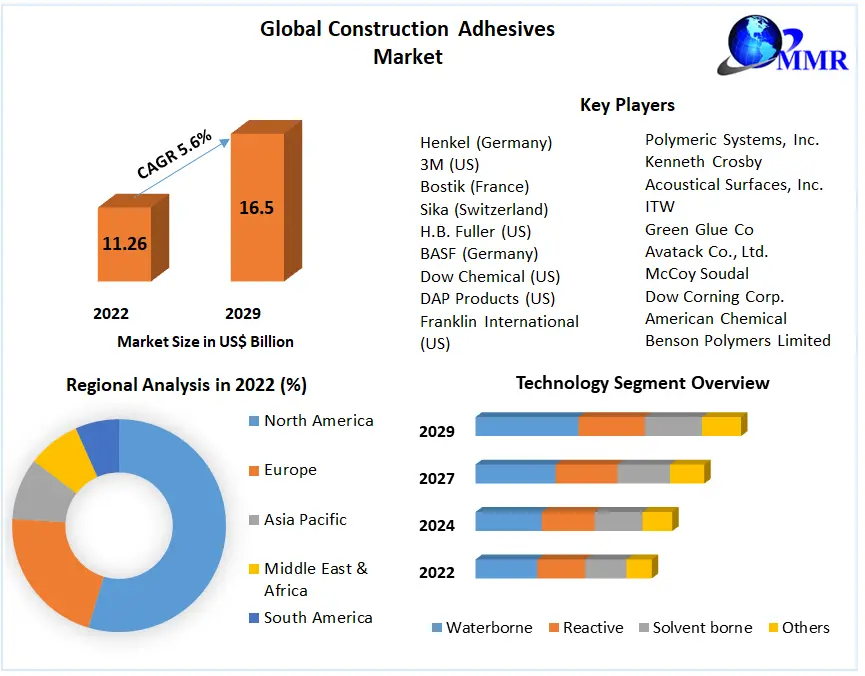
Construction Adhesives Market size is expected to reach nearly US$ 16.50 Bn. by 2029 with the CAGR of 5.6% during the forecast period.
The report includes an analysis of the impact of COVID-19 lockdown on the revenue of market leaders, followers, and disruptors. Since the lockdown was implemented differently in various regions and countries; the impact of the same is also seen differently by regions and segments. The report has covered the current short-term and long-term impact on the market, and it would help the decision-makers to prepare the outline and strategies for companies by region.
 To know about the Research Methodology :- Request Free Sample Report
Construction Adhesives Market Dynamics:
Construction adhesives are largely used for roofing, waterproofing, flooring & insulation, cladding, and reinforcement purposes. Also, for holding and bonding applications due to its high shear and tensile strength and for filling gaps and resist relative movement of the substrates. Increasing demand for residential housing and commercial offices, along with the rising construction activities is fueling the demand for construction adhesives.
Construction Adhesives Market Segment Analysis:
The construction adhesives market based on the end-use sector; the residential sector is expected to be one of the major contributors to the market growth. Increasing demand for new and innovative products and growing research & development in construction adhesives are driving the growth of the segment.
PU segment based on resin type is expected to contribute the largest share in the construction adhesives market during the forecast period. PU adhesives are used in an extensive range of applications in the construction industry.
Construction Adhesives Market Regional Insights:
Geographically, Asia Pacific is expected to be one of the largest markets for the construction adhesives market during the forecast period on account of enhancing the construction industry. Countries such as China, India, Thailand, and Indonesia are witnessing large investments in the building & construction industry.
Construction Adhesives Market, Key Highlights:
Global Market analysis and forecast, in terms of value.
Comprehensive study and analysis of market drivers, restraints and opportunities influencing the growth of the Global Market
Global Market segmentation on the basis of type, source, end-user, and region (country-wise) has been provided.
Global Market strategic analysis with respect to individual growth trends, future prospects along with the contribution of various sub-market stakeholders have been considered under the scope of study.
Global Market analysis and forecast for five major regions namely North America, Europe, Asia Pacific, the Middle East & Africa (MEA) and Latin America along with country-wise segmentation.
Profiles of key industry players, their strategic perspective, market positioning and analysis of core competencies are further profiled.
Competitive developments, investments, strategic expansion and competitive landscape of the key players operating in the Global Market are also profiled.
Construction Adhesives Market Scope: Inquire before buying
| Global Construction Adhesives Market | |||
|---|---|---|---|
| Report Coverage | Details | ||
| Base Year: | 2022 | Forecast Period: | 2022-2029 |
| Historical Data: | 2018 to 2022 | Market Size in 2022: | US$ 11.26 Bn. |
| Forecast Period 2023 to 2029 CAGR: | 5.60% | Market Size in 2029: | US$ 16.5 Bn. |
| Segments Covered: | by Resin Type | Acrylic PVA PU Epoxy Others |
|
| by Technology | Waterborne Reactive Solvent borne Others |
||
| by End-Use Sector | Residential Non-Residential Infrastructure |
||
Construction Adhesives Market, by Region
North America (United States, Canada and Mexico)
Europe (UK, France, Germany, Italy, Spain, Sweden, Austria, Turkey, Russia and Rest of Europe)
Asia Pacific (China, India, Japan, South Korea, Australia, ASEAN and Rest of APAC)
Middle East and Africa (South Africa, GCC, Egypt, Nigeria and Rest of ME&A)
South America (Brazil, Argentina, Columbia and Rest of South America)
Construction Adhesives Market, Key Players are
1.Henkel (Germany)
2. 3M (US)
3. Bostik (France)
4. Sika (Switzerland)
5. H.B. Fuller (US)
6. BASF (Germany)
7. Dow Chemical (US)
8. DAP Products (US)
9. Franklin International (US)
10. Illinois Tool Works (US)
11. Avery Dennison (US)
12. Polymeric Systems, Inc.
13. Kenneth Crosby
14. Acoustical Surfaces, Inc.
15. ITW
16. Green Glue Co
17. Avatack Co., Ltd.
18. McCoy Soudal
19. Dow Corning Corp.
20. American Chemical
21. Benson Polymers Limited
22. Master Bond Inc.
23. Huntsman Corporation
24. Hexcel and Gorilla Glue Inc
Frequently Asked Questions:
1. Which region has the largest share in Global Construction Adhesives Market?
Ans: Asia Pacific region holds the highest share in 2022.
2. What is the growth rate of Global Construction Adhesives Market?
Ans: The Global Construction Adhesives Market is growing at a CAGR of 5.60% during forecasting period 2023-2029.
3. What is scope of the Global Construction Adhesives market report?
Ans: Global Construction Adhesives Market report helps with the PESTEL, PORTER, COVID-19 Impact analysis, Recommendations for Investors & Leaders, and market estimation of the forecast period.
4. Who are the key players in Global Construction Adhesives market?
Ans: The important key players in the Global Market are – Henkel (Germany), 3M (US), Bostik (France), Sika (Switzerland), H.B. Fuller (US), BASF (Germany), Dow Chemical (US), DAP Products (US), Franklin International (US), Illinois Tool Works (US), Avery Dennison (US), Polymeric Systems, Inc., Kenneth Crosby, Acoustical Surfaces, Inc., ITW, Green Glue Co, Avatack Co., Ltd., McCoy Soudal, Dow Corning Corp., American Chemical, Benson Polymers Limited, Master Bond Inc., Huntsman Corporation, and Hexcel and Gorilla Glue Inc.
5. What is the study period of this market?
Ans: The Global Market is studied from 2022 to 2029.