
Computer Vision Market by Component, Product, Application, End-User and Region – Global Market Size Estimation, Industry-Wide Analysis, Competitive Landscape Assessment & Long-Term Forecast to 2032
Overview
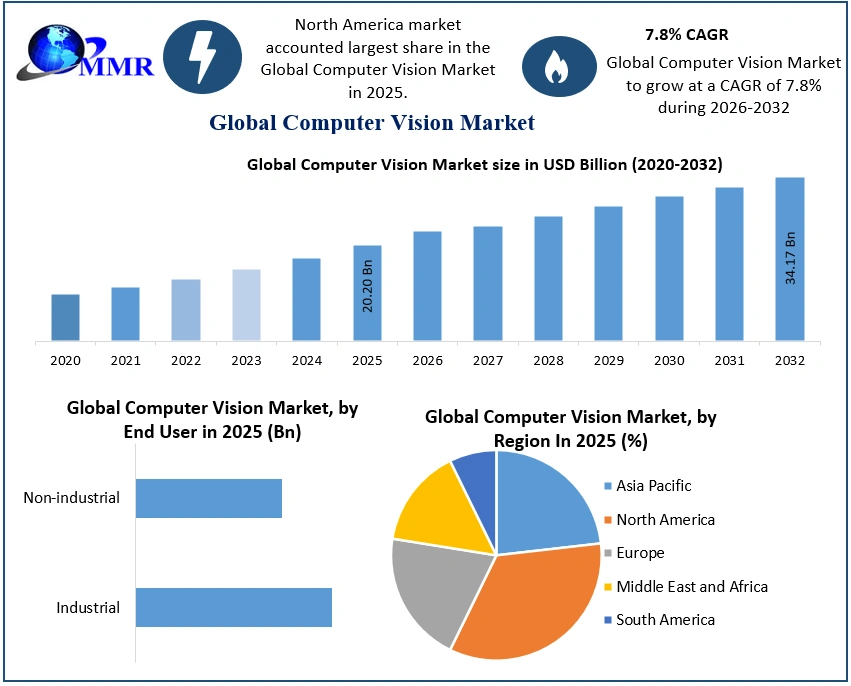
The Computer Vision Market size was valued at USD 20.20 Billion in 2025 and the total Computer Vision revenue is expected to grow at a CAGR of 7.8% from 2025 to 2032, reaching nearly USD 34.17 Billion by 2032.
Computer Vision Market Overview
Computer Vision is a field of Artificial Intelligence (AI) that enables computers and other systems to derive meaningful information from digital images and visual inputs, take actions, and make recommendations based on the information. If AI enables computers to think, computer vision enables them to see, observe, and understand. Computer vision trains machines to perform various functions, and needs to perform many functions in less time with cameras, data, and algorithms rather than retinas, optic nerves, and visual cortex. Manufacturing, Healthcare, automotive, agriculture, and logistics & supply chain make heavy use of computer vision, which significantly boosts the Computer Vision market growth.
Computer Vision arguments and automates human sights in computer. The computer Vision industry is revolutionizing and empowering businesses to achieve operational efficiency, mitigate risks, enhance security, and automate surveillance.
To know about the Research Methodology :- Request Free Sample Report
Computer Vision Market Scope and Research Methodology
The Computer Vision Market report offers a thorough evaluation of the market for the forecast period. It examines patterns and factors shaping the market, including drivers, restraints, opportunities, and challenges. The report also provides expected revenue growth for the Asia Pacific market during the forecast period. The research on the Asia Pacific market analyses of major applications, business strategies, and influencing factors. The report examines market trends, volume, cost, share, supply and demand, and utilizes methods like SWOT and PESTLE analysis. Primary research resources include databases and surveys.
Computer Vision Market Dynamics:
Increased demand for Automation to boost the Computer Vision Market growth
Industries such as manufacturing, automotive, and agriculture are increasingly adopting computer vision to automate various tasks. This includes quality control, inspection, and autonomous navigation, leading to improved efficiency and cost savings. With concerns about security and safety on the rise, computer vision is being used for surveillance and security applications. This includes facial recognition, object detection, and anomaly detection, enhancing security measures in public spaces and businesses, which is expected to boost the Computer Vision Market growth. E-commerce platforms use it for recommendation engines and visual search, improving the overall shopping experience. The development of autonomous vehicles heavily relies on computer vision technologies. These systems enable vehicles to perceive and navigate their surroundings, making them a key driver in the automotive industry.
Computer vision is a fundamental component of AR and VR technologies. It enables immersive experiences by tracking and interpreting the user's physical environment and gestures. The integration of computer vision in consumer devices, such as smartphones and smart cameras, has become increasingly common. Features like facial recognition and augmented reality filters have driven consumer demand. Governments around the world are investing in computer vision technologies for various applications, including public safety, transportation, and healthcare, further boosting the Computer Vision Industry growth. The proliferation of data and improved connectivity infrastructure has made it easier to collect, transmit, and process visual data, enabling more robust computer vision applications.
Top Trends for Computer Vision
Ensuring Safety: When considering industrial enterprises, the paramount importance of workplace safety for employees cannot be overstated. In times of crisis, such as the COVID-19 pandemic, computer vision technology has played a pivotal role in rapidly identifying whether employees are adhering to safety protocols by wearing masks and other protective gear. This application became an urgent necessity during the initial phases of the pandemic.
While the world is gradually recovering from the pandemic, the utilization of computer vision within industrial sectors remains indispensable in ensuring both public and workplace safety. This includes tasks such as maintaining social distancing, analyzing break times, assessing employee efficiency, and more. Notably, is has witnessed the practical implementation and discussion of these technologies, as exemplified by their use in Amazon warehouses.
Quality Inspection: Ensuring the highest product quality is essential for not only surviving but thriving in today's relentlessly competitive market. There is simply no room for quality failures. Given the ceaseless production, packaging, and distribution processes, manual monitoring often falls short of preventing faults and errors, resulting in subpar product quality. However, with computer vision, maintaining product quality and enhancing quality analysis operations becomes more accessible and precise.
Vision Guidance (Robots): An increasing number of companies are placing their trust in robots, particularly within the manufacturing sector. However, robots equipped with vision-guidance technology have proven to be exceptionally valuable. Thanks to computer vision, robots can assist businesses in proactively addressing the challenges posed by an aging workforce and escalating labor costs, all while enhancing automated processes. Some prime illustrations of vision-based guidance in automating tools include unmanned vehicles or autonomous cars and user access systems employing facial recognition technology, among others. This unique trend is creating opportunities for the computer vision market growth.
Edge Computing: Edge computing, a technology linked directly to physical machines, facilitates rapid data processing and analysis right at the point of collection. In industries frequently plagued by network disruptions, this real-time aspect of computer vision proves invaluable, eliminating the need for data centers or cloud infrastructure. In addition to providing on-site data analysis, insights, and calculations in real-time, edge computing can help identify and address latency reductions and anomalies, making it an ideal solution for businesses susceptible to network outages. This not only benefits areas with slow or unreliable internet connections but also significantly reduces the data processing demands for complex tasks.
Anomaly Detection: Just as identifying production faults is crucial, error detection in financial transactions holds equal significance. Indeed, anomaly detection in financial transactions has been identified as one of the ongoing computer vision trends expected to extend into 2025. The adoption of computer vision for anomaly detection is gaining popularity as a means to mitigate hacking risks and enhance security levels in payment processing. This technology now enables the prevention of potential fraud and the identification of anomalies in payment procedures through real-time training of machine learning models, eliminating the need for manual analysis by individuals.
Data Annotation: Computer vision encompasses more than just data accumulation; it also involves precise data annotation to facilitate the learning process for artificial intelligence systems. The quality of data annotation directly correlates with the effectiveness of data analysis. Therefore, it's evident that one of the prevailing trends in computer vision advancements will revolve around data annotation, leading to enhanced data analysis, automated data labeling, and the establishment of resilient workflows. The demand for data scientists skilled in refining annotations to ensure cleaner data structures is expected to rise in the coming year. As the adage goes, "garbage in, garbage out," and with ongoing technological improvements, what was once considered low-quality data from the past is poised to become the valuable information of the future.
Ensuring Transparency in Banking: Despite various technologically advanced tools, the banking industry continues to grapple with cybercrime and theft. Particularly, the need to perform laborious tasks such as processing and analyzing vast amounts of sensitive data sets this industry apart from others. However, with the advent of computer vision, the security aspect can now be addressed while simultaneously expediting data analysis. Optical Character Recognition (OCR), a subset of computer vision, can efficiently capture and extract banking data at an unprecedented pace. The banking sector is expected to leverage various computer vision technologies extensively for tasks related to analysis, authentication, and more, which is expected to boost the Computer Vision Market growth.
Data Privacy and Security Concerns to restrain the Computer Vision Market growth
The use of computer vision, particularly in applications like facial recognition and surveillance, raises significant privacy and security concerns. Regulatory challenges and public apprehension can hinder the widespread adoption of these technologies. Implementing computer vision systems can be costly, especially for smaller businesses. The expense associated with hardware, software, and specialized talent is a barrier to entry for some organizations. Computer vision requires expertise in machine learning, computer science, and image processing.
The shortage of skilled professionals in this field can limit the development and deployment of computer vision solutions. Training machine learning models for computer vision applications require large amounts of labeled data. Annotating and curating such datasets can be time-consuming and expensive. Some computer vision applications demand high-performance hardware, such as GPUs and specialized chips. These hardware requirements is a limitation for devices with limited computing power. Biases in training data and algorithms lead to unfair or discriminatory outcomes, raising ethical concerns. Addressing these biases and ensuring fairness in computer vision systems is a critical challenge.
High-performance computing hardware used in computer vision applications has a substantial environmental footprint. Energy consumption and e-waste management are growing concerns, which are expected to limit the Computer Vision Market growth. Regulations around the use of computer vision in various industries and applications are still evolving. Compliance with changing regulations can be challenging for businesses. Computer vision systems often struggle to perform consistently in complex, unstructured, or dynamic environments, limiting their application in certain contexts.
Computer Vision Market Segment Analysis:
Based on Components, the market is segmented into Hardware, Software, and Services. Hardware components held the largest Computer Vision Market share in 2025. Hardware components are fundamental components of computer vision systems for the development and deployment of computer vision solutions. Storage solutions are essential for storing vast amounts of visual data generated by computer vision applications. High-capacity hard drives, Solid State Drives (SSDs), and network-attached storage (NAS) systems ensure data can be accessed efficiently for analysis, training, and long-term retention. Edge computing has become increasingly important in computer vision. Edge devices such as smart cameras and embedded systems have the processing power to perform real-time analysis locally, reducing latency and dependence on cloud-based processing. These devices are vital for applications such as surveillance, autonomous vehicles, and industrial automation, which significantly boost the Computer Vision Industry's growth in 2025.

Based on Products, Computer vision systems ensure seamless workflows in tedious and repetitive operations like positioning, measurement, counting, and flaw detection, which can be mind-numbing if done manually. Some of its prominent benefits include enhanced productivity, quicker turnaround, compliance with standards, and higher flexibility. Quality control is a major factor driving its incorporation into industries like automotive, pharmaceutical, and F&B.
Modern cameras generate data at high rates, and the software demands high performance and computational speed. With heavy loads, it is imperative to ensure maximum compatibility for optimal performance, Smart cameras consist of a sensor, processor, and I/O in a compact arrangement, generally no bigger than a standard industrial camera. These solutions offer a demand for smart camera-based- computer vision and have the largest share of 42% in the product segment, and the other side PC-based- computer vision are drop there sell by 14% in 2025.

Computer Vision Market Regional Insights:
North America dominated the market in 2025 and is expected to hold the largest Computer Vision market share over the forecast period. The North American market has been characterized by rapid technological advancements, strong research and development activities, and widespread adoption across various industries. This market's dynamism has been fueled by the convergence of computer vision with AI and machine learning (ML), leading to transformative applications. Computer vision has played a pivotal role in revolutionizing industrial processes.
Manufacturing plants, automotive factories, and logistics centers in North America have integrated computer vision for quality control, defect detection, and the automation of routine tasks. Robots equipped with computer vision are now capable of precise and adaptable operations. The healthcare sector in North America has witnessed the integration of computer vision for medical image analysis, diagnosis, and surgical assistance. Computer vision algorithms assist radiologists in detecting anomalies in medical images, enhancing early disease diagnosis and treatment planning.
The retail landscape in North America has been reshaped by computer vision. Cashier-less checkout systems, powered by computer vision, have been adopted in supermarkets and convenience stores. Additionally, visual search capabilities have improved the online shopping experience, allowing consumers to search for products using images, which significantly contribute to increase the Computer Vision Market share. Facial recognition and object detection technologies have been widely used in security and surveillance systems across public spaces, airports, commercial establishments, and law enforcement agencies.
While enhancing security, these applications have raised concerns related to data privacy and ethics. Precision agriculture has benefited from computer vision applications. Drones equipped with computer vision cameras monitor crop health, detect pests, and predict yields, allowing farmers to make data-driven decisions and optimize agricultural practices. Both the U.S. and Canadian governments have recognized the strategic importance of AI and computer vision. Investments in AI research, innovation hubs, and educational initiatives have fostered a vibrant ecosystem for technological advancements.
Computer Vision Market Competitive Landscapes:
The competitive landscape in the computer vision market is dynamic and continually evolving, with various companies and start-ups offering innovative solutions across multiple industries. Collaboration between technology companies, research institutions, and industry verticals accelerates the development and deployment of Computer vision solutions, which helps to increase the Computer Vision market penetration.
NVIDIA is a major player known for its GPUs (Graphics Processing Units) that are widely used in computer vision applications. They offer hardware and software solutions for deep learning and computer vision tasks. In September 2022, NVIDIA Corporation introduced an open-source project, CV-CUDA, designed to improve end-to-end computer vision and image processing pipelines.
Computer Vision Market Scope: Inquiry Before Buying
| Computer Vision Market | |||
|---|---|---|---|
| Report Coverage | Details | ||
| Base Year: | 2025 | Forecast Period: | 2026-2032 |
| Historical Data: | 2020 to 2025 | Market Size in 2025: | USD 20.20 Bn. |
| Forecast Period 2026 to 2032 CAGR: | 7.8% | Market Size in 2032: | USD 34.17 Bn. |
| Segments Covered: | by Component | Hardware Software Service |
|
| by Product | PC-based Computer Vision Systems Smart Cameras-based Computer Vision Systems |
||
| by Application | Quality Assurance and Inspection Positioning and Guidance Measurement Identification Predictive Maintenance |
||
| by End-User | Industrial Non-industrial |
||
Computer Vision Market, by Region
North America (United States, Canada and Mexico)
Europe (UK, France, Germany, Italy, Spain, Sweden, Austria, Turkey, Russia and Rest of Europe)
Asia Pacific (China, India, Japan, South Korea, Australia, ASEAN and Rest of APAC)
Middle East and Africa (South Africa, GCC, Egypt, Nigeria and Rest of ME&A)
South America (Brazil, Argentina, Columbia and Rest of South America)
Computer Vision Market, Key Players:
North America:
1. NVIDIA Corporation
2. Intel Corporation
3. Microsoft Corporation
4. Amazon Web Services (AWS)
5. IBM Corporation
6. Google LLC
7. Facebook, Inc. (Meta Platforms)
8. Apple Inc.
9. Qualcomm Incorporated
10. Cognex Corporation
11. Xilinx, Inc.
Europe:
12. ARM Limited
13. Graphcore Ltd.
14. Basler AG
15. Bosch Sensortec
16. Dassault Systèmes
17. Thales Group
Asia-Pacific:
18. SenseTime
19. Dahua Technology
20. Hikvision
21. Alibaba Group
22. Samsung Electronics Co., Ltd.
23. Wipro Limited
24. TATA Consultancy Services (TCS)
25. Infosys Limited
Latin America:
26. Embraer SA
Middle East and Africa:
27. Mobileye (now part of Intel Corporation)
28. DarkMatter
FAQs:
1. Which region is expected to lead the Computer Vision Market during the forecast period?
Ans. North America region is expected to lead the Computer Vision Market during the forecast period.
2. What is the projected market size and growth rate of the Computer Vision Market?
Ans. The Computer Vision Market size was valued at USD 20.20 Billion in 2025 and the total Computer Vision revenue is expected to grow at a CAGR of 7.8% from 2025 to 2032, reaching nearly USD 34.17 Billion by 2032.
3. What segments are covered in the Computer Vision Market report?
Ans. The segments covered in the Computer Vision Market report are Component, Product, Application, End-User, and Region.
4. What is the study period of the Computer Vision Market?
Ans: The Computer Vision Market will be studied from 2025 to 2032.