
Catalog Management Systems Market: by Component (Solution, Service), by Deployment (On-premise, Cloud), by Organization Size (Large, SME), by Application (IT & Telecom, Retail & eCommerce, BFSI, Others) - Forecast to 2032
Overview
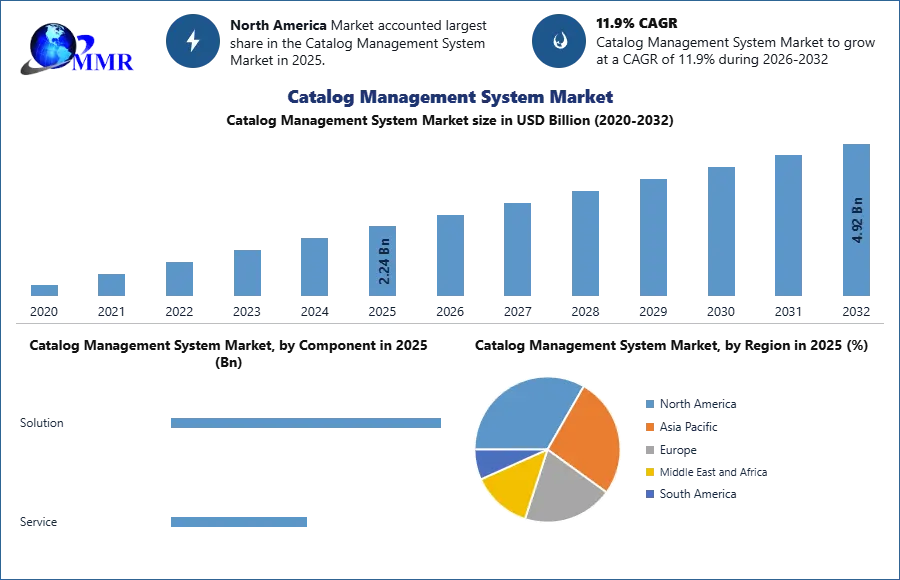
Catalog Management System Market was valued at USD 2.24 Bn. in 2025. The Global Catalog Management System Market size is estimated to grow at a CAGR of 11.9% over the forecast period.
Catalog Management System Market Overview:
The Catalog Management System market analyzes and forecasts the market size, in terms of value, for the market. Further, the Catalog Management System Market is segmented by Component, Deployment, Organization Size, Application, and Region. Based on Component, the Catalog Management System market is segmented under Solution and Service. Based on the Deployment, the market is segmented under the On-premise and Cloud. Based on Organization Size, the Catalog Management System market is segmented under Large and SME. Based on Application, the Catalog Management System market is segmented under IT & Telecom, Retail & eCommerce, BFSI, and Others. The market sizing and forecasts have been done for each segment based on value (in USD Billion).
To know about the Research Methodology:-Request Free Sample Report
Catalog Management System Market Dynamics:
The eCommerce industry has driven market growth, the growing number of consumers for products, increased availability of the internet, and the rise of smartphones. Worldwide online sales have increased dramatically. Catalog management enables businesses to reduce service delivery costs, improve customer experience, improve employee efficiency, boost productivity, and run a more efficient business. These solutions help businesses reduce time and automate the updating of product information on eCommerce platforms by providing detailed information on any product. Businesses can avail themselves of these benefits by implementing catalog management systems.
Catalog management systems involve the collection and transmission of data from one channel to another, the synchronization and publication of data across channels is also part of the catalog management solution. However, due to the lack of proper knowledge about security frameworks and their implementation, many companies are concerned that catalog management solutions could result in data breaches in highly abstracted data sets that are managed by the catalog management system.
Security concerns are the primary reason for hampering the adoption of catalog management solutions. Users refrain from implementing these solutions due to their concerns about losing their crucial master data and reference data due to errors in data compilation or upgrade. The users feel that their data privacy is in danger and that there is no accountability for data losses or thefts, nor would mitigation be provided. Additionally, users are concerned that their data will become unreliable.
In industry sectors such as healthcare, retail, and BFSI, organizations have been investing in and adopting new technologies to grow and stay ahead of their competitors. With AI-powered catalog management, products are automatically classified, anomalies are detected, enrichment processes are carried out based on the selection of data from trustworthy sources, and recommendations are contextualized. AI-based catalog management solutions can generate automated insights about data issues and create a holistic view of all data that is present across multiple systems to help customers understand their products better. In addition to improving customer experience and satisfaction, AI-enabled chatbots can increase revenues and profits.
ML-based catalog management solutions can also help organizations in managing compliance, driving data-driven digital transformation, and improving operational efficiency by spotting upcoming data quality issues and suggesting solutions that would improve match and avoid data inconsistency. ML-enabled catalog management solutions have begun to be offered by companies like IBM. This demand is predicted to grow, resulting in further development of catalog management applications.
Each enterprise has a different catalog requirement based on the products and services offered. Enterprises don't follow a standard format, which is a major challenge for the market. Although catalog management solutions can enhance the quality of data and cleanse, consolidate, and enrich product catalogs, businesses must establish a governance policy that ensures consistency across product catalogs to have standardized data. To achieve greater integration with existing systems, data coming from systems with poor information or inconsistent data must also be taken into consideration when formulating such policies.
Catalog Management System Market COVID19 Insights:
Its industry impact has been positive across retail, eCommerce, telecommunications, media, and entertainment. In addition, COVID-19 has led to digital transformation in multiple industries. These solutions provide an instant overview of products in a channel, capture and upload data, and can map it to customer needs. The services also enable validation, enrichment, and augmentation of data in real-time, as well as automating the creation of catalogs with data from multiple sources so that the availability of products can be improved and updated merchandise can be distributed faster across channels.
Catalog Management System Market Segment Analysis:
Based on Component, the Catalog Management System Market is segmented into Solutions and Services. The Service segment is expected to grow at a CAGR of 14.3% through the forecast period. As enterprises across various regions are required to provide professional support to ensure the smooth functioning of product data and consolidate the management of data in a single repository, they require active support from skilled professionals during both pre-and post-installation of catalog management solutions. These services ensure that the processes within an enterprise are efficient, increase company growth, and reduce unnecessary operational expenses.
Based on Deployment, the Catalog Management System Market is segmented into On-premises and Cloud. The Cloud-based segment had the highest market share of more than 59.9% in 2025. Cloud deployment of catalog management systems is becoming a popular method for digital transformation across multiple regions. Cloud deployment increases the flexibility of catalogs and further permits businesses to customize services and products on a large scale. Cloud deployment provides further advantages to businesses, such as the ability to set up a control center to arrange, monitor, and coordinate the different components of their digital marketing campaigns.
Based on Organization Size, the Catalog Management System Market is segmented into Large and, medium & small (SME). The Largely based segment has the largest market share accounting for 58% in 2025. With their extensive networks and diverse revenue streams, large companies look for innovative and cutting-edge technologies and solutions to expand their business operations. Government authorities providing capital for large companies to invest in digitization is expected to boost the growth of this segment.
Based on the Application, Catalog Management System Market is segmented into IT & Telecom, Retail & eCommerce, BFSI, and Others. The Retail & eCommerce based segment is expected to grow at a CAGR of 14.1% through the forecast period. As a result of the tremendous volume of product information today, customers require rich and consistent product information; as such, catalog managers ensure that all sales channels have quality product data. Retail and eCommerce have benefited from the boom in digital transformation initiatives to meet customers' dynamic needs. Merchants need to manage product data accuracy whether it is created internally or by third parties, such as suppliers. This includes organizing, standardizing, and publishing their data across each sales channel.
Catalog Management System Market Regional Insights:
The North American region held the largest market share accounting for 47% in 2025. The growing presence of industry players such as Oracle Corporation, Salsify, SAP SE, and Amdocs, as well as the growing number of SMEs in the region, are expected to drive market growth.
The Asia Pacific region is expected to witness significant growth at a CAGR of 16.1% through the forecast period. China, India, Japan, Australia, and New Zealand (ANZ) are the leading countries in terms of the adoption of catalog management software solutions and services in the region. IT expenditure across organizations in the region is gradually increasing, which is projected to lead to a surge in the adoption of catalog management software solutions.
Competitive Landscape:
There is moderate competition in the Catalog Management System Market, with a large number of local and international players. Vendors operating in the market are offering affordable solutions to gain market share. An improvement in digital transformation in the retail and e-commerce sectors is paving the way for upcoming players to enter the market. Leading key players operating in the global catalog management market are IBM, SAP, Oracle, Salsify, Coupa Software, ServiceNow, Proactis, Broadcom, Fujitsu, Comarch, Zycus, GEP, Ericsson, Amdocs, Episerver, and SunTec.
Recent Industry Developments (2025–2026):
| Exact Date | Company | Development | Impact |
|---|---|---|---|
| 06 March 2026 | SAP SE | The company integrated AI-driven data enrichment into its core catalog suite to facilitate real-time synchronization for global enterprises. | This development enhances omnichannel content delivery and sets a new standard for compliance in digital transformation. |
| 12 February 2026 | Salsify Inc. | Launched the updated Salsify PXM Advance platform, featuring automated content validation and out-of-the-box data extensions. | The platform significantly reduces manual data entry and improves time-to-market for brands across e-commerce marketplaces. |
| 15 January 2026 | HCL Software | Completed the full technical integration of Zeenea's metadata catalog into the Actian data platform. | Strengthens HCL's position in governance-led catalog management, providing deeper data discovery for large-scale enterprises. |
| 05 November 2025 | Oracle Corporation | Introduced new multi-domain product information features within its cloud-native catalog architecture. | Ensures high scalability and agility for retailers managing massive inventories across diverse geographic regions. |
| 22 September 2025 | Syndigo LLC | Expanded its Global Data Syndication Network to support real-time publication across 500+ new retail partners. | Improves product visibility and consistency for manufacturers navigating an increasingly fragmented digital supply chain. |
The objective of the report is to present a comprehensive analysis of the global Catalog Management System Market to the stakeholders in the industry. The past and current status of the industry with the forecasted market size and trends are presented in the report with the analysis of complicated data in simple language. The report covers all the aspects of the industry with a dedicated study of key players that include market leaders, followers, and new entrants.
PORTER, PESTEL analysis with the potential impact of micro-economic factors of the market have been presented in the report. External as well as internal factors that are supposed to affect the business positively or negatively have been analyzed, which will give a clear futuristic view of the industry to the decision-makers.
The reports also help in understanding the Catalog Management System Market dynamic and structure by analyzing the market segments and projecting the Catalog Management System Market size. Clear representation of competitive analysis of key players by Design, price, financial position, product portfolio, growth strategies, and regional presence in the Catalog Management System Market make the report investor’s guide.
Catalog Management System Market Scope:Inquire before buying
| Catalog Management System Market | |||
|---|---|---|---|
| Report Coverage | Details | ||
| Base Year: | 2025 | Forecast Period: | 2026-2032 |
| Historical Data: | 2020 to 2025 | Market Size in 2025: | 2.24 USD Billion |
| Forecast Period 2026-2032 CAGR: | 11.9% | Market Size in 2032: | 4.92 USD Billion |
| Segments Covered: | by Component | Solution Service |
|
| by Deployment | Cloud On-premise |
||
| by Organization Size | Large SME |
||
| by Application | IT & Telecom Retail & eCommerce BFSI Others |
||
Catalog Management System Market, by Region:
• North America (United States, Canada and Mexico)
• Europe (UK, France, Germany, Italy, Spain, Sweden, Austria and Rest of Europe)
• Asia Pacific (China, South Korea, Japan, India, Australia, Indonesia, Malaysia, Vietnam, Taiwan, Bangladesh, Pakistan and Rest of APAC)
• Middle East and Africa (South Africa, GCC, Egypt, Nigeria and Rest of ME&A)
• South America (Brazil, Argentina Rest of South America)
Key Players / Competitors Profiles Covered in Brief in Global Catalog Management System Market Report in Strategic Perspective:
- IBM
- Oracle Corporation
- SAP SE
- Salsify Inc.
- ServiceNow Inc.
- Broadcom Inc.
- Amdocs Limited
- Zycus Inc.
- Proactis Holdings Limited
- Fujitsu Limited
- Telefonaktiebolaget LM Ericsson
- Coupa Software Inc.
- GEP Worldwide
- Comarch SA
- SunTec Business Solutions
- Vinculum Solutions
- eJeeva Technologies
- Plytix
- Sellercloud
- Hansen Technologies Limited
- Akeneo SAS
- Stibo Systems
- Syndigo LLC
- Informatica LLC
- Mirakl Inc.