
Automotive Differential System Market Size – Industry Structure Evaluation, Demand Drivers Analysis, Regional Growth Analysis and Identification, Competitive Positioning Review & Global Market Size Forecast to 2032
Overview
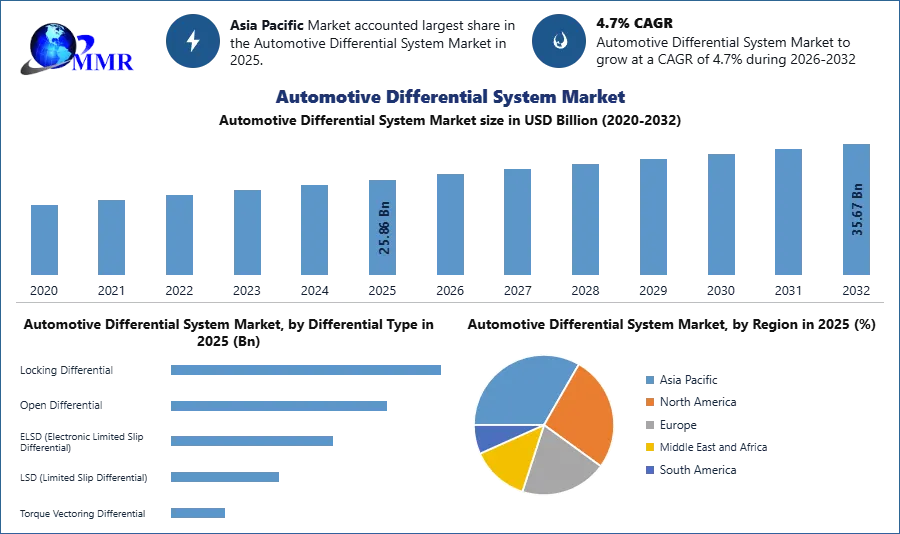
The Automotive Differential System Market is expected to reach USD 25.86 billion by 2025, thanks to growth in the vehicle type segment. The report analyzes automotive differential system market dynamics by region, differential type, vehicle type, component type, driver type, and application.
Automotive Differential System Market Overview:
The automotive differential system market was valued at USD 25.86 Bn. in 2025, and it is expected to reach USD 35.67 Bn. by 2032 with a CAGR of 4.7% during the forecast period.
An automotive differential system is a three-shaft gear train having the condition that one shaft's rotational speed is the average of the others' speeds or a fixed multiple of that average. The following automotive differential system description is for a classic rear-wheel-drive car or truck with an open or limited-slip differential and a bevel gear reduction gearset.
To know about the Research Methodology:- Request Free Sample Report
For instance, if the car is turning right, the primary ring gear may complete 10 full rotations. The left wheel will make more rotations during that period because it has a longer distance to travel, while the right wheel will make fewer rotations since it has a shorter distance to go. The sun gears (which drive the axle half-shafts) will rotate at different rates (one quicker, one slower) relative to the ring gear by, say, 2 complete revolutions each (4 full turns relative to each other), resulting in the left wheel turning 12 times and the right wheel turning 8.
2020 is considered a base year however 2020's numbers are on the real output of the companies in the market. Special attention is given to 2020 and the effect of lockdown on the demand and supply, and also the impact of lockdown for the next two years on the market. Some companies have done well in lockdown also and specific strategic analysis of those companies is done in the report.
Global Automotive Differential System Market Dynamics:
Demand for luxury and SUV vehicles is increasing:
AWD and 4WD systems are most commonly found in luxury cars and SUVs. The demand for luxury sector automobiles and SUVs has increased as economic conditions have improved, industrialization has increased, and customers' living standards have improved across the globe. Also, strict safety rules in regions such as Europe and North America have enticed consumers to opt for AWD and 4WD systems, which provide better traction control and vehicle stability.
The majority of SUVs are equipped with AWD or 4WD systems. SUV sales were overtaken by sedan series vehicles in the early 2000s. Given the advent of fuel-efficient AWD & 4WD systems, the demand for SUVs is increasing in this age of compact and fuel-efficient cars. The advent of new compact SUVs with improved technologies and the ability to drive in both traffic and off-road terrain has resulted in a surge in the SUV industry. Demand for SUVs in this class is expected to increase over the forecast period as per capita income rises, infrastructure improves, and customer preferences shift toward multi-utility vehicles (MUVs). As a result of this demand-driven increase, major automakers have begun to focus on developing customer-centric SUV, compact SUV, and MUV models. As a result, these variables may have an impact on the market for multi-wheel drive systems, which would drive demand for automobile differentials.
Surging adoption of electric vehicles (EVs):
The demand for electric vehicles has surged as governments around the world formulate more strict CO2 emission standards. Incentives and subsidies are also being offered by governments to stimulate the adoption of electric vehicles. Low or no registration fees, as well as exemptions from import tax, purchase tax, and road tax, are among the benefits. For example, the Norwegian government is exempting BEV (Battery Electric Vehicle) owners from paying value-added tax (VAT), which is over 25% of the vehicle's net price. Based on the battery capacity of BEVs and PHEVs, the Hamburg Municipal Corporation in Germany is proposing a tax adjustment of USD 295 per kilowatt-hour of battery capacity, up to a maximum of USD 8,830.
Automakers are investing in electric car technologies as a result of the growing demand for electric automobiles. Several automakers have indicated plans to invest in the development and sale of new electric vehicles. Ford, for example, has committed to investing US D11 billion in electric vehicles by 2025. By 2022, the business expects to provide 40 electric vehicles, 16 of which will be electric and 24 of which will be plug-in hybrids. Volkswagen AG said in 2019 that it would invest USD 66.3 billion over the next five years to produce more electric and hybrid vehicles, with plans to launch 75 fully electric and 60 hybrid models. MG Motor also plans to invest USD 0.50 billion in the research, manufacturing, and selling of electric vehicles in India by 2020. Thus, increasing adoption and demand for electric vehicles is expected to hamper market growth during the forecast period.
Technological advancements happening in the Automotive sector:
Manufacturers are now focused on component electrification as a result of the introduction of vehicle electrification. Electronically restricted slip differentials are now being used to replace differentials (ELSD). With the help of an electronic control unit, the ELSD system distributes enough torque to each wheel. In the event of a slide, the technique is advantageous since the extra torque is sent to the wheels with the most traction. During high-speed curves and lane changes, the technology provides improved handling. Mitsubishi's Active Center Differential, for example, allows drivers to select several defaults for driving on the road, gravel, and snow. As vehicles become more electrified, component and system manufacturers respond to the sophisticated needs of OEMs such as ELSD.
Designing electronic and electrical components that are fail-safe:
Electronic components have been introduced into automobiles as a result of technological advancements to increase vehicle performance. Mechanical components in differentials are being replaced by electronic components such as electronically restricted slip differentials. However, there are many concerns associated with this technology, including thermal systems, the possibility of fire or component failure, and others, which must be carefully evaluated. Component electrification raises a slew of safety concerns, including electric system safety, functional system safety, and vehicle maintenance, operation, and training.
Global Automotive Differential System Market Segment Analysis:
Based on Differential Type, the automotive differential system market is segmented as, locking, open, ELSD, LSD, and torque vectoring. Thanks to increased outbound activities and the popularity of ATVs in the market, locking differential is the most dominant category in the industry, accounting for approximately 42% of the market share in 2025. ATVs are utilized on a variety of terrains and require a locking differential to operate with all four wheels on the ground.
According to Eaton, the locking differential sector accounted for nearly USD 4.52 billion in 2025 and is expected to lead the market with a CAGR of approximately 5.21% over the forecast period. Thanks to increasing demand for high torque producing cars and increased implementation of torque vectoring in SUV car manufacture, torque vectoring is the market's second most dominant category.
Based on Vehicle Type, the automotive differential system market is segmented as, passenger cars, commercial vehicles, and off-road vehicles. Off-road vehicles have the largest market share, accounting for nearly US $1.40 billion in revenue in 2020. System compatibility on off-roads for differential systems and high vehicle productivity are two factors contributing to the expansion of the off-road vehicle segment. Also, the growing demand for cost-cutting solutions in the automotive parts manufacturing industry is a major factor driving the expansion of the automotive differential system market.
Commercial vehicles are the second dominating segment in the market with approximately 28% market share owing to increasing consumer preference towards SUVs and thereby increasing value addition for powertrains mechanism.
Detailed information about all segments is covered in the MMR’s report.
Recent Industry Developments (2025–2026)
| Exact Date | Company | Development | Impact |
|---|---|---|---|
| 23 April 2025 | Eaton | Launched the EV Truetrac differential designed specifically for electric vehicle applications at Auto Shanghai 2025. | This expands Eaton’s electrified drivetrain portfolio and strengthens its EV market positioning. |
| 31 July 2025 | BorgWarner Inc. | Secured multi-year supply contracts for its electric cross differential (eXD) with a major EV manufacturer. | This reinforces BorgWarner’s leadership in electric driveline systems and supports long-term revenue growth. |
| 15 March 2025 | Valeo | Introduced an integrated e-differential module optimized for compact EV front-axle platforms. | This enhances drivetrain efficiency and system integration for next-generation electric vehicles. |
| 12 January 2025 | Dana Incorporated | Expanded its European manufacturing capacity for intelligent differential systems to meet rising EV demand. | This strengthens regional production capabilities and improves supply chain resilience. |
| 08 February 2026 | Magna International Inc. | Announced a strategic collaboration for next-generation torque-vectoring differential systems for performance EV platforms. | This accelerates innovation in advanced traction and stability technologies within the automotive differential system market. |
Global Automotive Differential System Market Regional Insights:
Thanks to rising demand for commercial vehicles such as SUVs and heavy commercial vehicles in the region, Asia Pacific dominated the market, accounting for nearly 43.24% of the total market share in 2020. Also, the demand for automobiles in the market has increased as the population of the regions has grown. The factors contributing to market growth include increased government assistance and high domestic production rates in the region's rising countries.
Because of the number of raw materials and high transportation and production capabilities in the Chinese market, China is the dominant market in the region, with a volume share of around 49.52%. The Indian market is likely to have a comparatively large share of the industry thanks to the large number of major companies spending heavily in the region.
With a market share of almost 29%, Europe is the fastest-growing region in the automotive differential system market. The abundance of prominent manufacturers of automotive differential systems in the region is one factor contributing to market expansion. Thanks to established infrastructure for automotive component manufacture and rising consumer disposable income, Germany, together with the United Kingdom and Italy, has the greatest market share of around 54.24%.
The objective of the report is to present a comprehensive analysis of the market to the stakeholders in the industry. The past and current status of the industry with the forecasted market size and trends are presented in the report with the analysis of complicated data in simple language. The report covers all the aspects of the industry with a dedicated study of key players that include market leaders, followers, and new entrants.
PORTER, PESTEL analysis with the potential impact of micro-economic factors of the market have been presented in the report. External as well as internal factors that are supposed to affect the business positively or negatively have been analyzed, which will give a clear futuristic view of the industry to the decision-makers.
The report also helps in understanding the global market dynamics, structure by analyzing the market segments and projecting the global market size. Clear representation of competitive analysis of key players by product, price, financial position, product portfolio, growth strategies, and regional presence in the global market makes the report investor's guide.
Automotive Differential System Market Scope: Inquire before buying
| Automotive Differential System Market | |||
|---|---|---|---|
| Report Coverage | Details | ||
| Base Year: | 2025 | Forecast Period: | 2026-2032 |
| Historical Data: | 2020 to 2025 | Market Size in 2025: | 25.86 USD Billion |
| Forecast Period 2026-2032 CAGR: | 4.7% | Market Size in 2032: | 35.67 USD Billion |
| Segments Covered: | by Differential Type | Locking Differential Open Differential ELSD (Electronic Limited Slip Differential) LSD (Limited Slip Differential) Torque Vectoring Differential |
|
| by Vehicle type | Passenger Cars Light Commercial Vehicles Heavy Commercial Vehicles |
||
| by Componant | Differential Gear Differential Bearing Differential Case |
||
| by Driver Type | FWD RWD AWD/4WD |
||
| by Application | IC Engine Vehicles Off-Highway Mining Construction Tractors Forklifts |
||
Automotive Differential System Market, by Region
• North America
• Europe
• Asia Pacific
• The Middle East and Africa
• South America
key players / competitors profiles covered in the Automotive Differential System Market report in strategic perspective
GKN PLC
Eaton
American Axle and Manufacturing Inc.
JTEKT Corporation
Dana Ltd.
BorgWarner Inc.
Linamar Corporation
Schaeffler AG
ZF Friedrichshafen AG
Continental AG
Cusco Japan Co. Ltd.
NSK Ltd.
Auburn Gears LLC
Bharat Gears Ltd.
Drexler Automotive GmbH
RT Quaife Engineering Ltd.
Magna International Inc.
Hyundai WIA Corporation
Neapco Holdings LLC
Xtrac Limited
Oerlikon Graziano
Ricardo plc
Robert Bosch GmbH
NTN Corporation
The Timken Company
Yukon Gear & Axle
Aisin Corporation
Mitsubishi Motors Corporation
Hino Motors Ltd.