
Augmented Reality in BFSI Market Size by Component, Type, Deployment Mode, Applications, Region – Revenue Pool Analysis, Margin Structure Assessment, Capital Flow Trends, Competitive Benchmarking & Forecast to 2032
Overview
Global Augmented Reality in BFSI Market size was valued at USD 1544.15 Million in 2025 and the total Augmented Reality in BFSI revenue is expected to grow at a CAGR of 24.6% from 2026 to 2032, reaching nearly USD 7199.71 Million.
Augmented Reality in BFSI Market Overview:
Augmented reality (AR) is a cutting-edge technology that has the potential to transform the banking, financial services, and insurance (BFSI) sector. It enhances customer experiences by providing immersive and interactive visualizations of financial products and services. AR can also improve financial education, enable virtual branches and remote assistance, facilitate data visualization and analytics, enhance risk assessment and fraud detection, and support employee training and collaboration. AR has the potential to revolutionize the BFSI sector, bringing benefits such as improved customer engagement, operational efficiency, risk management, and innovation in financial services. As a result, the demand for augmented reality in the BFSI sector is increased significantly, driving the augmented reality in BFSI market growth.
Augmented Reality in the BFSI market is driven by factors such as the growing demand for enhanced customer experiences, the need for improved financial education, the rise of remote banking and virtual branches, the increasing focus on data-driven decision-making, and the growing importance of risk management and fraud detection. AR provides immersive and interactive experiences, allowing customers to visualize financial products, services, and information in a more engaging and personalized manner, which lead to improved customer engagement and loyalty.
However, the adoption of AR in BFSI is also challenged by factors such as high costs and investments, security and privacy concerns, and regulatory and compliance challenges. Nevertheless, the AR in BFSI market is expected to witness significant growth during the forecast period, as financial institutions leverage the potential of AR to enhance customer experiences, improve operational efficiency, and drive innovation in financial services.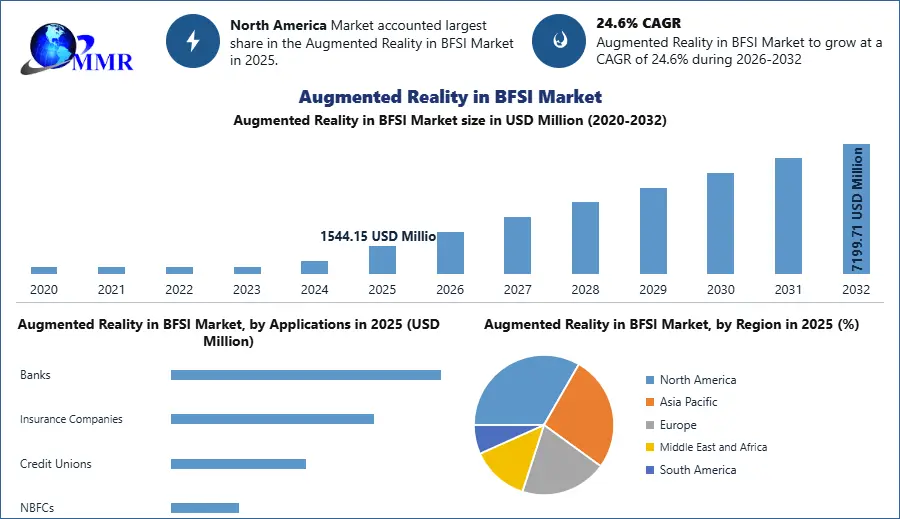 To know about the Research Methodology :- Request Free Sample Report
Augmented Reality in BFSI Market Dynamics:
AR in BFSI enables effortless payments.
Augmented Reality (AR) in the BFSI sector provides easier and more convenient payment options, which has led to an increased demand for AR technologies. AR-powered payment solutions allow users to make transactions seamlessly and securely using AR interfaces, eliminating the need for physical cards or cash. For example, with AR-enabled mobile banking apps, users can simply point their smartphone or tablet at a product or a QR code and make payments instantly. AR also enhances the user experience by providing real-time transaction details, personalized offers, and rewards, making the payment process more engaging and enjoyable for users. The ease and convenience offered by AR-powered payment solutions attract customers who seek a hassle-free and efficient payment experience. Thus, the demand is increased significantly, driving the augmented reality in BFSI market growth.
In addition, AR has the potential to transform the way businesses conduct transactions, particularly in sectors such as retail, e-commerce, and peer-to-peer transactions. AR-powered virtual storefronts, virtual try-on experiences, and virtual marketplaces enable users to make purchases directly from AR interfaces, simplifying the payment process and enhancing customer satisfaction. As the demand for convenient and seamless payment experiences increases, AR is emerging as a promising technology that can revolutionize the way payments are made in the BFSI sector, leading to an increased demand for AR applications in the industry.
Augmented Reality (AR) Improved Financial Education in BFSI Sector
The adoption of Augmented Reality (AR) has significantly improved financial education in the BFSI (Banking, Financial Services, and Insurance) sector. AR provides an immersive and interactive learning experience that helps individuals understand complex financial concepts more visually and engagingly. Through AR, users can visualize financial scenarios, explore virtual financial environments, and gain hands-on experience with financial simulations, leading to enhanced financial literacy and decision-making skills. AR also offers personalized and adaptive learning experiences, catering to the individual needs of learners. As financial literacy becomes increasingly important in today's complex financial landscape, the need for AR in the BFSI sector has increased to bridge the knowledge gap and empower individuals with the necessary financial skills and knowledge for making informed financial decisions. As a result, these factor is expected to drive the augmented reality in BFSI market growth throughout the forecast period.
High Cost and Investment in AR
The cost and investment required for implementing Augmented Reality (AR) technology in the BFSI sector are relatively significant and may act as a barrier to adoption. The upfront costs associated with hardware, software, and infrastructure needed for AR implementation are prohibitive, especially for smaller organizations with limited budgets. This financial burden is expected to hinder the widespread adoption of AR in the BFSI sector, limiting its potential benefits. The high costs associated with AR implementation may deter some BFSI organizations from adopting AR technology, as they need to carefully allocate their budgets and resources to various priorities.
Besides that, the return on investment (ROI) of AR solutions in the BFSI sector may not always be immediate or easily quantifiable, which is expected to further restrain the adoption and limits the augmented reality in BFSI market growth. Additionally, the complexity of integrating AR technology with existing systems and processes in the BFSI sector also contributes to the high costs and investment required. Customization, training, and ongoing maintenance may add to the overall cost of AR implementation, further reducing its adoption.
Augmented Reality in BFSI Market Segment Analysis:
Based on Deployment Mode, the global augmented reality in BFSI market is segmented based on On-premise and cloud segments. The on-premise segment dominated the market with the highest market share of 65% in 2025. The segment is expected to grow at a CAGR of XX% and maintain its dominance by 2032.
In an on-premise deployment mode for Augmented Reality (AR) in the BFSI sector, the AR solution is hosted and maintained locally within the financial institution's infrastructure. This includes the AR software, hardware, and data, which are deployed and managed on the financial institution's servers or data centers. Financial institutions often deal with sensitive customer information, such as financial transactions and personal data.
On-premise deployment allows financial institutions to have full control over their data and implement their security measures to ensure data confidentiality, integrity, and compliance with regulatory requirements. On-premise deployment of AR in the BFSI sector provides financial institutions with greater control, customization, flexibility, and compliance measures, which are expected to be the major factors driving its adoption in the industry. In addition, ongoing developments in the on-premise deployment of Augmented Reality in BFSI market are expected to further increase the segment size by 2032. For instance,
In 2020, Citibank revealed the implementation of an Augmented Reality (AR) solution called "Citi Vision" at its branch in Singapore. Citi Vision uses AR technology to provide customers with an immersive and interactive banking experience, allowing them to access financial information, product demos, and services through AR-powered devices.
DBS Bank has been actively exploring the use of AR in the BFSI sector. In 2019, DBS Bank launched an on-premise AR-powered wealth management tool called "DBS NAV Planner" in its branches in Singapore. The tool uses AR to overlay personalized financial information and investment recommendations onto physical documents, helping customers make informed investment decisions.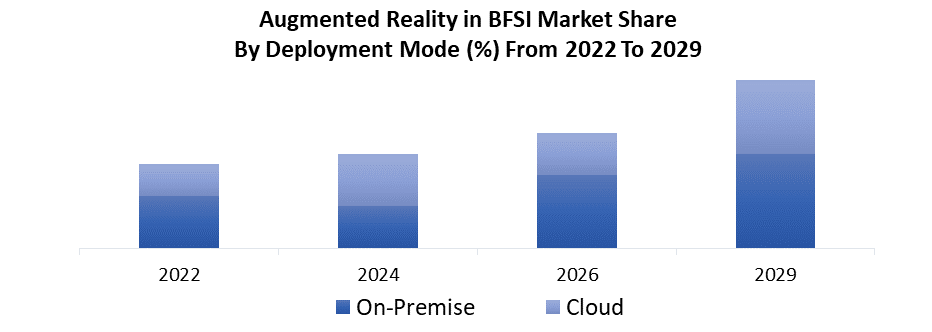 The cloud segment is expected to grow at a CAGR of 22.45% and offers favorable opportunities for market participants to expand and thrive in the augmented reality in BFSI market during the forecast period. Thanks to the advantages offered by cloud AR including the scalability, cost-effectiveness, rapid & easy deployment, remote accessibility, updates and maintenance, and integration capabilities of cloud-based AR solutions, increasing the adoption in the BFSI industry and offering significant benefits to financial institutions in terms of operational efficiency, customer experience, and competitive advantage. Thus the demand for cloud AR is expected to increase rapidly during the forecast period.
Augmented Reality in BFSI Market Regional Insights:
The Augmented Reality (AR) market in the Banking, Financial Services, and Insurance (BFSI) sector has been witnessing significant growth globally. North America has been a prominent region in the adoption of AR in BFSI and dominated the global augmented reality in BFSI market with the highest market share in 2025. The region has a mature financial industry and advanced technological infrastructure, which has facilitated the adoption of AR applications in multiple countries such as virtual banking experiences, financial simulations, customer engagement, and remote assistance for financial advisors, thereby driving the regional market growth.
The United States is a key market for AR in BFSI market. The multiple large organizations and startups actively developing AR solutions for the financial industry are expected to be the major driver for augmented reality in the BFSI market in the country. For instance,
In 2021, AR FinanceTech launched a new AR-powered platform called "AR Banker" which provides a range of AR-based solutions for banks and financial service providers. AR FinanceTech is a startup based in Silicon Valley that specializes in developing cutting-edge AR applications for financial institutions.
In addition, various financial institutions in the United States and Canada have been exploring the use of AR for virtual branches, remote customer service, virtual onboarding, and personalized financial advice, increasing the market demand. The mature technological landscape, high consumer adoption of smartphones, and a tech-savvy customer base have been driving factors for AR adoption in the BFSI sector in North America, thereby driving augmented reality in BFSI market during the forecast period.
Europe is expected to grow at a CAGR of 21.25% during the forecast period and offer lucrative growth opportunities for augmented reality in BFSI market players. European countries, such as the United Kingdom and Germany, have also seen the rapid adoption of AR in the BFSI sector, increasing the demand for AR in BFSI. Virtual branches, remote assistance, and gamified financial education are some of the major applications being explored in the European BFSI sector. Additionally, regulatory frameworks, such as the Revised Payment Services Directive (PSD2) in the European Union, have been driving innovation in financial services, including the use of AR for enhanced customer experiences and improved security, thereby driving market growth.
Asia Pacific region, particularly China and Japan, has been witnessing significant growth in AR adoption in the BFSI sector, supporting regional market growth. For example,
In China, virtual branches and remote assistance using AR are being leveraged by financial institutions to provide convenient and personalized services to a large and digitally-savvy customer base.
In Japan, AR is being explored for financial education and gamified learning experiences.
The growing middle-class population and increasing penetration of smartphones, Tech-savvy consumer base, etc. in the Asia Pacific have been key drivers for AR adoption in the BFSI sector, driving the augmented reality in BFSI market growth during the forecast period.
In addition, several APAC countries, such as China and Singapore, have implemented regulatory frameworks that promote innovation in the financial services industry. These frameworks encourage the adoption of technologies like AR to enhance customer experiences, improve operational efficiency, and drive digital transformation in the BFSI sector. This regulatory support has created a favorable environment for financial institutions to explore and adopt AR solutions in APAC. For instance,
China's Fintech Development Plan: China's central bank, the People's Bank of China (PBOC), has issued a series of policies and guidelines as part of its Fintech Development Plan, which promotes innovation in the financial services industry. The plan includes initiatives such as establishing regulatory sandboxes, encouraging the use of technologies like big data, cloud computing, and AI, and facilitating cross-border fintech collaborations. The regulatory sandboxes allow fintech companies to test their innovative products and services in a controlled environment, fostering experimentation and promoting innovation.
Singapore's FinTech Regulatory Sandbox: The Monetary Authority of Singapore (MAS) has established a FinTech Regulatory Sandbox that allows financial institutions and fintech companies to experiment with innovative financial products and services under relaxed regulatory requirements. This sandbox provides a conducive environment for testing new technologies, including AR, in the financial services industry, without being subject to the full regulatory burden, thereby promoting innovation.
Augmented Reality in BFSI Market Recent Industry Developments
| Date | Company | Development | Impact |
|---|---|---|---|
| 05 February 2026 | Axis Bank | The bank inaugurated the Axis Bank FutureTech Building at Plaksha University following a ₹80 Crore commitment to frontier technology research. | This facility focuses on Next-Gen AR/VR and AI interfaces to modernize customer onboarding and remote banking services. |
| 29 July 2025 | Worldline | Worldline entered exclusive negotiations with Magellan Partners to divest its Mobility & e-Transactional Services business. | The deal integrates Generative AI and AR consulting into Worldline’s core B2B2C digital banking solutions to enhance conversational platforms. |
| 15 May 2025 | Microsoft Corporation | The company launched an enterprise-grade AR toolkit specifically for Wealth Management advisors to visualize portfolio risks. | This toolkit allows banks to provide 3D financial simulations, significantly increasing customer engagement in complex investment planning. |
| 12 January 2025 | HCL Technologies | HCL expanded its Metafinity platform to include AR-based remote damage assessments for the insurance sector. | The expansion enables insurers to conduct virtual property inspections, reducing the claims processing time by up to 40%. |
Augmented Reality in BFSI Market Scope: Inquiry Before Buying
| Augmented Reality in BFSI Market | |||
|---|---|---|---|
| Report Coverage | Details | ||
| Base Year: | 2025 | Forecast Period: | 2026-2032 |
| Historical Data: | 2020 to 2025 | Market Size in 2025: | 1544.15 USD Million |
| Forecast Period 2026-2032 CAGR: | 24.6% | Market Size in 2032: | 7199.71 USD Million |
| Segments Covered: | by Component | Hardware Software Services |
|
| by Type | On-Premise Cloud |
||
| by Deployment Mode | APIs and SDKs Application Delivery Networks (ADNs) Content Delivery Networks (CDNs) Customer Relationship Management (CRM) Others |
||
| by Applications | Banks Insurance Companies Credit Unions NBFCs |
||
Augmented Reality in BFSI Market by Region
North America (United States, Canada and Mexico)
Europe (UK, France, Germany, Italy, Spain, Sweden, Austria and Rest of Europe)
Asia Pacific (China, South Korea, Japan, India, Australia, Indonesia, Malaysia, Vietnam, Taiwan, Bangladesh, Pakistan and Rest of APAC)
Middle East and Africa (South Africa, GCC, Egypt, Nigeria and Rest of ME&A)
South America (Brazil, Argentina Rest of South America)
Augmented Reality in BFSI Key Players:
- Microsoft Corporation
- Google LLC
- Apple Inc.
- Samsung Electronics Co. Ltd.
- Meta Platforms Inc.
- PTC Inc.
- Wikitude GmbH
- Blippar Ltd.
- Zappar Limited
- Magic Leap Inc.
- Infosys Limited
- Tata Consultancy Services (TCS)
- Accenture plc
- Oracle Corporation
- IBM Corporation
- Atheer Inc.
- Upskill (Honeywell International Inc.)
- Scope AR
- Zugara Inc.
- Vuzix Corporation
- Marxent Labs LLC
- Eon Reality Inc.
- Kudan NV
- Niantic Inc.
- 360World