
Global Artificial Intelligence (AI) in Food and Beverages Market: by Application (Food Sorting, Quality Control & Safety Compliance, Consumer Engagement, Production & Packaging, Maintenance, Other Applications), by End-User (Food Processing Industry, Hotel & Restaurant, Beverage Industry) - Forecast to 2029
Overview
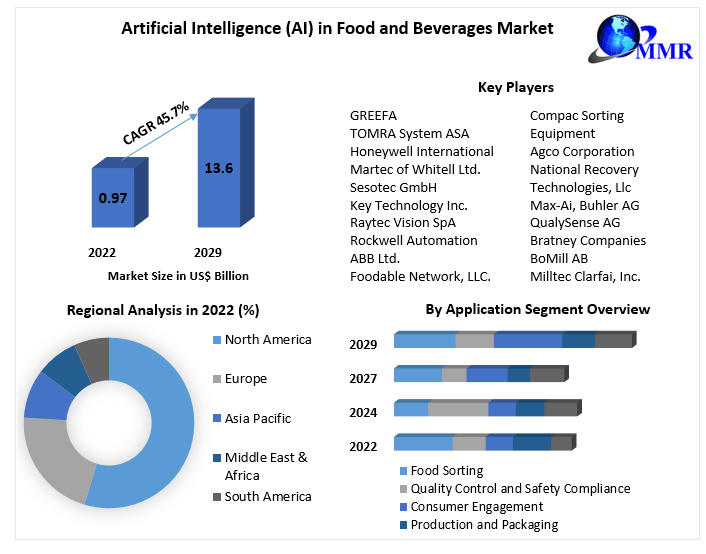
Artificial Intelligence (AI) in Food and Beverages Market is expected to reach US$ 13.6 Bn. by 2029, at a CAGR of 45.7% during the forecast period.
The Artificial Intelligence (AI) in Food and Beverages market report is a comprehensive analysis of the industry, market, and key players. The report has covered the market by demand and supply-side by segments. The Artificial Intelligence (AI) in Food and Beverages report also provides trends by market segments, technology, and investment with a competitive landscape.
 To know about the Research Methodology :- Request Free Sample Report
Overview of Artificial Intelligence (AI) in Food and Beverages:
Artificial intelligence in the food and beverage business is defined as solutions that aid in the improvement of the food and beverage industry's supply chain. This service assists them in finding new ways to satisfy their clients at a cheaper cost.
Artificial intelligence's introduction into the food and beverage business has provided various benefits, including better efficiency and execution of product delivery, enhanced food security, and reduced food waste.
Artificial Intelligence (AI) in Food and Beverages Market Dynamics:
Consumer preferences for fast, affordable, and easily accessible food options have prompted a transformation in the food and beverage industry, with market leaders leveraging advanced technologies like artificial intelligence and machine learning to scale operations and stay relevant in a dynamic market environment.
Over the last few years, AI has gained a lot of traction, with many corporations investing heavily in researching the technology's possibilities in the business. AI is assisting food and beverage industries with supply chain management via logistics, predictive analytics, and transparency. Organizations are increasingly digitizing their supply chains to differentiate themselves and drive revenue growth, which is boosting supply chain efficiency. Massive volumes of data are generated by supply chains, and AI is assisting the organization in analyzing this data.
Assurance of food quality and protection of the food supply:
Quality assurance is a critical use of AI in supply chain management since it allows organizations to reduce the risk of consumer sickness when a product or ingredient is known to be contaminated while protecting products that aren't.
AI is being used by food and beverage makers to better forecast which foods have been tainted, ensuring that these products do not reach customers. For example, Cornell University and IBM are collaborating to discover how to better secure the food supply using AI, so that when a small bit of goods is tainted, thousands or millions of pounds do not go to waste.
Demand for AI software is predicted to increase by 154 % in 2022 compared to the previous year. AI software is used in a variety of industries, including healthcare, travel, retail, financial services, and more. It's no surprise that food and beverage firms have so many potential use cases for AI, given that food tech & logistics, and transportation are two of the top areas for AI application.
Artificial Intelligence (AI) in Food and Beverages Market Segmentation:
Depending upon the application, artificial intelligence (AI) in the food and beverages market is segmented into food sorting, quality control and safety compliance, consumer engagement, production and packaging, maintenance, and other applications. Consumer engagement is predicted to increase significantly during the forecast timeline. One of the most important aspects of AI in the food and beverage sector is providing improved insights into what consumers require and how frequently they require it.
AI is being used to better understand consumer behavior, which should lead to more accurate predictions. It can also help marketers and businesses connect with customers on a more personal level, engage in deeper interactions, and improve their overall brand experience. Better consumer visibility should be able to come from a variety of sources, including federal or private demand projections for specific items and trends, sales data from merchants, demand statistics from real product orders, and more.
AI Chatbot Acceptance by Customers:
It is nearly impossible for humans to combine, clean, and use all of these various data sources without the help of AI. However, with AI Chatbot, product manufacturers can gather all of the valuable data sources they can get their hands on and feed them to a smart algorithm that assists them in making better decisions to ensure that products are available to consumers but do not go to waste. AI Chatbot saves users time and money while improving customer satisfaction. Chatbot use machine learning and natural language processing (NLP) to provide a conversational experience that is similar to that of a human.
AI can work effectively in offline mode, many consumers are adopting them. According to an American Express survey, more than half of customers are willing to spend more money with companies that provide superior customer service. This creates a huge opportunity for AI, which is likely to fuel the growth of AI in the food and beverage market.
Artificial Intelligence (AI) in Food and Beverages Market Regional Insights:
In North America, AI in the food and beverage business is booming, with the United States leading the way. In 2022, North America had a market share of xx%, making it the largest region for AI in the food and beverage industry. The leading drivers of their economic impact in North America are their readiness for adoption and high fractional increase in replacement AI, which reflects the region's leading stance on AI and its implementation, as well as the high automation potential that is expected to occur at the regional level between now and 2029
Packaging:
Artificial intelligence-driven robotics is helping to address pressing and picking demands. Customers' growing use of e-commerce has accelerated this trend. Because of the process's complexity and increased workload, intelligent automation has a lot of room for improvement.
February 2020 - ABB teamed up with Covariant, a Silicon Valley start-up, to develop improved picking robots that can work alongside human workers. Robots can learn new tasks independently using Covariant's product, which integrates 3D cameras and reinforcement learning. This takes into account significantly more advanced trial and error responses, resulting in incredible precision that can be scaled.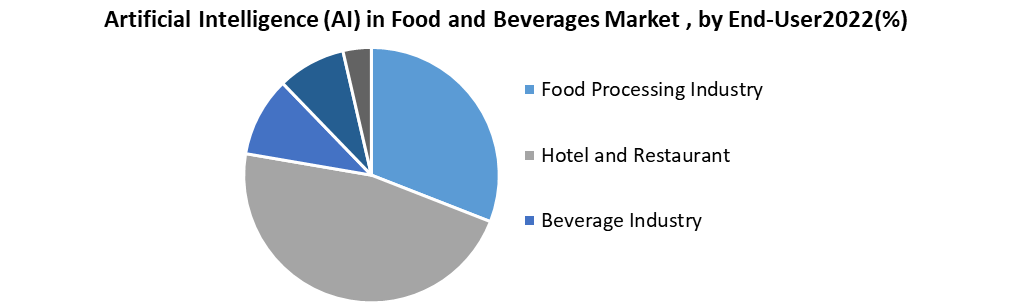 UberEats uses Michelangelo, a machine learning platform in the United States:
UberEats serves more than half of the United States' population, facilitating deliveries for about 100,000 restaurants. It also operates in 300 cities and 300 other places around the world. The company is leveraging AI to create restaurant and menu item recommendations, optimize delivery, and investigate the usage of drones. Michelangelo, a machine learning platform, is used by the organization for a variety of functions. On Michelangelo, they have several models operating, including meal delivery time forecasts, search rankings, search autocomplete, and restaurant rankings.
The objective of the report is to present a comprehensive analysis of the Artificial Intelligence (AI) in Food and Beverages Market to the stakeholders in the industry. The past and current status of the industry with the forecasted market size and trends are presented in the report with the analysis of complicated data in simple language. The report covers all the aspects of the industry with a dedicated study of key players that include market leaders, followers, and new entrants.
PORTER, SVOR, PESTEL analysis with the potential impact of micro-economic factors of the market have been presented in the report. External as well as internal factors that are supposed to affect the business positively or negatively have been analysed, which will give a clear futuristic view of the industry to the decision-makers.
The report also helps in understanding the Artificial Intelligence (AI) in Food and Beverages Market dynamics, structure by analyzing the market segments and project the Artificial Intelligence (AI) in Food and Beverages market size. Clear representation of competitive analysis of key players By Application, price, financial position, product portfolio, growth strategies, and regional presence in the Artificial Intelligence (AI) in Food and Beverages Market make the report investor’s guide.
Artificial Intelligence (AI) in Food and Beverages Market Scope: Inquire before buying
| Artificial Intelligence (AI) in Food and Beverages | |||
|---|---|---|---|
| Report Coverage | Details | ||
| Base Year: | 2022 | Forecast Period: | 2023-2029 |
| Historical Data: | 2017 to 2022 | Market Size in 2022: | US $ 0.97 Bn. |
| Forecast Period 2023 to 2029 CAGR: | 45.7% | Market Size in 2029: | US $ 13.6 Bn. |
| Segments Covered: | by Application | • Food Sorting • Quality Control and Safety Compliance • Consumer Engagement • Production and Packaging • Maintenance • Other Applications |
|
| by End-User | • Food Processing Industry • Hotel and Restaurant • Beverage Industry |
||
| by Region | • North America (United States, Canada and Mexico) • Europe (UK, France, Germany, Italy, Spain, Sweden, Austria and Rest of Europe) • Asia Pacific (China, South Korea, Japan, India, Australia, Indonesia, Malaysia, Vietnam, Taiwan, Bangladesh, Pakistan and Rest of APAC) • Middle East and Africa (South Africa, GCC, Egypt, Nigeria and Rest of ME&A) • South America (Brazil, Argentina Rest of South America) |
||
Artificial Intelligence (AI) in Food and Beverages Market Key Players
• GREEFA
• TOMRA System ASA
• Honeywell International Inc.
• Martec of Whitell Ltd. Sesotec GmbH
• Key Technology Inc.
• Raytec Vision SpA
• Rockwell Automation
• ABB Ltd.
• Foodable Network, LLC. Startup Creator
• Compac Sorting Equipment
• Agco Corporation
• National Recovery Technologies, Llc
• Max-Ai, Buhler AG
• QualySense AG
• Bratney Companies
• BoMill AB
• Milltec Clarfai, Inc.
• BBC technologies
• INTELLIGENTX Brewing Co.
• Other Key Players
Frequently Asked Questions:
1. Which region has the largest share in Global Artificial Intelligence (AI) in Food and Beverages Market?
Ans: North America region held the highest share in 2022.
2. What is the growth rate of Global Artificial Intelligence (AI) in Food and Beverages Market?
Ans: The Global Artificial Intelligence (AI) in Food and Beverages Market is growing at a CAGR of 45.7% during forecasting period 2023-2029.
3. What is scope of the Global Artificial Intelligence (AI) in Food and Beverages Market report?
Ans: Global Artificial Intelligence (AI) in Food and Beverages Market report helps with the PESTEL, PORTER, COVID-19 Impact analysis, Recommendations for Investors & Leaders, and market estimation of the forecast period.
4. Who are the key players in Global Artificial Intelligence (AI) in Food and Beverages Market?
Ans: The important key players in the Global Artificial Intelligence (AI) in Food and Beverages Market are – GREEFA, TOMRA System ASA, Honeywell International Inc., Martec of Whitell Ltd. Sesotec GmbH, Key Technology Inc., Raytec Vision SpA, Rockwell Automation, ABB Ltd., Foodable Network, LLC. Startup Creator, Compac Sorting Equipment, Agco Corporation, National Recovery Technologies, Llc, Max-Ai, Buhler AG, QualySense AG, Bratney Companies, BoMill AB, Milltec Clarfai, Inc., BBC technologies, INTELLIGENTX Brewing Co., Other Key Players
5. What is the study period of this Market?
Ans: The Global Artificial Intelligence (AI) in Food and Beverages Market is studied from 2022 to 2029.