
Amplifier Market – Global Market Size, Strategic Growth Drivers, Risk Assessment Framework, Regulatory Landscape Review, Competitive Intensity Mapping & Long-Term Industry Outlook to 2032
Overview
The Amplifier Market size was valued at USD 2.92 Billion in 2024 and the total Amplifier revenue is expected to grow at a CAGR of 2.96% from 2025 to 2032, reaching nearly USD 3.68 Billion.
Amplifier Market Overview
An amplifier is an electronic device that increases the power of a signal. It takes a weak input signal and boosts its strength, allowing it to drive larger loads such as speakers. This amplification process enables the production of louder sounds, making amplifiers essential components in audio systems, musical instruments, and various electronic devices. Amplifiers come in different types, including voltage, current, and power amplifiers, each designed for specific applications. These segments dominates the market, driven by the widespread use of amplifiers in home audio systems, personal audio devices, and home theater systems. Amplifiers are increasingly used in car audio systems, with the automotive segment showing significant growth due to the rising demand for advanced in-car entertainment systems.
According to MMR, an India-based automotive industry portal, India surpassed Japan in to become the world's third-largest light vehicle market. This shift was driven by a strong recovery in personal mobility and final-mile delivery demand following the pandemic. In , India achieved a production output of over 5 million units. Additionally, India concluded the year with annual sales of 3.8 million units, marking a growth of over 25 percent compared to Japan. In contrast, Japan saw a decline in sales, with nearly 200,000 fewer units sold compared to its figures of 3.7 million units.
Leading amplifier manufacturing companies include Texas Instruments, Yamaha Corporation, STMicroelectronics, Analog Devices, and Qualcomm, among others. These companies are continuously innovating and launching new products to meet the evolving demands of consumers and industry
June 21, 2024: STMicroelectronics launches high-efficiency TSB952 dual operational amplifier. STMicroelectronics’ TSB952 dual operational amplifier (op amp) has a 52MHz gain-bandwidth with a 36V supply current of only 3.3mA per channel, making it an excellent choice for applications that are power careful. To know about the Research Methodology :- Request Free Sample Report
Amplifier Market Dynamics
Rising Demand for Consumer Electronics to boost Amplifier Market growth
Consumer electronics are a primary driver of the amplifier market. With the proliferation of devices such as smartphones, tablets, smart TVs, and home audio systems, the need for amplifiers has surged. In 2024, the global consumer electronics market was valued at approximately $1.1 trillion, and it is projected to grow at a CAGR of around 8.5% through 2030. Amplifiers are integral to these devices, enhancing audio output quality and driving the market forward. The automotive industry has seen a rising integration of advanced audio systems, which rely heavily on amplifiers. Modern vehicles are equipped with sophisticated infotainment systems that require high-performance amplifiers to deliver premium sound quality. The shift towards wireless audio devices, such as Bluetooth speakers and wireless headphones, has significantly impacted the amplifier market. Amplifiers designed for these devices need to be compact, efficient, and capable of delivering high-quality sound.
Innovations in amplifier technology, such as the development of Class D amplifiers, have propelled the market forward. Class D amplifiers are known for their high efficiency and compact size, making them ideal for modern electronic devices. According to MMR, the demand for energy-efficient solutions is on the rise, with an increasing focus on sustainable and green technologies. The advancement of Class D amplifiers aligns with this trend, driving their adoption in various applications and contributing to market growth.
The growing sales of passenger vehicles are expected to drive the development of the amplifier market in the coming years. This increase in vehicle sales is attributed to several factors, including economic growth, easy access to financing options, a wide array of vehicle choices, and shifting consumer preferences towards personal mobility and convenience, especially in emerging markets. In passenger vehicles, amplifiers play a crucial role by enhancing audio quality. They boost signals from audio sources like radios or media players, delivering clear, powerful sound through the vehicle's speakers for an improved listening experience.
High Costs of Advanced Amplifier Technologies to boost Amplifier Market growth
High cost associated with advanced amplifier technologies, such as Class D amplifiers are more efficient and compact, but they also come with higher production costs due to the complex design and the need for high-quality components. This cost barrier limit the adoption of these advanced amplifiers, especially among cost-sensitive consumers and small-scale manufacturers. The amplifier market is highly competitive, with numerous established players and new entrants vying for Amplifier industry share. This intense competition lead to market saturation, particularly in mature markets like North America and Asia Pacific. As a result, companies struggle to differentiate their products and achieve significant profit margins. The pressure to continuously innovate and reduce prices to stay competitive also strain resources and impact profitability.
The global supply chain for electronic components has been highly volatile, particularly in recent years. Disruptions caused by geopolitical tensions, trade wars, have led to shortages of critical components, such as semiconductors. These supply chain issues delay production and increase costs for amplifier manufacturers, impacting their ability to meet market demand efficiently. Integrating amplifiers into modern electronic devices, especially compact and portable ones, is be complex and challenging. The need for miniaturization without compromising performance requires sophisticated engineering and design capabilities. This complexity lead to higher development costs and longer time-to-market, restraining the growth of the amplifier market.
Amplifier Market Segment Analysis
Based on Type, the market is segmented into Voltage Amplifier, Current Amplifier, Power Amplifier, and Others. Voltage Amplifier segment dominated the market in 2024 and is expected to hold the largest Amplifier Market share over the forecast period. Voltage amplifiers are electronic devices designed to increase the amplitude of input voltage signals. They are used extensively in audio, video, telecommunications, instrumentation, and other electronic systems where weak signals need to strengthened for further processing or transmission. Op-amps are widely used as voltage amplifiers due to their versatility and high gain capabilities. They are integrated circuits (ICs) with two input terminals (inverting and non-inverting) and one output terminal. Op-amps configured in various ways (inverting, non-inverting, differential amplifiers) to suit different voltage amplification requirements.
Amplifier Market Regional Insight
Growth in Automotive Industry to boost Asia Pacific Amplifier Market growth
Asia Pacific dominated the market in 2024 and is expected to hold the largest Amplifier Market share over the forecast period. The automotive sector in Asia-Pacific is experiencing robust growth, fueled by increasing vehicle production and rising consumer demand for advanced in-car entertainment systems. Amplifiers play a crucial role in enhancing audio quality in vehicles, driving their integration into automotive audio systems. Countries like China and India are leading contributors to automotive production in the region. Insights from MMR indicate substantial investments in automotive technology, including audio and infotainment systems, bolster the amplifier market growth.
Asia-Pacific countries import a significant amount of amplifiers, especially from manufacturing hubs like China and Japan. These imports cater to the region's growing consumer electronics and automotive industries. The region also exports amplifiers to global markets, leveraging its strong manufacturing base and technological expertise. Key export destinations include North America and Europe.
Urbanization trends in Asia-Pacific lead to higher demand for commercial and residential infrastructure, including office spaces, shopping malls, and residential complexes. These developments require sophisticated audio systems, where amplifiers are essential for delivering clear and powerful sound. Regional insights highlight significant investments in smart city initiatives and infrastructure projects across countries like China, India, and Southeast Asian nations, contributing to the amplifier market’s growth. India's growing consumer electronics market, coupled with increasing disposable incomes and urbanization, fuels amplifier demand. The automotive sector also shows significant growth, supported by rising vehicle sales and technological advancements.
Technological Advancements to boost North America Amplifier Market Growth
North America is at the forefront of technological innovation, particularly in industries such as telecommunications, electronics, and automotive sectors. Technological advancements drive the demand for advanced amplifier technologies that offer higher efficiency, better performance, and integration capabilities. Innovations in 5G technology, IoT (Internet of Things), autonomous vehicles, and aerospace applications require robust amplification solutions, thereby boosting the market.
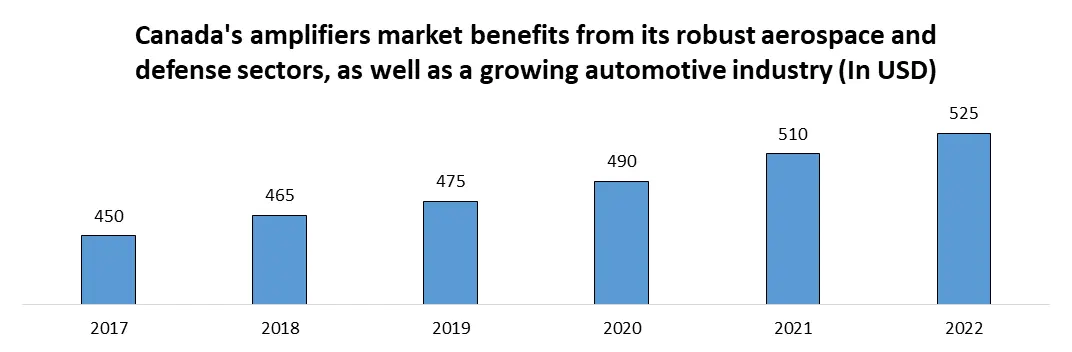
The United States dominates the North American amplifiers market, driven by its strong presence in semiconductor manufacturing, telecommunications, and consumer electronics industries. Silicon Valley and other technology hubs foster innovation and development of cutting-edge amplifier technologies, attracting investments and research initiatives. Canada amplifiers market benefits from its robust aerospace and defense sectors, as well as a growing automotive industry.
Amplifier Market Scope: Inquire Before Buying
| Global Amplifier Market | |||
|---|---|---|---|
| Report Coverage | Details | ||
| Base Year: | 2024 | Forecast Period: | 2025-2032 |
| Historical Data: | 2019 to 2024 | Market Size in 2024: | USD 2.92 Bn. |
| Forecast Period 2025 to 2032 CAGR: | 2.96% | Market Size in 2032: | USD 3.68 Bn. |
| Segments Covered: | by Product | Voltage Amplifier Current Amplifier Power Amplifier Others |
|
| by Class Type | Class A Class B Class C Others |
||
| by End User | Transportation Medical Defense Industrial Oil and Gas Other |
||
Amplifier Market, by Region
North America (United States, Canada and Mexico)
Europe (UK, France, Germany, Italy, Spain, Sweden, Austria and Rest of Europe)
Asia Pacific (China, South Korea, Japan, India, Australia, Indonesia, Malaysia, Vietnam, Taiwan, Bangladesh, Pakistan and Rest of APAC)
Middle East and Africa (South Africa, GCC, Egypt, Nigeria and Rest of ME&A)
South America (Brazil, Argentina Rest of South America)
Leading Amplifier Manufacturers include:
1. Texas Instruments - Dallas, Texas, USA
2. Analog Devices - Norwood, Massachusetts, USA
3. STMicroelectronics - Geneva, Switzerland
4. Infineon Technologies - Neubiberg, Germany
5. NXP Semiconductors - Eindhoven, Netherlands
6. Renesas Electronics Corporation - Tokyo, Japan
7. ON Semiconductor - Phoenix, Arizona, USA
8. Maxim Integrated - San Jose, California, USA
9. Broadcom Inc. - San Jose, California, USA
10. Microchip Technology - Chandler, Arizona, USA
11. Cree, Inc. - Durham, North Carolina, USA
12. Toshiba Electronic Devices & Storage Corporation - Tokyo, Japan
13. ON Semiconductor - Phoenix, Arizona, USA
14. ROHM Semiconductor - Kyoto, Japan
15. Vishay Intertechnology - Malvern, Pennsylvania, USA
16. Monolithic Power Systems - San Jose, California, USA
17. Cirrus Logic - Austin, Texas, USA
18. Silicon Labs - Austin, Texas, USA
19. Infineon Technologies - Munich, Germany
20. Yamaha Corporation.- Japan
Frequently asked Questions:
1. What is driving the growth of the amplifier market?
Ans: The amplifier market is driven by increasing demand in consumer electronics such as smartphones, tablets, and home audio systems. Additionally, growth in automotive applications, particularly advanced in-car entertainment systems, contributes significantly to market growth.
2. How do technological advancements impact the amplifier market?
Ans: Technological advancements, such as the development of Class D amplifiers known for their efficiency, compact size, and suitability for wireless devices, are driving market growth. Innovations in 5G technology, IoT, and automotive advancements also require advanced amplification solutions, further boosting the market.
3. What are the challenges faced by the amplifier market?
Ans: Challenges include high costs associated with advanced amplifier technologies like Class D amplifiers, supply chain disruptions affecting component availability, and the complexity of integrating amplifiers into compact electronic devices without compromising performance.
4. Which regions dominate the amplifier market?
Ans: Asia-Pacific leads the amplifier market due to robust growth in automotive production and increasing investments in infrastructure and consumer electronics. North America is driven by technological innovation and strong presence in semiconductor manufacturing.
5. What was the Global Amplifier Market size in 2024?
Ans: The Global Amplifier Market size was USD 2.92 Billion in 2024.