
Luminum Forging Market Size by Alloy Type, Component Type, Manufacturing Process, End-User Industry and Region – Segment-Level Market Assessment, Growth Opportunity Analysis, Competitive Mapping & Forecast to 2030
Overview
The Aluminum Forging Market size was valued at USD 90.24 Bn in 2023 and is expected to reach USD 147.77 Bn by 2030, at a CAGR of 7.3 %.
Overview of the Aluminum Forging Market
The aluminum forging market encompasses the industry engaged in the manufacturing and sale of forged aluminum products. Forging is a metal shaping process that utilizes localized compressive forces applied by means of dies or tools. In the context of aluminum forging, this process is specifically applied to aluminum alloys.The Aluminum Forging Market is thoroughly elaborated by offering several pieces of information such as market size, key players and their market value, their recent developments as well as their partnerships, mergers, and acquisitions. The graphical representation and structural exclusive information showed dominating region of the Aluminum Forging Market. The detailed and constructive formation of key drivers, opportunities, and unique segmentation outputs structural and optimistic data. Validated using primary as well as secondary research methodology and scope of the Aluminum Forging Market.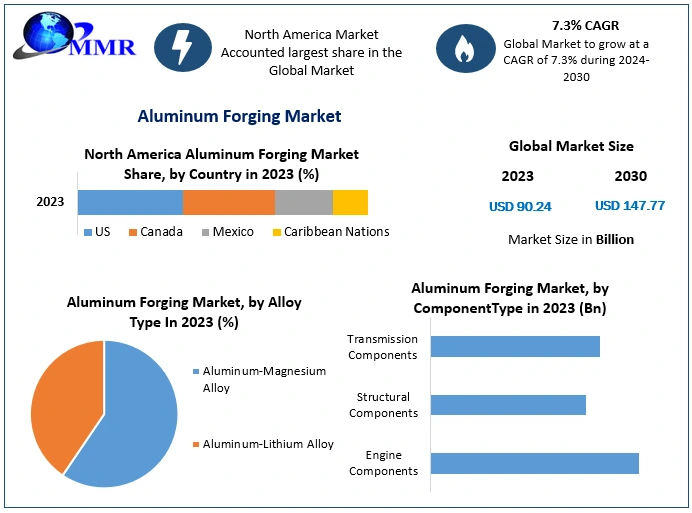 To know about the Research Methodology :- Request Free Sample Report
Aluminum Forging Market Dynamics
Lightweight Fuel-Efficient Vehicles, Aerospace Industry Growth, and Infrastructure Development are the major drivers of the Aluminum Forging Market.
The automotive industry's focus on lightweight materials to enhance fuel efficiency and reduce emissions generates substantial demand for aluminum-forged components. Aluminum's excellent strength-to-weight ratio makes it an optimal choice for manufacturing lighter parts without compromising durability and performance. The aerospace sector heavily relies on the aluminum forging market for producing critical components like aircraft wings, fuselage sections, landing gear, and engine parts. The increasing demand for air travel, coupled with the need for fuel-efficient aircraft, drives the heightened demand for aluminum-forged products in the aerospace industry. The investment in infrastructure projects such as bridges, buildings, and transportation networks drives the demand for robust and long-lasting aluminum-forged components Aluminum Forging industry.
Aluminum's corrosion resistance and structural integrity make it well-suited for various construction applications, propelling the need for aluminum forging in the infrastructure sector. Advancements in Manufacturing Technologies offer continuous progress in forging techniques, including advanced die designs, computer-controlled forging processes, and automated systems, significantly enhancing the efficiency, precision, and quality of aluminum forging. These technological advancements enable manufacturers to produce intricate and highly engineered aluminum components, expanding the Aluminum Forging market's potential.
Sustainability with Recycling Initiatives, Rising Demand for Customization, and Shift toward Electric Vehicles are the factors that drive the Aluminum Forging Market.
Aluminum stands out as a highly recyclable material, and the focus on sustainable practices and environmental responsibility drives the adoption of aluminum forging. The ability to recycle and reuse aluminum alloys reduces waste and minimizes the carbon footprint, aligning with the growing emphasis on eco-friendly manufacturing processes. Aluminum forging allows manufacturers to create components tailored to specific customer requirements, offering design flexibility and customization options. This capability holds particular importance in industries like automotive and aerospace, where unique designs and specifications are essential to meet performance and safety standards. The global transition towards electric vehicles (EVs) presents opportunities for the aluminum forging market. EVs require lightweight components to optimize range and battery efficiency. Aluminum forged parts, such as battery housings, structural components, and cooling systems, play a crucial role in the development of electric vehicle technology in the Aluminum Forging industry.
Restraints, Opportunities, and Trends of Aluminum Forging Market
Fluctuating Raw Material Prices, Intense Competition, and Environmental Regulations are major restraints on the aluminum forging market
Volatility in aluminum alloy prices can impact the aluminum forging market, leading to potential cost fluctuations in production and affecting overall profitability. The aluminum forging industry faces strong competition from alternative manufacturing processes, such as casting and machining. This competition poses challenges in terms of cost-effectiveness and the ability to differentiate products. Stringent environmental regulations concerning emissions and waste management impose compliance costs on aluminum forging companies, increasing operational challenges.
Lightweight products in the Automotive Industry, Growth in the Aerospace Sector, and Infrastructure Development are the current opportunities in the aluminum forging market
The automotive industry's increasing emphasis on lightweight to enhance fuel efficiency presents significant opportunities for aluminum forgings. Their high strength-to-weight ratios make them well-suited for meeting these demands. The aerospace industry's continuous demand for lightweight, high-strength components creates substantial opportunities for aluminum forgings. Applications such as aircraft structures and engine components benefit from these specialized products. Emerging aluminum forging markets and infrastructure projects offer promising opportunities for aluminum forgings. Applications like bridges, railways, and construction equipment present avenues for growth and expansion in the aluminum forging industry.
Advanced Forging Techniques, Automation and Robotics, and Sustainability and Recycling are the trends in the aluminum forging market
The adoption of advanced forging techniques like precision forging and near-net-shape forging is on the rise. These techniques optimize material utilization, reduce machining requirements, and enhance the overall quality of forged aluminum components. The integration of automation and robotics in the forging process is increasing, leading to improved productivity, process control, and operational efficiency. This trend enhances manufacturing capabilities and competitiveness. The aluminum forging industry is placing greater emphasis on sustainable practices, including the recycling of aluminum scrap and implementing waste reduction measures.
Aluminum Forging Market Segmentation Analysis
End-Use Industry:Aerospace Segment: Aluminum is usually alloyed with elements such as manganese, silicon, copper, magnesium, or zinc to further increase strength. The alloys are made stronger by cold working. Some alloys are further strengthened and hardened by heat treatments. Aluminum alloy 2024 is the most widely used in aerospace development. The alloy has a high yield strength and is a high-grade alloy with excellent fatigue resistance. It is commonly used in sheet form for the wings and fuselage. This segment encompasses the manufacturing of aluminum forged components specifically designed for the aerospace industry, including vital parts like aircraft wings, fuselage sections, landing gear, and engine components the vast use of aluminum in these industries is driving the significant growth of the aluminum forging market.
Automotive Segment: The automotive industry utilizes aluminum forgings to produce a variety of parts, including engine blocks, suspension components, wheels, and transmission parts. The benefits of using aluminum forgings in the production of automobile parts include improved strength, lighter weight, and better resistance to corrosion. In the automotive industry, aluminum forging is used in engine radiators, wheels, bumpers, suspension parts, engine cylinder blocks, transmission bodies and body parts: the hoods, the doors, and even the frame these factors are boosting the aluminum forging market growth.
Construction Segment: This segment involves the production of aluminum-forged components used in construction applications, including bridges, buildings, infrastructure projects, and transportation systems these are in demand in the aluminum forging market.
Alloy Type:Aluminum-Lithium Alloy Segment: This segment concentrates on the forging of aluminum-lithium alloys, known for their exceptional strength, lightweight properties, and superior fatigue resistance. Such alloys are predominantly utilized in the aerospace sector. These types of alloy are raising the demand for the aluminum forging market.
Aluminum-Magnesium Alloy Segment: This segment involves the forging of aluminum-magnesium alloys, which provide improved strength, corrosion resistance, and thermal stability. They find applications in industries such as automotive, marine, and aerospace. Such components are boosting the aluminum forging market.
Component Type:
Engine Components Segment: This segment specializes in the manufacturing of aluminum forged components designed for engines, encompassing items such as cylinder heads, pistons, connecting rods, and crankshafts. This component is boosting the aluminum forging market growth.
Structural Components Segment: Within this segment, aluminum forging is dedicated to producing components used for structural purposes, including beams, brackets, frames, and supports. These are the major uses that boost the aluminum forging industry.
Transmission Components Segment: This segment focuses on the forging of aluminum components used in transmissions, such as gears, shafts, and housings that comprise the demand in the aluminum forging industry.
Manufacturing Process:
Closed-Die Forging Segment: In this segment, aluminum forged components are manufactured using the closed-die forging process, involving the shaping of metal within a closed mold or die.
Open-Die Forging Segment: This segment encompasses the production of aluminum forged components using the open-die forging process, where the metal is shaped between flat dies without complete enclosure. These manufacturing processes are boosting the aluminum forging market.
Regional Insights of the Aluminum Forging Market
North America has traditionally held a significant market share in the aluminum forging industry. The region boasts a substantial presence of major aerospace and automotive manufacturers, leading to a high demand for aluminum-forged components. Moreover, ongoing infrastructure development projects and technological advancements further stimulate the market. The United States, in particular, is renowned for its well-established market.
The Asia Pacific region showcases the significant aluminum forging market growth. Rapid industrialization, upgrading infrastructural developments, and economic stability are to boost the aluminum forging market.
Europe stands as another prominent region in the market. The region hosts a strong presence of aerospace and automotive industries that necessitate high-quality aluminum forged components.
Latin America has a developing aluminum forging market with noteworthy contributions from countries such as Mexico and Brazil. The automotive industry in these countries plays a crucial role in driving the demand for aluminum-forgedindustry components. Additionally, ongoing infrastructure projects and increasing investments in renewable energy sectors contribute to the aluminum forging market growth within the region.The Middle East & Africa region is gradually emerging as a notable market for aluminum forging.
Competitive Landscape Analysis of the Aluminum Forging Market
Bharat Forge, based in India, has been actively expanding its global presence through strategic partnerships and acquisitions. In 2020, the company partnered with Paramount Group to manufacture defense components. They also acquired a stake in Tevva Motors, a UK-based electric vehicle technology company. Bharat Forge specializes in the production of aluminum-forged components for various industries, including automotive, aerospace, and defense. Their flagship products include engine components, chassis components, and structural parts. Arconic, a global aluminum forging company, has focused on enhancing its capabilities through acquisitions and divestitures. In 2020, the company sold its rolling mill business while acquiring a facility in Cleveland, Ohio, to expand its aerospace and defense forging capacity. Arconic offers a range of aluminum forged products such as structural components, aero structures, and engine components. Their products find applications in the aerospace, automotive, and industrial sectors which boosts the aluminum forging market.
Norsk Hydro, a Norwegian company, has been actively involved in expanding its aluminum forging operations. In 2020, the company acquired the remaining shares of Sapa AS, strengthening its position in the extruded aluminum products in the aluminum forging market. Norsk Hydro manufactures a wide range of aluminum forged products, including extrusions, sheet and plate products, and precision tubing. These products cater to industries such as automotive, transportation, and construction. Aleris, a global aluminum producer, has undergone significant developments in recent years. In 2020, the company was acquired by Novelis, a subsidiary of Hindalco Industries, expanding its capabilities in the aluminum value chain. Aleris specializes in aluminum forging for industries like aerospace, automotive, and industrial applications in the aluminum forging market.
Their flagship products include aerospace plates and sheets, automotive body panels, and heat exchanger materials. Precision Castparts Corporation (PCC), an American company, has been involved in strategic acquisitions to expand its aluminum forging capabilities. In 2019, PCC acquired Permaswage, a manufacturer of fluid fittings and assemblies, enhancing its product portfolio. PCC offers aluminum forging solutions for the aerospace, power generation, and general industrial sectors. Their flagship products include aerospace forgings, airfoil castings, and structural components.
Aluminum Forging Market Scope: Inquire before buying
| Global Aluminum Forging Market | |||
|---|---|---|---|
| Report Coverage | Details | ||
| Base Year: | 2023 | Forecast Period: | 2024-2030 |
| Historical Data: | 2018 to 2023 | Market Size in 2023: | US $ 90.24 Bn. |
| Forecast Period 2024 to 2030 CAGR: | 7.3% | Market Size in 2030: | US $ 147.77 Bn. |
| Segments Covered: | by Alloy Type | Aluminum-Magnesium Alloy Aluminum-Lithium Alloy |
|
| by Component Type | Engine Components Structural Components Transmission Components |
||
| by Manufacturing Process | Closed-Die Forging Open-Die Forging |
||
| by End-User Industry | Aerospace Industry Automotive Industry Construction Industry |
||
Aluminum Forging Market, by Region
North America (United States, Canada and Mexico)
Europe (UK, France, Germany, Italy, Spain, Sweden, Austria and Rest of Europe)
Asia Pacific (China, South Korea, Japan, India, Australia, Indonesia, Malaysia, Vietnam, Taiwan, Bangladesh, Pakistan and Rest of APAC)
Middle East and Africa (South Africa, GCC, Egypt, Nigeria and Rest of ME&A)
South America (Brazil, Argentina Rest of South America)
Aluminum Forging Market Key Players
1. Alcoa Corporation (United States)
2. Bharat Forge Limited (India)
3. Nippon Steel & Sumitomo Metal Corporation (Japan)
4. Precision Castparts Corp. (United States)
5. Arconic Inc. (United States)
6. Thyssenkrupp AG (Germany)
7. ATI (Allegheny Technologies Incorporated) (United States)
8. Bharat Heavy Electricals Limited (India)
9. Metaldyne Performance Group Inc. (United States)
10. American Axle & Manufacturing Holdings, Inc. (United States)
11. Aichi Steel Corporation (Japan)
12. Mahindra CIE Automotive Limited (India)
13. Scot Forge Company (United States)
14. Ellwood Group, Inc. (United States)
15. Bruck GmbH (Germany)
Frequently Asked Questions and Answers for Aluminum Forging Market
1. What are the advantages of aluminum forging?
Ans: Aluminum forging offers several advantages, including:
1. Increased strength and durability compared to other manufacturing processes
2. Enhanced structural integrity and reliability
3. Improved mechanical properties, such as fatigue resistance
4. Enhanced surface finish and dimensional accuracy
5. Ability to create complex shapes and designs
6. Cost-effectiveness for high-volume production
2. What industries use aluminum forging?
Ans: Aluminum forging finds applications in various industries, including:
1. Aerospace and aviation
2. Automotive
3. Defense and military
4. Industrial machinery and equipment
5. Oil and gas
6. Construction and infrastructure
7. Electrical and electronics
8. Marine and shipbuilding
3. What factors affect the cost of aluminum forging?
Ans: Several factors influence the cost of aluminum forging, including:
1. Material costs
2. Design complexity
3. Tooling and equipment requirements
4. Production volume
5. Post-forging processes (such as machining, heat treatment, and finishing)
6. Quality and testing requirements
7. Market Demand and Competition
4. What are the future prospects and trends in the aluminum forging market?
Ans: Some future prospects and trends in the aluminum forging market include:
1. Increasing use of advanced forging techniques, such as precision forging and near-net-shape forging.
2. Integration of automation and robotics in the forging process for improved efficiency and productivity.
3. Growing emphasis on sustainable and eco-friendly forging practices, including recycling and waste reduction.
4. Expansion into emerging markets with rising industrialization and infrastructure development.
5. Development of new aluminum alloys with enhanced properties for specific applications.
5. What are the major challenges faced by the aluminum forging market?
Ans: The aluminum forging market faces several challenges, including:
1. Fluctuating prices of raw materials, such as aluminum alloys, which can impact production costs.
2. Intense competition from alternative manufacturing methods, such as casting and machining.
3. Stringent regulatory standards and environmental regulations affect the production process.
4. Increasing demand for sustainable and eco-friendly manufacturing practices.