Aircraft Door Market – Global Market Size, Strategic Growth Drivers, Risk Assessment Framework, Regulatory Landscape Review, Competitive Intensity Mapping & Long-Term Industry Outlook to 2032

5.8%
CAGR (2026-2032)
629 USD Mn.
Market Size
308
Report Pages
145
Market Tables

Overview

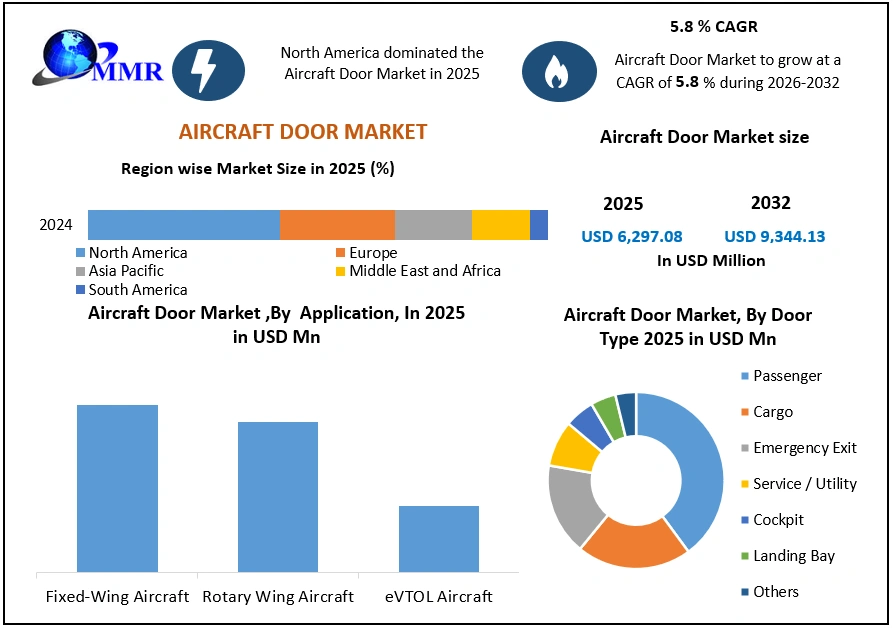
The Aircraft Door Market size was valued at USD 6,297.08 Million in 2025, and the total revenue is expected to grow at CAGR of 5.8 % from 2026 to 2032, reaching nearly USD 9,344.13 Million.

The MMR report comprehensively covers the above aspects of the Aircraft Door Market, providing in-depth analysis across fleet evolution and demand dynamics, regional cost and pricing structures, aftermarket and MRO trends, value chain and supply chain dependencies, material usage, manufacturing processes, logistics, R&D and innovation, risk and reliability assessment, import–export flows, sustainability considerations, investment trends, and regulatory and certification frameworks, offering stakeholders a holistic, data-driven understanding of market performance, operational risks, and long-term growth opportunities.

Aircraft Door Market Overview:

Aircraft Door Market was valued at USD 5317.19 Million in 2022 and is predicted to grow at a CAGR of 5.8 % to USD 7890.08 Million by 2029. The Aircraft Door Market is studied by segments like Aircraft Type (Narrow-body aircraft, Wide Body Aircraft, General Aviation, Regional Aircraft), Door Type (Passenger Door, Emergency Door, Service Door, Cargo Door, Nose landing gear door, Main landing gear door), End-user (OE, Aftermarket), Material Type (Aluminium, Composite), Application (Commercial Aviation, Military Aviation). The report consists of the Trend, forecasts, Competitive Analysis, and Growth Opportunities of the market.

An aircraft door is designed and produced with extreme precision in order to meet the required safety. It must meet airworthiness regulation criteria set by government bodies such as the FAA and EASA. The aircraft doors are also integrated and adjusted so that they fulfil increasing customer expectations while also taking into account the industry's economic requirements.

The increasing demand for lightweight aircraft parts to improve an aircraft's fuel efficiency, combined with the predicted increase in air passenger traffic, is causing a paradigm shift in its material dynamics. These doors provide the option of being operated manually or automatically. As opposed to classic aircraft doors, new Aircraft doors are built to provide further robustness while decreasing door weight.
Aircraft Door Market 2025-2032To know about the Research Methodology:-Request Free Sample Report

Aircraft Door Market Dynamics:

The demand for the global Aircraft door market is rising across various industries

Global demand for low-cost carriers is driven by increased corporate travel and improving the tourism industry. Robust economic growth improved living circumstances, and the presence of major aircraft manufacturers contributes to the growth of the Aircraft door market. Furthermore, increased seating capacity in low-cost carriers and lower rates and levies compared to traditional air carriers are encouraging market growth. Proliferating commercial operations, as well as expanding air passenger and freight traffic, are enticing government and other foreign entities to participate in the industry.

To increase profitability, Aircraft door manufacturers are focusing on long-term growth plans with aircraft companies and MROs, investing in production and research programs, extending their line of business, and increasing quality and productivity. Airline ticket prices have been falling in recent years as a result of increased competition among airlines and increased operational efficiency.

Manufacturers are also expanding their customer base in developing nations such as India and China in order to profit from the Aircraft door market’s growth potential. The encounter may limit market income due to the technical difficulties that hydraulically the aircraft door market, such as cargo doors and weapon-bay doors. Additional hurdles to developing Aircraft doors include a lack of fluid compatibility, the demand for fire-resistant fluids and zero leakage hydraulics, and precise maintenance schedules for monitoring fluid conditions aboard aircraft.

Impact of COVID-19 on Aircraft Door market

The COVID-19 pandemic has devastated the global economy and humanity. Due to the high infection rate and negative impact on public health systems, governments in various nations were forced to implement statewide lockdowns, hurting production, supply chains, trade, and related services.

The advent of COVID-19 generated unthinkable losses. For the last few years, the industry appeared to be circling a vicious circle of hurdles and downward trajectories that resulted in colossal supply chain disruption, production halts, and deferred orders. However, as the effect of COVID-19 second wave has reduced and airlines are making a comeback, the Aircraft door market is anticipated to increase in the forecast period.

Aircraft Door Market Segment Analysis:

On the basis of Aircraft Type, the Aircraft Door market is classified into narrow-body aircraft, wide-body aircraft, regional aircraft, and general aviation. Despite a massive drop in 2020 as a result of the pandemic, narrow-body aircraft are predicted to remain the most significant demand generator for doors among all aircraft types during the projection period.

Early narrow-body aircraft recovery, as evidenced by the resumption of B737MAX production, expected rebound in production rates of critical aircraft programs such as the A320 family, and market entry of new aircraft programs (COMAC C919 and Irkut MC-21), are likely to create massive growth opportunities for door manufacturers in the narrow-body aircraft type segment over the forecast period.

Based on the door type, in 2025, passenger doors dominated the Aircraft Door Market due to high installation volumes in commercial narrowbody and widebody aircraft and strict safety regulations. Cargo doors hold a significant share, driven by growth in air freight and widebody fleets. Emergency exit doors maintain steady demand due to mandatory evacuation standards. Service/utility and cockpit doors support consistent replacement demand in both OEM and aftermarket segments, while landing bay doors are primarily defense-driven. Other specialized doors serve niche military, business jet, and special-mission aircraft applications.

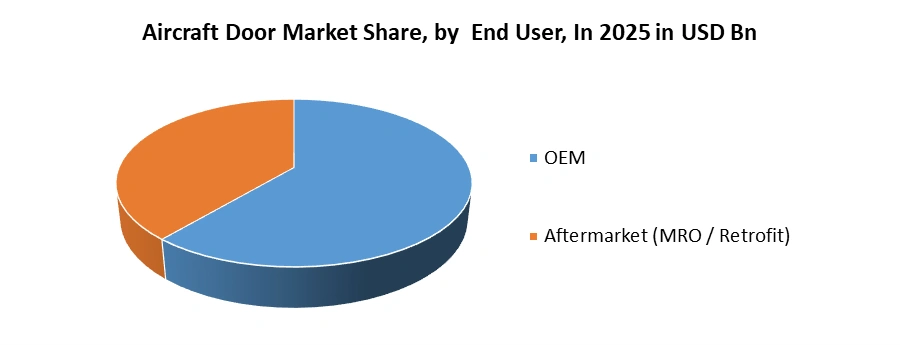
Based on End User, in 2025, OEM dominated the aircraft door market, driven by rising aircraft production rates, fleet modernization programs, and integration of advanced, lightweight door systems at the manufacturing stage. Aftermarket (MRO / Retrofit) represents a steady and growing segment, supported by aging fleets, mandatory safety upgrades, door replacement cycles, and retrofitting of enhanced sealing, locking, and composite structures to extend aircraft service life and ensure regulatory compliance.
Aircraft Door Market by End UserOn the basis of Material Type, The Aircraft Door Market is segmented into Aluminium and composite. During the projection period, aluminium is predicted to remain the dominating material, while composite doors are expected to be the fastest-growing material type in the Aircraft Door market. Years of established track record combined with a long list of advantages over aluminium left the aerospace behemoths (Boeing and Airbus) with no choice but to use composites in large quantities in critical areas of their latest aircraft programmes.

A critical component, the door, has seen a similar material change, with the passenger and service doors of the current aircraft programmes being built with composites. There have been tremendous technological advances even with composites, with companies attempting to manufacture doors by resin transfer.

On the basis of application, the Aircraft door market is segmented into commercial aviation and military aviation. Compared to commercial aircraft, the doors used in the military segment are more complex and have higher prices on average. The commercial aviation segment is expected to lead the aircraft door market in the forecast period. The global client base for commercial Aircrafts is expanding in all regions. Airlines from the Middle East and the Asia Pacific are becoming more prominent in the worldwide aviation industry.

Increased air passenger traffic has prompted airline operators to increase the size of their aircraft fleets, which has contributed to an increase in new aircraft orders. The increase in commercial Aircraft production is likely to drive demand for aerospace components such as aircraft doors in the near future.

Aircraft Door Market Regional Insights:

North America is predicted to hold the largest share of xx% in the aircraft door market by 2029, due to the presence of a large number of major OEMs, such as Boeing and Airbus, which make the region a key growth engine of the aerospace industry, and subsequently, for the Aircraft door market.

Most Aircraft door suppliers have a presence in the region to serve OEMs' emerging needs and to be a partner in their existing programmes. Europe is expected to account for the second-highest share in terms of revenue in the near future, followed by Asia Pacific, Latin America, and Middle East & Africa. Increasing production of aircraft in Europe is one of the reasons for augmentin growth of the aircraft door market in the region.

Asia-Pacific is expected to be the fastest-growing region during the forecast period, owing to several factors such as a rise in spending power by consumers in countries like China, Japan, India, and Australia. As well as increased demand for commercial aircraft to support expected increases in passenger traffic, the opening of Boeing and Airbus assembly plants, and upcoming indigenous commercial aircraft (COMAC C919).

The objective of the report is to present a comprehensive analysis of the Aircraft Door market to the stakeholders in the industry. The past and current status of the industry with the forecasted market size and trends are presented in the report with the analysis of complex data in simple language. The report covers all the aspects of the industry with a dedicated study of key players that include market leaders, followers, and new entrants.

PORTER, PESTEL analysis with the potential impact of micro-economic factors of the market have been presented in the report. External as well as internal factors that are supposed to affect the business positively or negatively have been analyzed, which is anticipated to give a clear, futuristic view of the industry to the decision-makers.

The report also helps in understanding the market dynamics, and structure by analyzing the market segments and projecting the market size. Explicit representation of competitive analysis of key players by product, price, financial position, product portfolio, growth strategies, and regional presence in the market make the report investor’s guide.

Aircraft Door Market Scope: Inquiry Before Buying

Global Aircraft Door Market
Report Coverage Details
Base Year: 2025 Forecast Period: 2026-2032
Historical Data: 2020 to 2025 Market Size in 2025: USD 6297.08 Mn.
Forecast Period 2026 to 2032 CAGR: 5.8% Market Size in 2032: USD 9344.13 Mn.
Segments Covered: by Door Type Passenger
Cargo
Emergency Exit
Service / Utility
Landing Bay
Cockpit
Others
by Component Hinge arms
Latches
Handles
Girt
Seals
Structural panels/skins
Actuation systems
Others
by Material Aluminum Alloys
Composite Materials
Titanium
Steel
Others
by Mechanism Hydraulic
Electric
Pneumatic
by Application Fixed-Wing
  Commercial Aviation
       Narrowbody Aircraft
       Widebody Aircraft
       Regional Jets
    Business & General Aviation
       Business Jets
       Light Aircraft
    Military Aviation
      Combat Aircraft
     Transport Aircraft
     Special Mission Aircraft
Rotary Wing
Commercial Helicopter
   Military Helicopter
eVTOL Aircraft
by End User OEM
Aftermarket (MRO / Retrofit)

Aircraft Door Market, by Region

North America (United States, Canada and Mexico)
Europe (UK, France, Germany, Italy, Spain, Sweden, Austria, Turkey, Russia and Rest of Europe)
Asia Pacific (China, India, Japan, South Korea, Australia, ASEAN and Rest of APAC)
Middle East and Africa (South Africa, GCC, Egypt, Nigeria and Rest of ME&A)
South America (Brazil, Argentina, Columbia and Rest of South America)

Aircraft Door Market, Key Players are

The Aircraft Door Market has become competitive, with various players in the industry have adopted product launches and business expansion as their developmental strategies to expand their market share, increase profitability, and remain stable in the market.
To grow their product range and acquire a competitive edge in the industry, key players in the Aircraft Door market are employing various business tactics such as business expansion, product innovation. To strengthen their market position, significant organizations in the industry are pursuing various business strategies such as mergers and acquisitions.

1. Safran SA
2. Airbus Defence and Space
3. Boeing Company
4. Collins Aerospace (RTX Corporation)
5. Latecoere
6. Spirit AeroSystems Inc.
7. Bombardier
8. Mitsubishi Heavy Industries, Ltd.
9. Saab AB
10. Elbit Systems Ltd.
11. Triumph Group, Inc.
12. Aernnova Aerospace S.A.
13. Daher
14. Textron Aviation
15. Barnes Group Inc.
16. SICAMB S.p.A.
17. Terma A/S
18. Korea Aerospace Industries, Ltd.
19. GKN Aerospace
20. Hindustan Aeronautics Limited
21. Leonardo S.p.A.
22. Potez Aéronautique
23. Honeycomb Company of America
24. Delastek Inc.
25. Diehl Stiftung & Co. KG
26. Jamco Corporation
27. Kawasaki Heavy Industries, Ltd.
28. Singapore Technologies Engineering Ltd.
29. Others

Frequently Asked Questions:

1] What segments are covered in the Aircraft Door Market report?
Ans. The segments covered in the Aircraft Door Market report are based on Door Type, Component, Material, Mechanism, Application, End User and region

2] Which region is expected to hold the highest share of the Aircraft Door Market?
Ans. The North America region is expected to hold the highest share of the Aircraft Door Market.

3] What is the market size of the Aircraft Door Market by 2032?
Ans. The market size of the Aircraft Door Market by 2032 is USD 9,344.13 Mn.

4] What is the growth rate of the Aircraft Door Market?
Ans. The Global Aircraft Door Market is growing at a CAGR of 5.8 % during the forecasting period 2026-2032.

5] What was the market size of the Aircraft Door Market in 2025?
Ans. The market size of the Aircraft Door Market in 2025 was USD 6,297.08 Mn.

Table of Contents

1. Aircraft Door Market: Executive Summary 1.1. Executive Summary 1.1.1. Market Size (2025) & Forecast (2026-2032) 1.1.2. Market Size (Value in USD Million, Volume in Units’000) - By Segments, Regions, and Country 2. Aircraft Door Market: Competitive Landscape 2.1. MMR Competition Matrix 2.2. Competitive Positioning of Key Players 2.3. Key Players Benchmarking 2.3.1. Company Name 2.3.2. Headquarter 2.3.3. Product Portfolio 2.3.4. Market Share (%) By Region 2.3.5. Growth Rate (%) 2.3.6. Revenue 2025 2.3.7. Profit Margin (%) 2.3.8. R&D spending as % of revenue 2.3.9. Recycling and Material Reuse Rate (%) 2.3.10. On-Time Delivery Rate (%) 2.3.11. New Product Innovation Rate 2.3.12. Supplier Dependency Ratio 2.3.13. Key Client 2.3.14. Geographical Presence 2.4. Market Structure 2.4.1. Market Leaders 2.4.2. Market Followers 2.4.3. Emerging Players 2.5. Mergers and Acquisitions Details 2.6. Top OEM And Tier-1 / Tier-2 Market Share Analysis 2.6.1. Global and regional revenue share by aircraft door type (passenger, cargo, emergency, cockpit) 2.6.2. Contribution of top Tier-1 door suppliers to OEM aircraft programs 2.6.3. Tier-2 supplier specialization in hinges, latches, actuators, seals, and structures 2.6.4. OEM dependency ratios on single-source vs. multi-source door suppliers 2.6.5. Vertical integration trends among major aircraft door manufacturers 2.7. Emerging Entrants and Niche Door Specialists 2.7.1. Entry of composite and lightweight structure specialists into door manufacturing 2.7.2. Niche players focused on electric and electro-mechanical door actuation systems 2.7.3. SME participation driven by defense offsets and localization mandates 2.7.4. Strategic acquisitions of niche door technology firms by Tier-1 aerostructure players 2.8. Research and Development 3. Aircraft Door Market: Dynamics 3.1. Aircraft Door Market Trends 3.2. Aircraft Door Market Dynamics 3.2.1. Drivers 3.2.2. Restraints 3.2.3. Opportunities 3.2.4. Challenges 3.3. PORTER’s Five Forces Analysis 3.4. PESTLE Analysis 3.5. Key Opinion Leader Analysis for the Aircraft Door Market 3.6. Analysis of Government Schemes and Support for the Industry 4. Fleet Evolution and Aircraft Door Demand Assessment 4.1. Aircraft Fleet Expansion and Replacement Cycles Influencing Door Demand 4.2. Narrowbody vs. Widebody Fleet Mix Impact on Door System Requirements 4.3. Growth of Low-Cost Carriers and Door Configuration Standardization 4.4. Defense Fleet Modernization and Specialized Door Demand 4.5. eVTOL and Urban Air Mobility Fleet Emergence 4.6. Aircraft Utilization Rates and Replacement Frequency Impact 4.7. Long-Term Fleet Growth Implications for Door Suppliers 5. Cost Structure & Pricing Analysis by Region 5.1. Cost Breakdown Across Materials, Engineering, and Assembly 5.2. Price Differentiation by Door Type and Aircraft Category 5.3. OEM Procurement Pricing vs. Aftermarket Pricing Dynamics 5.4. Impact of Customization and Low-Volume Production on Costs 5.5. Lifecycle Cost Comparison: New Installation vs. Retrofit 5.6. Inflationary Pressures on Aerospace-Grade Materials 5.7. Margin Structures Across OEMs and Suppliers 6. Aftermarket, MRO & Retrofit Analysis 6.1. Aircraft Door Replacement and Overhaul Demand Drivers 6.2. Inspection, Repair, and Refurbishment Cycles 6.3. Retrofit Opportunities Linked to Fleet Modernization Programs 6.4. Spare Parts Availability and Lead-Time Challenges 6.5. Role of Certified MRO Providers in Door Servicing 6.6. Digital MRO Documentation and Predictive Maintenance Trends 6.7. Revenue Contribution of Aftermarket Services 7. Industry Ecosystem and Value Chain 7.1. Aircraft Door Manufacturing Ecosystem Overview 7.2. Role of OEMs in Door Design and Certification (Airbus, Boeing, Embraer, Lockheed Martin) 7.3. Tier-1 and Tier-2 Supplier Interdependencies in Door Programs 7.4. OEM–Supplier Collaboration Models for Safety-Critical Door Systems 7.5. Design-to-Manufacturing and Certification Workflow for Aircraft Doors 7.6. Role of Aftermarket and MRO in Door Replacement and Retrofit Deman 8. Material Analysis and Dependency Mapping 8.1. Material Composition by Door Type and Aircraft Category 8.2. Key Materials: Aluminum Alloys, Titanium, Composites, Hybrid Structures 8.3. Regional Production Capacity and Material Supply Concentration 8.4. Dependency on Critical Materials for Actuation and Locking Systems 8.5. OEM Qualification Cycles and Door-Specific Material Standards 8.6. Recycling, Repairability, and Reusability of Door Components 8.7. Price Volatility and Procurement Risk for Door Manufacturers 9. Production and Manufacturing Analysis 9.1. Overview of Aircraft Door Manufacturing Processes 9.2. Global Manufacturing Capacity and Facility Distribution 9.3. Key Aerospace Industrial Clusters for Door Manufacturing 9.4. Production Workflow: Design → Machining → Assembly → Testing → Certification 9.5. Manufacturing Technologies: Machining, Composite Layup, Additive Parts 10. Logistics and Inventory Dynamics 10.1. Global Supply Nodes for Door Structures and Mechanisms 10.2. Just-in-Time vs. Just-in-Case Inventory Strategies 10.3. Handling of Oversized, Safety-Critical Door Assemblies 10.4. Role of 4PL / 5PL Providers in Aerospace Logistics 10.5. Inventory Cost Optimization and Spare Parts Planning 10.6. Regional Logistics Risk Mapping and Supply Disruption Exposure 11. Research, Development, and Patent Landscape 11.1. R&D Spending Trends in Aircraft Door Technologies 11.2. Key Innovation Focus Areas: Safety, Electrification, Weight Reduction 11.3. Patent Activity in Door Structures, Latches, and Actuation Systems 11.4. OEM-Driven Innovation versus Supplier-Led Development 11.5. Long-Term Technology Roadmap for Aircraft Doors 12. Risk, Reliability & Failure Mode Analysis 12.1. Common Failure Modes in Aircraft Door Systems 12.2. Structural Fatigue, Seal Degradation, and Latch Wear Risks 12.3. Risk Assessment Across Pressure, Vibration, and Temperature Cycles 12.4. Reliability Benchmarks and MTBF Metrics 12.5. Safety Incident Analysis and Corrective Design Responses 12.6. Operational Risk Mitigation Through Design and Maintenance 12.7. Insurance and Liability Considerations for Door System Failures 13. Technology & Innovation Analysis 13.1. Smart and Sensor-Enabled Door Technology Development 13.2. Electric and Electro-Mechanical Door System Innovation 13.3. Aircraft Door Material Innovation Analysis 13.4. Locking, Latching, and Actuation Technology Assessment 13.5. Safety, Pressure Resistance, and Fail-Safe Design Analysis 13.6. System Integration with Fuselage and Cabin Technologies 14. Import–Export & Trade Flow Analysis (2025) 14.1. Global Aircraft Door Trade Flow Assessment 14.2. Major Importing and Exporting Regions 14.3. Cross-Border Supply Chain Dependencies 14.4. OEM versus Aftermarket Trade Dynamics 14.5. Impact of Trade Policies, Tariffs, and Sanctions 14.6. Localization Trends and Regional Manufacturing Shifts 14.7. Future Outlook for Global Aircraft Door Trade 15. Supply Chain Analysis 15.1. Raw Material Sourcing and Supplier Concentration 15.2. Specialized Component Manufacturing and Tier-2 Supplier Dependencies 15.3. Door Structure Fabrication and System Integration Workflow 15.4. Certification, Quality Assurance, and Traceability Requirements 15.5. OEM versus Tier-1 Supplier Production Responsibilities 15.6. Logistics, Transportation, and Handling of Oversized Door Assemblies 15.7. Aftermarket, Spares Distribution, and MRO Supply Chain Dynamics 16. Sustainability & Material Efficiency Analysis 16.1. Lightweight Door Systems Supporting Emission Reduction Targets 16.2. Recyclability of Materials Used in Aircraft Doors 16.3. Sustainable Manufacturing Practices in Aerospace Components 16.4. Regulatory Pressure on Environmental Compliance 16.5. Lifecycle Environmental Impact Assessment of Door Systems 16.6. Adoption of Bio-Based and Low-Carbon Materials 16.7. Sustainability-Driven Design Trade-Offs and Cost Implications 17. Investment & Financial Analysis 17.1. Capital Investment Trends in Aircraft Door Manufacturing 17.2. OEM and Tier-1 Supplier Investment Strategies 17.3. Mergers, Acquisitions, Joint Ventures, and Strategic Partnerships 17.4. Capacity Expansion and Facility Modernization Investments 17.5. R&D and Technology-Focused Capital Allocation 17.6. ROI and Payback Analysis 17.7. Investment Risk Assessment and Long-Term Attractiveness 18. Regulatory, Safety & Certification Analysis by Region 18.1. Airworthiness Standards Governing Aircraft Door Systems 18.2. FAA, EASA, and Military Certification Requirements 18.3. Emergency Exit Compliance and Evacuation Time Regulations 18.4. Structural Testing, Fatigue Testing, and Pressure Cycle Validation 18.5. Maintenance Documentation and Traceability Obligations 18.6. Impact of Regulatory Revisions on Retrofit Demand 18.7. Certification Timelines and Cost Implications for Manufacturing 19. Aircraft Door Market: Global Market Size and Forecast by Segmentation (by Value in USD Million, Volume in Units’000) (2025-2032) 19.1. Aircraft Door Market Size and Forecast, By Door Type (2025-2032) 19.1.1. Passenger 19.1.2. Cargo 19.1.3. Emergency Exit 19.1.4. Service / Utility 19.1.5. Landing Bay 19.1.6. Cockpit 19.1.7. Others 19.2. Aircraft Door Market Size and Forecast, By Component (2025-2032) 19.2.1. Hinge arms 19.2.2. Latches 19.2.3. Handles 19.2.4. Girt 19.2.5. Seals 19.2.6. Structural panels/skins 19.2.7. Actuation systems 19.2.8. Others 19.3. Aircraft Door Market Size and Forecast, By Material (2025-2032) 19.3.1. Hydraulic 19.3.2. Electric 19.3.3. Pneumatic 19.4. Aircraft Door Market Size and Forecast, By Mechanism (2025-2032) 19.4.1. Daily Consumption 19.4.2. Occasional Consumption 19.4.3. Culinary & Cooking Use 19.4.4. Others 19.5. Aircraft Door Market Size and Forecast, By Application (2025-2032) 19.5.1. Fixed-Wing 19.5.1.1. Commercial Aviation 19.5.1.1.1. Narrowbody Aircraft 19.5.1.1.2. Widebody Aircraft 19.5.1.1.3. Regional Jets 19.5.1.2. Business & General Aviation 19.5.1.2.1. Business Jets 19.5.1.2.2. Light Aircraft 19.5.1.3. Military Aviation 19.5.1.3.1. Combat Aircraft 19.5.1.3.2. Transport Aircraft 19.5.1.3.3. Special Mission Aircraft 19.5.2. Rotary Wing 19.5.2.1. Commercial Helicopter 19.5.2.2. Military Helicopter 19.5.3. eVTOL Aircraft 19.6. Aircraft Door Market Size and Forecast, By End User (2025-2032) 19.6.1. OEM 19.6.2. Aftermarket (MRO / Retrofit) 19.7. Aircraft Door Market Size and Forecast, By Region (2025-2032) 19.7.1. North America 19.7.2. Europe 19.7.3. Asia Pacific 19.7.4. Middle East and Africa 19.7.5. South America 20. North America Aircraft Door Market Size and Forecast by Segmentation (by Value in USD Million, Volume in Units’000) (2025-2032) 20.1. North America Aircraft Door Market Size and Forecast, By Door Type (2025-2032) 20.1.1. Passenger 20.1.2. Cargo 20.1.3. Emergency Exit 20.1.4. Service / Utility 20.1.5. Landing Bay 20.1.6. Cockpit 20.1.7. Others 20.2. North America Aircraft Door Market Size and Forecast, By Component (2025-2032) 20.2.1. Hinge arms 20.2.2. Latches 20.2.3. Handles 20.2.4. Girt 20.2.5. Seals 20.2.6. Structural panels/skins 20.2.7. Actuation systems 20.2.8. Others 20.3. North America Aircraft Door Market Size and Forecast, By Material (2025-2032) 20.3.1. Aluminum Alloys 20.3.2. Composite Materials 20.3.3. Titanium 20.3.4. Steel 20.3.5. Others 20.4. North America Aircraft Door Market Size and Forecast, By Mechanism (2025-2032) 20.4.1. Hydraulic 20.4.2. Electric 20.4.3. Pneumatic 20.5. North America Aircraft Door Market Size and Forecast, By Application (2025-2032) 20.5.1. Fixed-Wing 20.5.1.1. Commercial Aviation 20.5.1.1.1. Narrowbody Aircraft 20.5.1.1.2. Widebody Aircraft 20.5.1.1.3. Regional Jets 20.5.1.2. Business & General Aviation 20.5.1.2.1. Business Jets 20.5.1.2.2. Light Aircraft 20.5.1.3. Military Aviation 20.5.1.3.1. Combat Aircraft 20.5.1.3.2. Transport Aircraft 20.5.1.3.3. Special Mission Aircraft 20.5.2. Rotary Wing 20.5.2.1. Commercial Helicopter 20.5.2.2. Military Helicopter 20.5.3. eVTOL Aircraft 20.6. North America Aircraft Door Market Size and Forecast, By End User (2025-2032) 20.6.1. OEM 20.6.2. Aftermarket (MRO / Retrofit) 20.7. North America Aircraft Door Market Size and Forecast, by Country (2025-2032) 20.7.1. United States 20.7.1.1. United States Aircraft Door Market Size and Forecast, By Door Type (2025-2032) 20.7.1.2. United States Aircraft Door Market Size and Forecast, By Component (2025-2032) 20.7.1.3. United States Aircraft Door Market Size and Forecast, By Material (2025-2032) 20.7.1.4. United States Aircraft Door Market Size and Forecast, By Mechanism (2025-2032) 20.7.1.5. United States Aircraft Door Market Size and Forecast, By Application (2025-2032) 20.7.1.6. United States Aircraft Door Market Size and Forecast, By End User (2025-2032) 20.7.2. Canada 20.7.2.1. Canada Aircraft Door Market Size and Forecast, By Door Type (2025-2032) 20.7.2.2. Canada Aircraft Door Market Size and Forecast, By Component (2025-2032) 20.7.2.3. Canada Aircraft Door Market Size and Forecast, By Material (2025-2032) 20.7.2.4. Canada Aircraft Door Market Size and Forecast, By Mechanism (2025-2032) 20.7.2.5. Canada Aircraft Door Market Size and Forecast, By Application (2025-2032) 20.7.2.6. Canada Aircraft Door Market Size and Forecast, By End User (2025-2032) 20.7.3. Mexico 20.7.3.1. Mexico Aircraft Door Market Size and Forecast, By Door Type (2025-2032) 20.7.3.2. Mexico Aircraft Door Market Size and Forecast, By Component (2025-2032) 20.7.3.3. Mexico Aircraft Door Market Size and Forecast, By Material (2025-2032) 20.7.3.3.1. 20.7.3.4. Mexico Aircraft Door Market Size and Forecast, By Mechanism (2025-2032) 20.7.3.5. Mexico Aircraft Door Market Size and Forecast, By Application (2025-2032) 20.7.3.6. Mexico Aircraft Door Market Size and Forecast, By End User (2025-2032) 21. Europe Aircraft Door Market Size and Forecast by Segmentation (by Value in USD Million, Volume in Units’000) (2025-2032) 21.1. Europe Aircraft Door Market Size and Forecast, By Door Type (2025-2032) 21.2. Europe Aircraft Door Market Size and Forecast, By Component (2025-2032) 21.3. Europe Aircraft Door Market Size and Forecast, By Material (2025-2032) 21.4. Europe Aircraft Door Market Size and Forecast, By Mechanism (2025-2032) 21.5. Europe Aircraft Door Market Size and Forecast, By Application (2025-2032) 21.6. Europe Aircraft Door Market Size and Forecast, By Application (2025-2032) 21.7. Europe Aircraft Door Market Size and Forecast, By End User (2025-2032) 21.8. Europe Aircraft Door Market Size and Forecast, By Country (2025-2032) 21.8.1. United Kingdom 21.8.2. France 21.8.3. Germany 21.8.4. Italy 21.8.5. Spain 21.8.6. Sweden 21.8.7. Russia 21.8.8. Rest of Europe 22. Asia Pacific Aircraft Door Market Size and Forecast by Segmentation (by Value in USD Million, Volume in Units’000) (2025-2032) 22.1. Asia Pacific Aircraft Door Market Size and Forecast, By Door Type (2025-2032) 22.2. Asia Pacific Aircraft Door Market Size and Forecast, By Component (2025-2032) 22.3. Asia Pacific Aircraft Door Market Size and Forecast, By Material (2025-2032) 22.4. Asia Pacific Aircraft Door Market Size and Forecast, By Mechanism (2025-2032) 22.5. Asia Pacific Aircraft Door Market Size and Forecast, By Application (2025-2032) 22.6. Asia Pacific Aircraft Door Market Size and Forecast, By Application (2025-2032) 22.7. Asia Pacific Aircraft Door Market Size and Forecast, By End User (2025-2032) 22.8. Asia Pacific Aircraft Door Market Size and Forecast, by Country (2025-2032) 22.8.1. China 22.8.2. S Korea 22.8.3. Japan 22.8.4. India 22.8.5. Australia 22.8.6. Indonesia 22.8.7. Malaysia 22.8.8. Philippines 22.8.9. Thailand 22.8.10. Vietnam 22.8.11. Rest of Asia Pacific 23. Middle East and Africa Aircraft Door Market Size and Forecast by Segmentation (by Value in USD Million, Volume in Units’000) (2025-2032) 23.1. Middle East and Africa Aircraft Door Market Size and Forecast, By Door Type (2025-2032) 23.2. Middle East and Africa Aircraft Door Market Size and Forecast, By Component (2025-2032) 23.3. Middle East and Africa Aircraft Door Market Size and Forecast, By Material (2025-2032) 23.4. Middle East and Africa Aircraft Door Market Size and Forecast, By Mechanism (2025-2032) 23.5. Middle East and Africa Aircraft Door Market Size and Forecast, By Application (2025-2032) 23.6. Middle East and Africa Aircraft Door Market Size and Forecast, By Application (2025-2032) 23.7. Middle East and Africa Aircraft Door Market Size and Forecast, By End User (2025-2032) 23.8. Middle East and Africa Aircraft Door Market Size and Forecast, By Country (2025-2032) 23.8.1. South Africa 23.8.2. GCC 23.8.3. Nigeria 23.8.4. Rest of ME&A 24. South America Aircraft Door Market Size and Forecast by Segmentation (by Value in USD Million, Volume in Units’000) (2025-2032) 24.1. South America Aircraft Door Market Size and Forecast, By Door Type (2025-2032) 24.2. South America Aircraft Door Market Size and Forecast, By Component (2025-2032) 24.3. South America Aircraft Door Market Size and Forecast, By Material (2025-2032) 24.4. South America Aircraft Door Market Size and Forecast, By Mechanism (2025-2032) 24.5. South America Aircraft Door Market Size and Forecast, By Application (2025-2032) 24.6. South America Aircraft Door Market Size and Forecast, By Application (2025-2032) 24.7. South America Aircraft Door Market Size and Forecast, By End User (2025-2032) 24.8. South America Aircraft Door Market Size and Forecast, By Country (2025-2032) 24.8.1. Brazil 24.8.2. Argentina 24.8.3. Colombia 24.8.4. Chile 24.8.5. Rest of South America 25. Company Profile: Key Players 25.1. Safran SA 25.1.1. Company Overview 25.1.2. Business Portfolio 25.1.3. Financial Overview 25.1.4. SWOT Analysis 25.1.5. Strategic Analysis 25.1.6. Recent Developments 25.2. Airbus Defence and Space 25.3. Boeing Company 25.4. Collins Aerospace (RTX Corporation) 25.5. Latecoere 25.6. Spirit AeroSystems Inc. 25.7. Bombardier 25.8. Mitsubishi Heavy Industries, Ltd. 25.9. Saab AB 25.10. Elbit Systems Ltd. 25.11. Triumph Group, Inc. 25.12. Aernnova Aerospace S.A. 25.13. Daher 25.14. Textron Aviation 25.15. Barnes Group Inc. 25.16. SICAMB S.p.A. 25.17. Terma A/S 25.18. Korea Aerospace Industries, Ltd. 25.19. GKN Aerospace 25.20. Hindustan Aeronautics Limited 25.21. Leonardo S.p.A. 25.22. Potez Aéronautique 25.23. Honeycomb Company of America 25.24. Delastek Inc. 25.25. Diehl Stiftung & Co. KG 25.26. Jamco Corporation 25.27. Kawasaki Heavy Industries, Ltd. 25.28. Singapore Technologies Engineering Ltd. 25.29. Others 26. Key Findings 27. Analyst Recommendations 28. Aircraft Door Market – Research Methodology

Custom Market Research Services

We Will Customise The Research For You, In Case The Report Listed Above Does Not Meet With Your Requirements