
Electric Car Market Size Segment-Level Market Assessment, Growth Opportunity Analysis, Competitive Mapping & Forecast to 2032
Overview
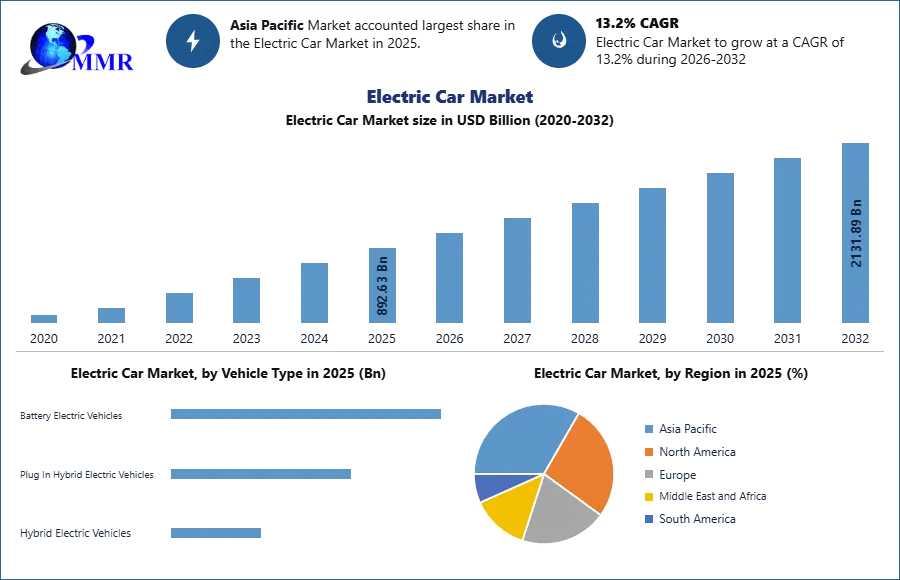
An Electric Car Market size was valued at USD 892.63 Billion in 2025 and the total Electric Car revenue is expected to grow at a CAGR of 25.77% from 2025 to 2032, reaching nearly 2,131.89 Billion in 2032
Electric Car Market Overview:
An Electric Car is an automobile that is propelled by one or more electric motors, using only energy stored in batteries. Compared to internal combustion engine (ICE) vehicles, Electric Car s are quieter, have no exhaust emissions, and lower emissions overall. In the United States and the European Union, the total cost of ownership of recent electric vehicles is cheaper than that of equivalent ICE cars, due to lower fueling and maintenance costs. Charging an Electric Car can be done at a variety of charging stations; these charging stations can be installed in both houses and public areas.
 To know about the Research Methodology :- Request Free Sample Report
All-electric vehicles (EVs) have an electric motor instead of an internal combustion engine. The vehicle uses a large traction battery pack to power the electric motor and must be plugged in to a charging station or wall outlet to charge. Depending on the size of the battery pack of an EV, the battery can last for a range of 100-450 km. To give some clarity, a mid-sized 22 kWh battery gives a range of around 130-160 kms. In India, the BMW iX xDrive40, offers the best range among all Electric Car s.
The report explores the Global Electric Car Market segments (Type, Vehicle Type, Technology, Vehicle Class, Top Speed and Region). Data has been provided by market participants, and regions (North America, Asia Pacific, Europe, Middle East & Africa, and South America). The MMR market report provides a thorough analysis of the rapid advances that are currently taking place across all industry sectors. Facts and figures, illustrations, and presentations are used to provide key data analysis for the historical period from 2020 to 2025. The report investigates the Global Electric Car Market drivers, limitations, prospects, and barriers. This MMR report includes investor recommendations based on a thorough examination of the Global Electric Car Market contemporary competitive scenario.
Electric Car Market Dynamics:
The regulatory actions, customer choice, the availability of specific models, generous subsidies and tight regulation are the factors which drives the growth of the Global Electric Car Market. Changes related to battery technology and charging infrastructure are boosting the market. Energy and petrochemical companies are committed to expanding charging infrastructure. The government policy has been at the forefront driving the switch to new energy vehicles. Factors such as increase in demand for fuel-efficient, high-performance, & low-emission vehicles, stringent government rules & regulations toward vehicle emission along with reduction in cost of electric vehicle batteries and increasing fuel costs supplement leads to the Global Electric Car Market.
With the growing environmental concerns, governments and environmental agencies across the world are enacting stringent emission norms and laws to reduce vehicle emission. Major regulatory measures are stringent emissions targets for the reduction of nitrogen oxides (NOx) and carbon dioxide (CO2) in air. High amounts of greenhouse gases being emitted from vehicles and federal and state governments in the U.S. are stepping up efforts to make transportation cleaner.
Therefore, with enactment of the emission regulations for fossil fuel-powered vehicle, the burden on vehicle manufacturers, especially on commercial vehicle manufacturers, has further increased. This, in turn, is expected to drive the demand for electric vehicles. Thus, stringent emission norms imposed on fossil-fuel powered commercial vehicles significantly driving growth of the electric vehicle market.
Poor charging infrastructure and shorter life span will act as a restraint to the market. For reducing emission of greenhouse into environment, the governments of various countries are promoting adoption of electric vehicles for commercial purpose. However, lack of charging infrastructure for electric vehicles acts as an obstacle for the electric vehicle market. The creation of robust electric vehicle infrastructure is one of the key requirements to ensure the adoption of electric vehicles.
Unfortunately, EV charging infrastructure in most of developing countries is inadequate at present and yet to catch up to meet the requirement, which in turn is hampering the growth of the electric vehicle market. In addition, though China is one of the biggest markets for electric vehicles, the country is struggling to support the sufficient electric vehicle charging infrastructure to recharge electric fleets, which is anticipated to hindering the market. Thus, lack of charging infrastructure is restraining the growth of EV market. The lack of charging infrastructure, high manufacturing cost, and range anxiety and serviceability are the factors which hinders the growth of the Global Electric Car Market.
COVID-19 Impact on Global Electric Car Market:
The overall automotive industry and electric vehicle industry had adverse effect on the Electric Car Market on the COVID-19 pandemic. The regulations and lockdown were imposed by the government during the pandemic which hinders the Electric Car market. As per the data released by Society of Electric Vehicle Manufacturers (SMEV), new EV registration of all types of electric vehicles during FY21 dropped by 20 percent compared with the number of new EV registrations in FY20. In addition, amid pandemic many different players are trying to devise different approaches in order to keep up with the condition by using electric vehicles for medical supplies as it provides affordable transportation with excellent manoeuvrability.
Electric Car body work and painting workshop would be another business opportunity related to electric vehicles. The workshop focusses mainly electric vehicles and can be extended to all kinds of vehicles. EV charging station management and repair would be a profitable business. Electric Car s capture the automotive market since manufacturers started focusing on electric vehicles. World’s top vehicle manufacturers already declared their plans on electric mobility. The growth of electric vehicles opens up Electric Car business opportunities.
Another Electric Car -related business opportunity is EV charging station. Electric Car charging stations can be developed and installed as per the standards accepted in the area where it is installed. Home-based charging stations, private charging stations are other opportunities in electrical car-related business. Electric Car charging station business opportunity will be practical in many countries as the number of EVs increases day by day.
The current crop of EVs in the market is very expensive and there’s no used of EV market yet. There is also an issue of maintenance which is reliant on the main dealers. Public charging infrastructure provides free services to increase the buying of EVs, charging companies and private systems offer efficient and latest technology. Factors such as variation in charging loads have emphasized the need to standardize electric vehicle charging stations. EV charging stations may only be compatible with certain types of voltages. For developing a favorable ecosystem and increase the sales of EVs, the Governments need to standardize charging infrastructure.
The lack of standardization across countries may impact the installation of charging stations and this result into hampering the growth of the electric vehicle charging station market. The use of these different charging standards around the world is a barrier to standardization for EV charging stations. While companies are moving toward the use of a common socket or multiple types of sockets in charging stations, there is still a long way to go in the standardization of all charging points. Standardization of charging points would simplify charging EVs in public and lead to faster growth of EV demand worldwide.
Global Electric Car Market Segment Analysis:
Based on vehicle type, the market has been divided into Battery Electric Vehicles and Plug In Hybrid Electric Vehicles. Among these, the Battery Electric Vehicles sub-segment was projected to generate the maximum revenue. The Battery Electric Vehicles sub-segment witnessed the highest market share in the global electric car market in 2025.
Battery electric vehicles relied entirely on rechargeable battery systems without using gasoline engines, which allowed them to achieve zero tailpipe emissions and higher energy efficiency compared with hybrid alternatives. In 2025, consumers and governments had increasingly prioritized fully electric vehicles as part of global decarbonization strategies. Advances in battery technology significantly improved driving range and reduced charging times, making battery electric vehicles more practical for daily mobility and long-distance travel. Automakers also expanded their BEV product portfolios across hatchback, sedan, and SUV segments to meet rising demand from urban commuters and commercial fleet operators. Because of these advantages, battery electric vehicles remained the dominant segment of the electric car market in 2025.
Regional Insights:
Asia Pacific region dominated the market in the year 2025, and is expected to continue its dominance during the forecast period. The electric car market in Asia Pacific has witnessed notable developments that significantly shaped the global automotive landscape. In recent years, governments across the region have implemented strong policy frameworks aimed at reducing vehicle emissions and accelerating adoption of clean mobility technologies.
Countries such as China, Japan, and South Korea significantly expanded electric vehicle production and infrastructure investments. China, in particular, emerged as the world’s largest electric vehicle market, supported by government incentives, advanced battery manufacturing capacity, and strong domestic demand for electric mobility solutions. The region also benefited from the presence of major electric vehicle manufacturers and a robust supply chain for batteries, electronic components, and charging infrastructure. As consumer awareness regarding environmental sustainability increased, demand for electric vehicles continued to grow across urban transportation networks. These factors collectively enabled Asia Pacific to maintain its leadership position in the global electric car market during 2025.
The objective of the report is to present a comprehensive analysis of the Global Electric Car Market to the stakeholders in the industry. The past and current status of the industry with the forecasted market size and trends are presented in the report with the analysis of complicated data in simple language. The report covers all the aspects of the industry with a dedicated study of key players that include market leaders, followers, and new entrants.
PORTER, PESTEL analysis with the potential impact of micro-economic factors of the market have been presented in the report. External as well as internal factors that are supposed to affect the business positively or negatively have been analyzed, which will give a clear futuristic view of the industry to the decision-makers.
The reports also help in understanding the Global Electric Car Market dynamic, structure by analyzing the market segments and projecting the Global Electric Car Market size. Clear representation of competitive analysis of key players by Vehicle type, price, financial position, product portfolio, growth strategies, and regional presence in the Global Electric Car Market make the report investor’s guide.
Recent Developments
March 2025
BYD expanded its electric vehicle product portfolio by launching new high-efficiency battery electric models aimed at strengthening its global market presence. The company also accelerated international expansion plans in Europe and Southeast Asia to capture increasing demand for affordable electric mobility solutions.
May 2025
Tesla introduced upgraded battery technologies designed to enhance vehicle driving range and charging performance. The innovation focused on improving energy density and thermal management systems, allowing electric vehicles to achieve longer travel distances and faster charging cycles across global markets.
August 2025
Volkswagen Group expanded its electric vehicle production capacity through investments in battery manufacturing facilities and EV assembly plants. The expansion aimed to increase electric vehicle output and strengthen the company’s transition toward a fully electrified vehicle portfolio across major automotive markets.
Electric Car Market Scope: Inquire before buying
| Electric Car Market | |||
|---|---|---|---|
| Report Coverage | Details | ||
| Base Year: | 2025 | Forecast Period: | 2026-2032 |
| Historical Data: | 2020 to 2025 | Market Size in 2025: | 43.18 USD Billion |
| Forecast Period 2026-2032 CAGR: | 8% | Market Size in 2032: | 74 USD Billion |
| Segments Covered: | by Vehicle Type | Battery Electric Vehicles Plug In Hybrid Electric Vehicles Hybrid Electric Vehicles |
|
| by Vehicle Class | Hatchback Sedan Sport Utility Vehicles |
||
| by Battery Type | Lithium Ion Battery Solid State Battery Nickel Metal Hydride Battery |
||
| by Charging Type | AC Charging DC Fast Charging Wireless Charging |
||
| by End Use | Personal Use Commercial Use Fleet Operations |
||
Electric Car Market, by Region
North America (United States, Canada and Mexico)
Europe (UK, France, Germany, Italy, Spain, Sweden, Austria and Rest of Europe)
Asia Pacific (China, South Korea, Japan, India, Australia, Indonesia, Malaysia, Vietnam, Taiwan, Bangladesh, Pakistan and Rest of APAC)
Middle East and Africa (South Africa, GCC, Egypt, Nigeria and Rest)
Electric Car Market, Key Players
1.Honda Motor Co., Ltd.
2.Toyota Motor Corporation
3.Tesla Motors, Inc.
4.Ford Motor Company
5.Nissan Motor Corporation Ltd
6.Bayerische Motoren Werke Aktiengesellschaft
7.BYD Company Limited
8.Daimler AG
9.Energica Motor Company S.p.A
10.Volkswagen AG
11.Smith Electric Vehicles
12.Renault S.A
13.Mitsubishi Motors Corporation
14.Mahindra and Mahindra
15.Lucid Motors
16.NIO
17.General Motors
18.SAIC Motor
19.Great Wall Motor Co. Ltd.
20.Ampere Vehicles
21.Benling India Energy and Technology Pvt Ltd
22.BMW AG
23.Chevrolet Motor Company
24.Hero Electric
25. Hyundai Motor Company
25.Karma Automotive
25.Kia Corporation
25.Lucid Group, Inc.
25.NIO
30.Nissan Motors Co., Ltd.
31.Okinawa Autotech Pvt. Ltd.
32.Rivain
33.WM Motor
34.Xiaopeng Motors